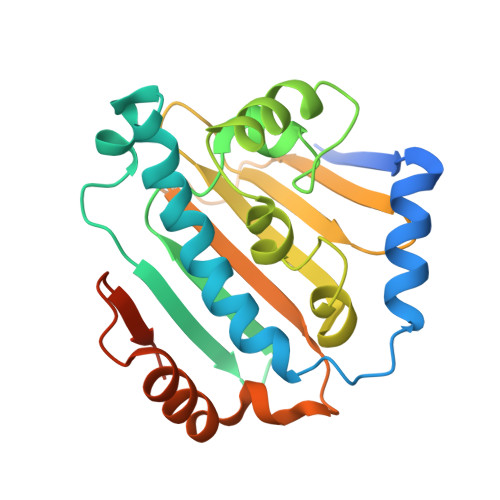
9X72 | pdb_00009x72

closed-form Hsp90a T36E N-terminal domain

  • Classification: CHAPERONE
  • Organism(s): Homo sapiens
  • Expression System: Escherichia coli
  • Mutation(s): Yes 

  • Deposited: 2025-10-16 Released: 2026-02-11 
  • Deposition Author(s): Wan, C.J.
  • Funding Organization(s): National Natural Science Foundation of China (NSFC)

Experimental Data Snapshot

  • Method: SOLUTION NMR
  • Conformers Calculated: 200 
  • Conformers Submitted: 10 
  • Selection Criteria: back calculated data agree with experimental NOESY spectrum 

wwPDB Validation 3D Report Full Report

Validation slider image for 9X72

This is version 1.1 of the entry. See complete history

Literature

Distinct phosphorylation mechanisms as dynamic switches for Hsp90 regulation.

Wan, C.Zhu, L.Wang, S.Zhang, X.Zhao, J.Qu, X.Huang, C.

(2026) Nat Commun 

  • DOI: https://doi.org/10.1038/s41467-026-73400-w
  • Primary Citation Related Structures: 
    9X6X, 9X70, 9X71, 9X72, 9X73

  • PubMed Abstract: 

    Phosphorylation is a central post-translational mechanism for on-demand regulation of protein function. In the ATP-dependent molecular chaperone Hsp90, multiple phosphorylation sites have been implicated in activity control, yet how individual sites encode regulatory instructions remains unclear. Here, using solution NMR spectroscopy, we delineate how site-specific phosphorylation distinctly reshapes the conformational energy landscape of Hsp90 across its ATPase cycle. The phospho-mimetic mutation T115E induces a global redistribution of the N-terminal domain energy landscape, flattening conformational barriers, pre-populating a lid-closed-like excited state in the apo form, weakening ATP-driven stabilization, and impairing ADP-mediated resetting. In contrast, T36E preserves the overall structure but selectively rewires dynamics at the ATP-bound step, where accelerated exchange and a reduced excited-state population bias the ensemble toward the ground state. Together, these findings reveal that phosphorylation sites engage different dynamic allosteric routes, yet converge on a common functional outcome by suppressing productive progression through the Hsp90 ATPase cycle.


  • Organizational Affiliation
    • MOE Key Laboratory for Cellular Dynamics, Hefei National Laboratory for Physical Sciences at the Microscale, Biomedical Sciences and Health Laboratory of Anhui Province, Division of Life Sciences and Medicine, University of Science and Technology of China, Hefei, P. R. China.

Macromolecule Content 

  • Total Structure Weight: 26.76 kDa 
  • Atom Count: 1,628 
  • Modeled Residue Count: 207 
  • Deposited Residue Count: 237 
  • Unique protein chains: 1

Macromolecules

Find similar proteins by:|  3D Structure
Entity ID: 1
MoleculeChains  Sequence LengthOrganismDetailsImage
Heat shock protein HSP 90-alpha237Homo sapiensMutation(s): 1 
Gene Names: HSP90AA1HSP90AHSPC1HSPCA
EC: 3.6.4.10
UniProt & NIH Common Fund Data Resources
Find proteins for P07900 (Homo sapiens)
Explore P07900 
Go to UniProtKB:  P07900
PHAROS:  P07900
GTEx:  ENSG00000080824 
Entity Groups
Sequence Clusters30% Identity50% Identity70% Identity90% Identity95% Identity100% Identity
UniProt GroupP07900
Sequence Annotations
Expand
Reference Sequence

Experimental Data & Validation

Experimental Data

  • Method: SOLUTION NMR
  • Conformers Calculated: 200 
  • Conformers Submitted: 10 
  • Selection Criteria: back calculated data agree with experimental NOESY spectrum 

Structure Validation

View Full Validation Report


Entry History 

& Funding Information

Deposition Data

  • Released Date: 2026-02-11 
  • Deposition Author(s): Wan, C.J.

Funding OrganizationLocationGrant Number
National Natural Science Foundation of China (NSFC)China31770807
National Natural Science Foundation of China (NSFC)China31971144

Revision History  (Full details and data files)

  • Version 1.0: 2026-02-11
    Type: Initial release
  • Version 1.1: 2026-07-08
    Changes: Database references