9X2M | pdb_00009x2m

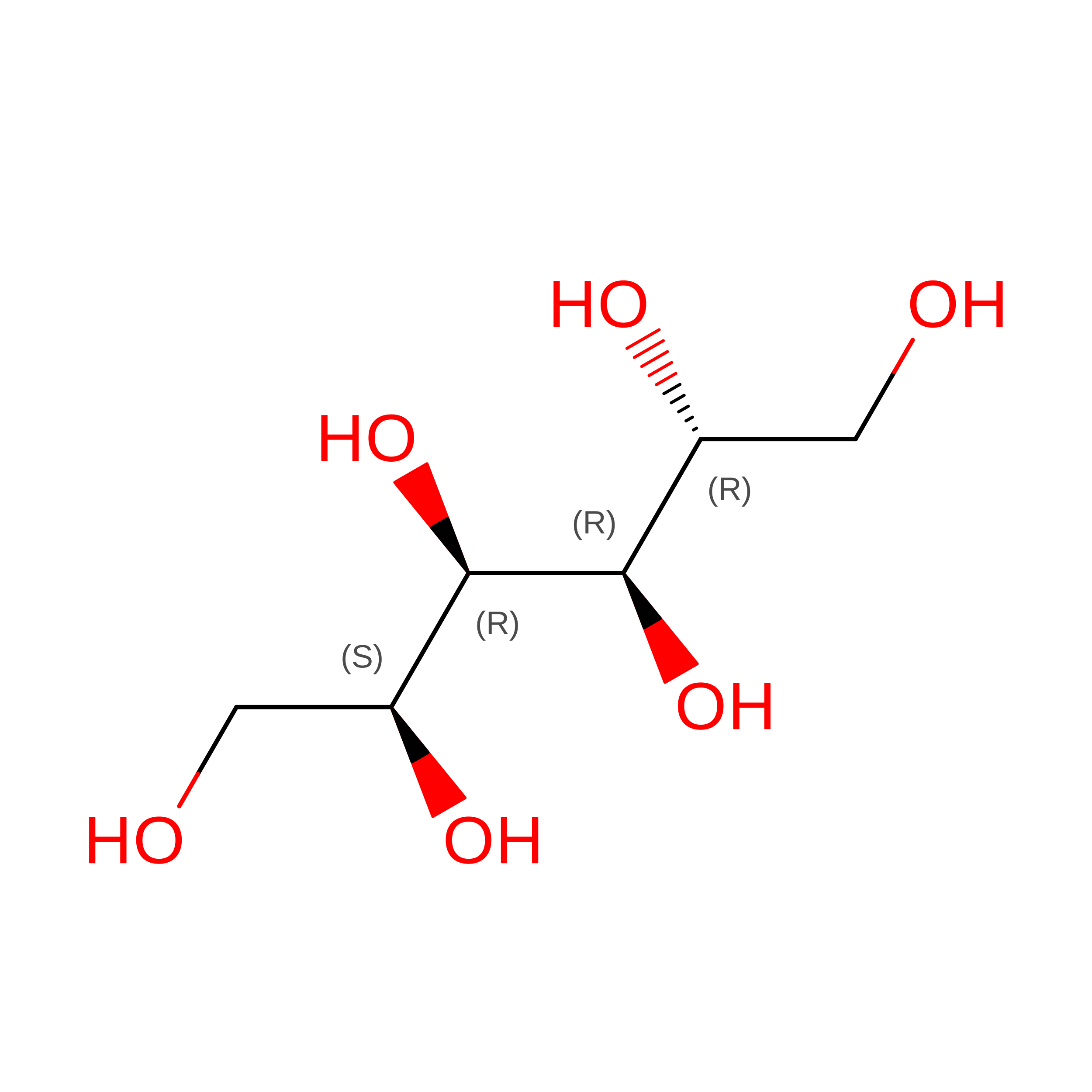
Gut transporter with sorbitol


Experimental Data Snapshot

  • Method: ELECTRON MICROSCOPY
  • Resolution: 3.44 Å
  • Aggregation State: PARTICLE 
  • Reconstruction Method: SINGLE PARTICLE 

wwPDB Validation   3D Report Full Report


This is version 1.2 of the entry. See complete history


Literature

A trimeric architecture reveals the glucitol PTS transporter as a distinct superfamily.

Deng, T.Liu, X.Zeng, J.Ge, X.Wang, J.

(2026) Commun Biol 

  • DOI: https://doi.org/10.1038/s42003-026-09835-0
  • Primary Citation Related Structures: 
    9X2M

  • PubMed Abstract: 

    The bacterial phosphoenolpyruvate:sugar phosphotransferase system (PTS) catalyzes the transport and phosphorylation of carbohydrates. The glucitol (Gut) PTS transporter from Escherichia coli has often been discussed in relation to the Glucose-Fructose-Lactose (GFL) superfamily, although other work has suggested that it may instead form a separate PTS superfamily. This uncertainty is linked to its unusual genetic organization, in which the transmembrane IIC domain is divided into two polypeptides (IIC1/GutE and IIC2/GutA). Here, we present the cryo-electron microscopy (cryo-EM) structure of the complete Gut transporter, which resolves this discrepancy by revealing a homotrimeric architecture for its transmembrane domain-a fold unprecedented among sugar-transporting PTS permeases. This structural evidence supports the view that the Gut family represents a distinct PTS superfamily. Within the trimer, the protomers are captured in inward-facing and inward-occluded conformations, providing a structural basis for an alternating-access transport mechanism. Furthermore, the structure suggests a unique in-trans phosphotransfer pathway between the IIB and IIC domains of adjacent subunits and identifies the substrate-binding pocket at the GutA/GutE interface. Our work redefines the structural landscape of PTS transporters and provides a mechanistic framework for sugar transport by this unique trimeric porter.


  • Organizational Affiliation
    • State Key Laboratory of Membrane Biology, Beijing Frontier Research Center for Biological Structure, School of Life Sciences, Tsinghua University, Beijing, China.

Macromolecules
Find similar proteins by:  (by identity cutoff)  |  3D Structure
Entity ID: 1
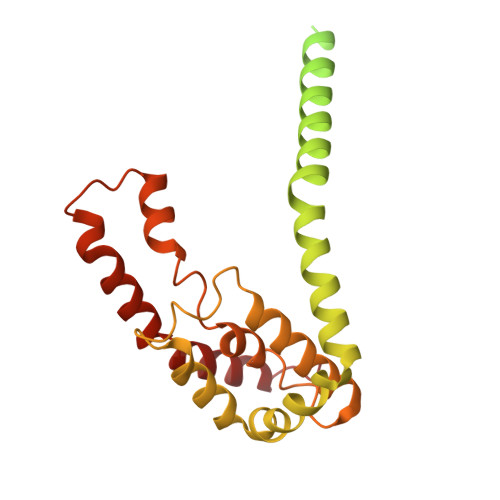
MoleculeChains Sequence LengthOrganismDetailsImage
PTS system glucitol/sorbitol-specific EIIB componentA [auth 1],
E,
F
319Escherichia coli K-12Mutation(s): 0 
Gene Names: srlEgutAgutEb2703JW5430
EC: 2.7.1.198
UniProt
Find proteins for P56580 (Escherichia coli (strain K12))
Explore P56580 
Go to UniProtKB:  P56580
Entity Groups  
Sequence Clusters30% Identity50% Identity70% Identity90% Identity95% Identity100% Identity
UniProt GroupP56580
Sequence Annotations
Expand
  • Reference Sequence
Find similar proteins by:  (by identity cutoff)  |  3D Structure
Entity ID: 2
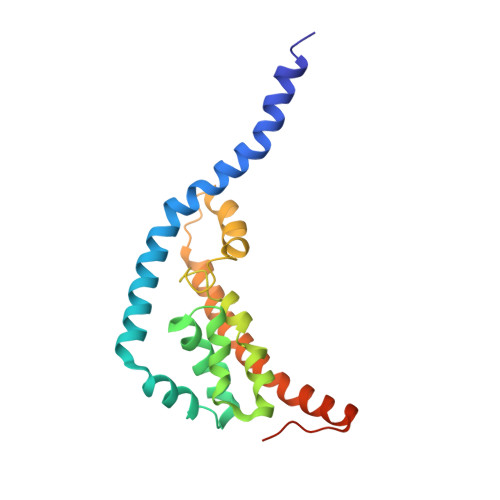
MoleculeChains Sequence LengthOrganismDetailsImage
PTS system glucitol/sorbitol-specific EIIC componentB [auth 2],
C [auth A],
D [auth B]
187Escherichia coli K-12Mutation(s): 0 
Gene Names: srlAgutAsblb2702JW5429
UniProt
Find proteins for P56579 (Escherichia coli (strain K12))
Explore P56579 
Go to UniProtKB:  P56579
Entity Groups  
Sequence Clusters30% Identity50% Identity70% Identity90% Identity95% Identity100% Identity
UniProt GroupP56579
Sequence Annotations
Expand
  • Reference Sequence
Experimental Data & Validation

Experimental Data

  • Method: ELECTRON MICROSCOPY
  • Resolution: 3.44 Å
  • Aggregation State: PARTICLE 
  • Reconstruction Method: SINGLE PARTICLE 
EM Software:
TaskSoftware PackageVersion
MODEL REFINEMENTPHENIX1.20.1_4487:
RECONSTRUCTIONcryoSPARC

Structure Validation

View Full Validation Report


Entry History & Funding Information

Deposition Data


Funding OrganizationLocationGrant Number
National Natural Science Foundation of China (NSFC)China32371254
National Natural Science Foundation of China (NSFC)China32171190
National Natural Science Foundation of China (NSFC)China32501078

Revision History  (Full details and data files)

  • Version 1.0: 2026-03-04
    Type: Initial release
  • Version 1.1: 2026-03-18
    Changes: Data collection, Database references
  • Version 1.2: 2026-03-25
    Changes: Data collection, Database references