Download Mendeley
Design of miniprotein inhibitors targeting complement C9 to block membrane attack complex assembly.
Li, M., Wang, N., Fu, X., Wei, G., Zhang, Z., Yu, Y., Xue, T., Zhao, Y., Pan, J., Wang, D., Liu, M., Li, Y., Tang, J., Cao, L., Jian, Z., Liang, S., Yu, B.(2026) Nat Commun 17
- PubMed: 41813685 Search on PubMed
- DOI: https://doi.org/10.1038/s41467-026-70667-x
- Primary Citation Related Structures:
9X1W, 9X1X - PubMed Abstract:
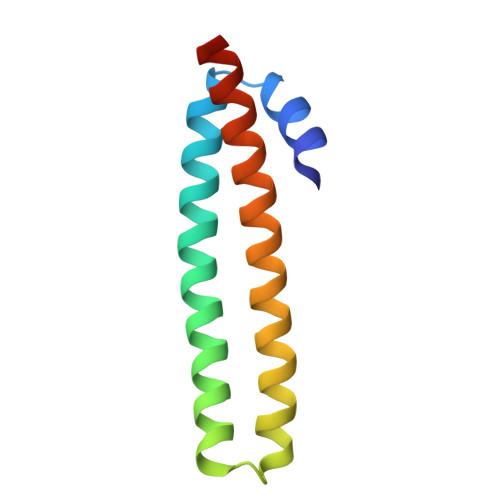
The abnormal formation of the membrane attack complex (MAC) is intrinsically linked to a range of acute and chronic immune diseases. The insertion of complement C9 into the membrane is the final step and kinetic bottleneck of MAC formation. However, research on blocking the MAC formation of C9 is currently limited. Given its broad, flat, and polar functional interface, complement C9 is a challenging target for rational design. Here, we utilize deep learning-based methods for protein scaffold generation, sequence design, and complex structure prediction to de novo design mini-protein inhibitors that specifically block the membrane insertion of soluble complement C9. The binding affinity of the mini-protein inhibitor is further optimized to 700 pM via partial diffusion. Design accuracy and binding specificity are verified through X-ray crystallography and biochemical studies. An in vivo acute hemolysis inhibition assay reveals that the C9 mini-protein inhibitors remain effective against hemolysis even 8 minutes after complement activation, outperforming the complement C5 inhibitor eculizumab. The de novo designed C9 mini-protein inhibitors can offer an optional therapeutic approach for the prevention and treatment of acute or chronic immune diseases associated with abnormal complement activation.
- Key Laboratory of Immune Microenvironment and Inflammatory Disease Research in Universities of Shandong Province, School of Basic Medical Sciences, Shandong Second Medical University, Weifang, China.
Organizational Affiliation: