Download Mendeley
Structural and mechanistic insights into the dual-nuclease defense protein Upx as an anti-phage system.
Zhou, R., Liu, Y., Zhang, Q., Yin, Z., Tong, J., Zhang, C., Zhang, L., Li, X., Zhao, Y., Zhang, S., Liu, Z., Chen, W., Ji, N., Zhang, H., Li, Z., Yin, H., Zuo, S., Wei, Y.(2026) Nat Commun 17
- PubMed: 41803127 Search on PubMedSearch on PubMed Central
- DOI: https://doi.org/10.1038/s41467-026-70435-x
- Primary Citation Related Structures:
9WUF - PubMed Abstract:
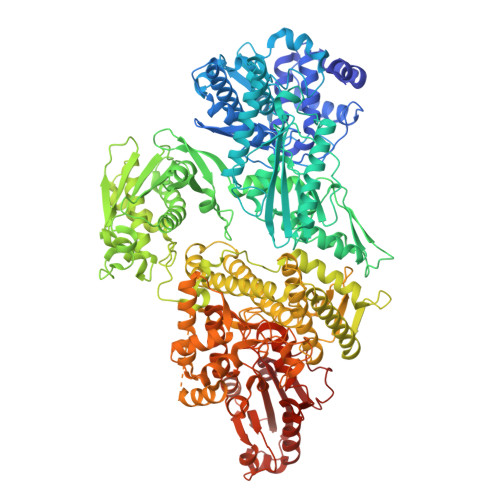
Nucleic acid degradation is a common strategy for prokaryotic anti-phage systems, as exemplified by the CRISPR-Cas system. The PD-(D/E)-XK nucleases constitute a widely distributed family in these defenses. Notably, most members exhibit a single nuclease domain, while variants containing dual nuclease domains within a single polypeptide remain underexplored, and their molecular mechanisms largely obscure. Here, we biochemically and functionally study a single-protein system containing an uncharacterized PD-(D/E)-XK defense protein (Upx). As revealed by single-particle electron cryo-microscopy (cryo-EM) structure, the C-terminal domain (CTD) harboring the conserved PD-(D/E)XK catalytic core is buttressed by the N-terminal domain (NTD) and the middle domain (MD). Functional assays demonstrate that the nucleic acid binding capability of the CTD is enhanced by the MD. The NTD also displays a noncanonical, basal exonuclease activity that is auto-inhibited by MD. IP-MS experiments identify Upx-interacting phage proteins, and substrate profiling defines its physiological preferences, collectively pointing to its potential physiological targets. Notably, the phage protein gp16 was found to relieve MD-mediated inhibition of the NTD, suggesting a virus-triggered mechanism for activating Upx's dual nuclease activity. Together, these findings establish Upx as a single-protein dual-nuclease anti-phage system, expanding our understanding of bacterial immunity and informing antiviral strategy development.
- Key Laboratory of Immune Microenvironment and Disease (Ministry of Education), State Key Laboratory of Experimental Hematology, The Province and Ministry Co-sponsored Collaborative Innovation Center for Medical Epigenetics, Tianjin Key Laboratory of Cellular Homeostasis and Disease, Department of Biochemistry and Molecular Biology, School of Basic Medical Sciences, Tianjin Medical University, Tianjin, China.
Organizational Affiliation: