Download Mendeley
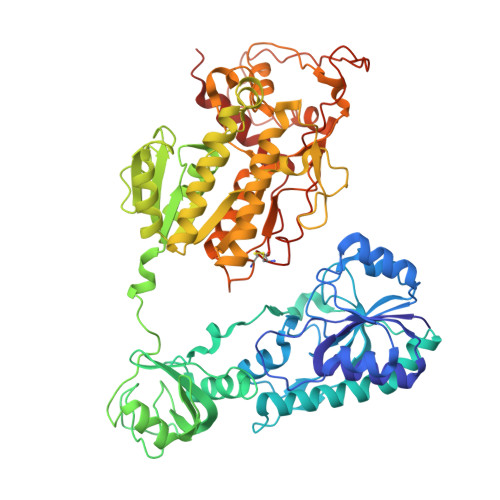
Structural Basis for Targeting the Bifunctional Enzyme ArnA.
Liu, X., Yang, R., Ren, L., Li, T., Li, Y., Yan, Z., Gao, Y., Yang, M., Li, J.(2025) Biomolecules 15
- PubMed: 41301511 Search on PubMedSearch on PubMed Central
- DOI: https://doi.org/10.3390/biom15111594
- Primary Citation Related Structures:
9WI0 - PubMed Abstract:
Polymyxin antibiotics are often the last line of defense against multidrug-resistant Gram-negative pathogens. A key resistance mechanism involves the addition of 4-amino-4-deoxy-L-arabinose (L-Ara4N) to lipid A, mediated by the bifunctional enzyme ArnA. However, the evolutionary rationale and structural basis for ArnA's domain fusion, hexameric assembly, and catalytic coordination remain mechanistically unresolved. Here, we integrate evolutionary genomics, high-resolution cryo-electron microscopy (cryo-EM), and computational protein design to provide a comprehensive mechanistic analysis of ArnA. Our evolutionary analysis reveals that the dehydrogenase (DH) and formyltransferase (TF) domains evolved independently and were selectively fused in Gammaproteobacteria, suggesting an adaptive advantage. A 2.89 Å cryo-EM structure of apo-ArnA resolves the flexible interdomain linker and reveals a DH-driven hexameric architecture essential for enzymatic activity. 3D variability analysis captures intrinsic conformational dynamics, indicating a molecular switch that may coordinate sequential catalysis and substrate channeling. Structure-based peptide inhibitors targeting the hexamerization and predicted ArnA-ArnB interaction interfaces were computationally designed, offering a novel strategy for disrupting L-Ara4N biosynthesis. These findings illuminate a previously uncharacterized structural mechanism of antimicrobial resistance and lay the groundwork for therapeutic intervention.
- Institutes of Biomedical Sciences, Inner Mongolia University, Hohhot 010020, China.
Organizational Affiliation: