Download Mendeley
Structure-Guided Engineering of Tryptophan Hydroxylase Relieves Tunnel Congestion and Substrate Trapping to Enhance 5-Hydroxytryptophan Biosynthesis.
Han, J., You, J., Fan, Z., Liu, F., Zhang, H., Zhu, R., Chen, X., Zhang, R., Rao, Z.(2026) J Agric Food Chem 74: 1312-1325
- PubMed: 41460668 Search on PubMed
- DOI: https://doi.org/10.1021/acs.jafc.5c14467
- Primary Citation Related Structures:
9WGZ - PubMed Abstract:
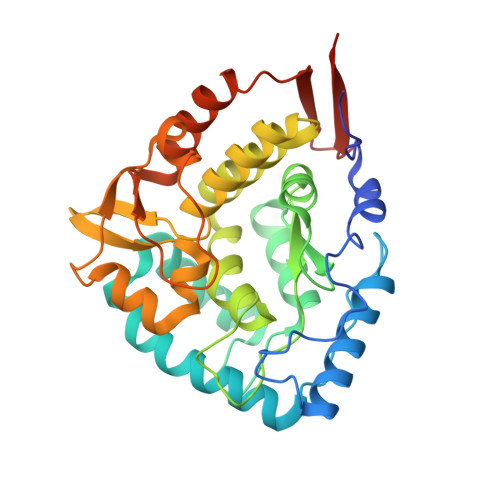
Substrate inhibition limits the industrial use of tryptophan hydroxylase (TPH), the key catalyst for 5-hydroxytryptophan (5-HTP) production, by causing tunnel congestion and substrate trapping at high concentrations. We developed a mechanism-guided strategy to overcome this. The crystal structure of the Y235S (MS) variant revealed a 243% expansion of the substrate channel, reducing tunnel congestion and increasing activity 2.38-fold, though substrate affinity decreased. Mechanistic analysis showed loop II acts as a molecular gate controlling cofactor-substrate binding. Its rational stabilization in variant MS4 enhanced loop stability and optimized substrate orientation, increasing catalytic efficiency by over 150% compared to MS and specific activity by 285% compared to wild-type. This approach proved generalizable across TPH orthologs. Combined with a tetrahydrobiopterin regeneration system, MS4 broke through the substrate concentration limitation, achieving >5-fold higher whole-cell 5-HTP production (16.37 mM in 4 h). This work establishes a general framework for relieving tunnel congestion and substrate trapping through integrated structural, computational, and loop engineering.
- Key Laboratory of Industrial Biotechnology of the Ministry of Education, School of Biotechnology, Jiangnan University, Wuxi 214122, China.
Organizational Affiliation: