Download Mendeley
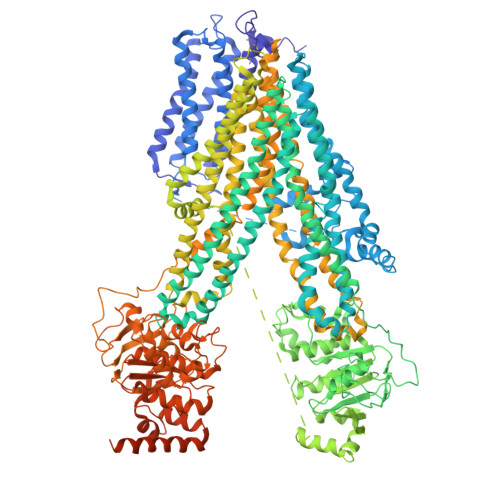
Structural insights into toxicant export mediated by ABCC2 in Arabidopsis thaliana.
Qiu, X., Yang, Z., Gao, Y., Sun, L., Liu, X.(2025) Nat Commun 16: 11554-11554
- PubMed: 41430060 Search on PubMedSearch on PubMed Central
- DOI: https://doi.org/10.1038/s41467-025-67713-5
- Primary Citation Related Structures:
9LI5, 9LI6, 9LI7, 9LI9, 9WFP, 9WFQ - PubMed Abstract:
Plants are highly vulnerable to damage from environmental pollutants, making detoxification mechanisms essential for sustaining growth and development. ABCC2 in Arabidopsis thaliana (AtABCC2) plays a critical role in detoxification by exporting diverse toxic compounds. Here, we report the structures of AtABCC2 in three distinct states: substrate-free, bound to the substrate S-(2,4-dinitrophenyl)glutathione (DNP-GS), and bound to ATP. Both monomeric and dimeric forms of AtABCC2 are observed. Unlike other dimeric ABCC homologs, AtABCC2 features a dimer interface mediated by its transmembrane domains. DNP-GS occupies an amphipathic cavity formed by the transmembrane domains. ATP binding drives the conformational changes in each protomer which bring the transmembrane and nucleotide-binding domains closer together, transitioning the transporter from a cytosolic-facing to an occluded state. Together, these findings advance our understanding of the molecular basis of substrate binding and transport by AtABCC2, and shed light on plant detoxification mechanisms.
- Department of Neurology, The First Affiliated Hospital of USTC, MOE Key Laboratory for Membraneless Organelles and Cellular Dynamics, Hefei National Research Center for Physical Sciences at the Microscale, Division of Life Sciences and Medicine, University of Science and Technology of China, Hefei, China.
Organizational Affiliation: