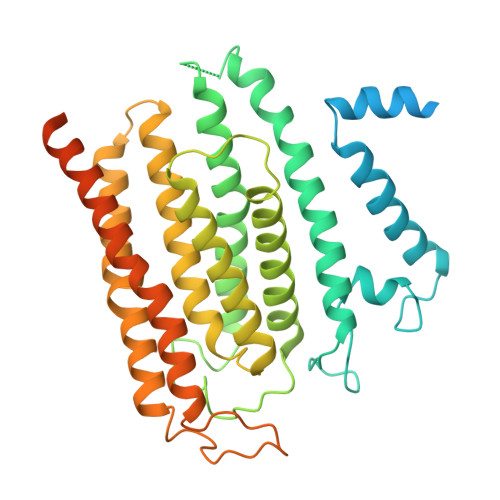
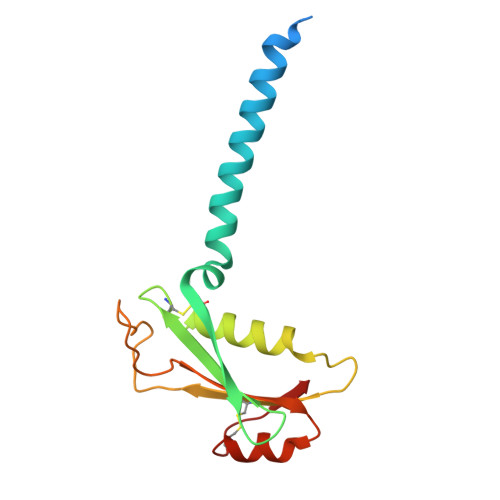
9W3Z | pdb_00009w3z

Cryo-EM structure of the 4:4 Lac1-Lip1 complex


Experimental Data Snapshot

  • Method: ELECTRON MICROSCOPY
  • Resolution: 3.36 Å
  • Aggregation State: PARTICLE 
  • Reconstruction Method: SINGLE PARTICLE 

wwPDB Validation 3D Report Full Report

Validation slider image for 9W3Z

This is version 1.2 of the entry. See complete history

Literature

Structural and functional dissection of a higher-order oligomerization interface in yeast ceramide synthase.

Fang, Q.Yang, C.Yao, N.Xie, T.Gong, X.

(2026) Nat Commun 17

  • DOI: https://doi.org/10.1038/s41467-026-71272-8
  • Primary Citation Related Structures: 
    9W3Z

  • PubMed Abstract: 

    Ceramide synthases (CerSs) are crucial enzymes in sphingolipid metabolism and have shown therapeutic potential for treating various metabolic disorders. However, their regulatory mechanisms remain poorly understood. In this study, we report the cryo-electron microscopy structure of a yeast CerS (yCerS), composed of a catalytic Lac1 subunit and a regulatory Lip1 subunit, organized into a higher-order 4:4 assembly. This assembly is formed by dimerization of two 2:2 Lac1-Lip1 subcomplexes via an interface primarily involving the Lac1 subunit. Notably, within this interface, the C-terminal transmembrane helix (TM8) of Lac1 adopts a dramatically twisted conformation and engages in extensive interactions with TMs 6/7/8 of the adjacent Lac1 subunit. This structural rearrangement sterically occludes the catalytic chamber and blocks acyl-CoA substrate entry. Functional assays further demonstrate that, although structurally reminiscent of an autoinhibitory conformation, this interface is required for the regulation of ceramide output and cellular adaption during perturbation of complex sphingolipid biosynthesis. Together, our findings uncover a complex oligomerization-mediated regulatory mechanism in yCerS, advancing the mechanistic understanding of ceramide synthesis control and highlighting the nuanced role of oligomerization in modulating CerS activity.


  • Organizational Affiliation
    • Shenzhen Key Laboratory of Plant Genetic Engineering and Molecular Design, Department of Biology, School of Life Sciences, Southern University of Science and Technology, Shenzhen, Guangdong, China.

Macromolecule Content 

  • Total Structure Weight: 270.07 kDa 
  • Atom Count: 14,854 
  • Modeled Residue Count: 1,800 
  • Deposited Residue Count: 2,312 
  • Unique protein chains: 2

Macromolecules

Find similar proteins by:|  3D Structure
Entity ID: 1
MoleculeChains  Sequence LengthOrganismDetailsImage
Ceramide synthase LAC1A,
B [auth C],
E,
F [auth G]
428Saccharomyces cerevisiae S288CMutation(s): 0 
Gene Names: LAC1DGT1YKL008CYKL156
EC: 2.3.1.297
UniProt
Find proteins for P28496 (Saccharomyces cerevisiae (strain ATCC 204508 / S288c))
Explore P28496 
Go to UniProtKB:  P28496
Entity Groups
Sequence Clusters30% Identity50% Identity70% Identity90% Identity95% Identity100% Identity
UniProt GroupP28496
Sequence Annotations
Expand
Reference Sequence
Find similar proteins by:|  3D Structure
Entity ID: 2
MoleculeChains  Sequence LengthOrganismDetailsImage
Ceramide synthase subunit LIP1C [auth B],
D,
G [auth F],
H
150Saccharomyces cerevisiae S288CMutation(s): 0 
Gene Names: LIP1YMR298W
UniProt
Find proteins for Q03579 (Saccharomyces cerevisiae (strain ATCC 204508 / S288c))
Explore Q03579 
Go to UniProtKB:  Q03579
Entity Groups
Sequence Clusters30% Identity50% Identity70% Identity90% Identity95% Identity100% Identity
UniProt GroupQ03579
Sequence Annotations
Expand
Reference Sequence

Experimental Data & Validation

Experimental Data

  • Method: ELECTRON MICROSCOPY
  • Resolution: 3.36 Å
  • Aggregation State: PARTICLE 
  • Reconstruction Method: SINGLE PARTICLE 
EM Software:
TaskSoftware PackageVersion
MODEL REFINEMENTPHENIX1.18.2_3874
RECONSTRUCTIONcryoSPARC

Structure Validation

View Full Validation Report


Entry History 

& Funding Information

Deposition Data


Funding OrganizationLocationGrant Number
National Natural Science Foundation of China (NSFC)China--

Revision History  (Full details and data files)

  • Version 1.0: 2026-04-08
    Type: Initial release
  • Version 1.1: 2026-04-15
    Changes: Data collection, Database references
  • Version 1.2: 2026-06-03
    Changes: Data collection, Database references