Download Mendeley
Ligand binding modes of the bitter taste receptor T2R14 and T2R46.
Tan, Q., Yu, Y., Han, X., Liu, K., Han, S., Wang, M., Wei, Y., Zhu, Y., Chen, Q., Ma, L., Yi, C., Chu, X., Wu, B., Zhao, Q.(2026) Nat Struct Mol Biol 33: 691-700
- PubMed: 42009775 Search on PubMedSearch on PubMed Central
- DOI: https://doi.org/10.1038/s41594-026-01786-8
- Primary Citation Related Structures:
9W0P, 9W0Q, 9W0R, 9W0S, 9W0T, 9W0U, 9W0W - PubMed Abstract:
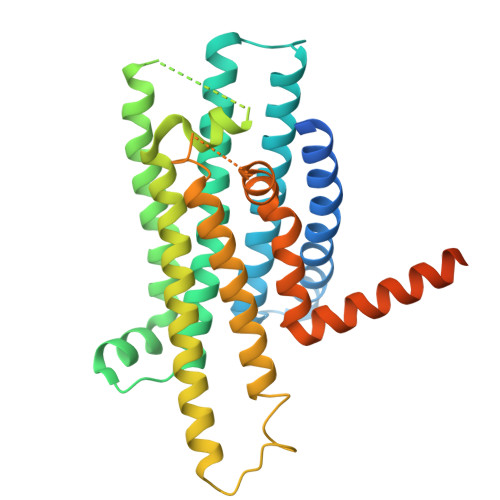
Bitter taste receptors (T2Rs) are considered attractive drug targets. However, the ligand recognition and selectivity of these receptors remain elusive, hampering their drug development. Here we present seven structures of human T2R14 and T2R46 in apo or ligand-bound state. Combined with molecular docking and mutagenesis data, the structures reveal an extracellular ligand-binding site in T2R14 for most of its ligands, which is different from the intracellular binding site reported recently. In contrast, T2R46 exhibits a conserved binding pocket that accommodates various ligands with distinct interaction patterns. Furthermore, the second extracellular loop in T2R14 and T2R46 acts as a tethered agonist to potentially facilitate agonist response of these two receptors to the weak tastant agonists. These findings could accelerate drug discovery targeting T2Rs.
- State Key laboratory of Drug, Research, State Key Laboratory of Chemical Biology, Shanghai Institute of Materia Medica, Chinese Academy of Sciences, Shanghai, China. qxtan@simm.ac.cn.
Organizational Affiliation: