Download Mendeley
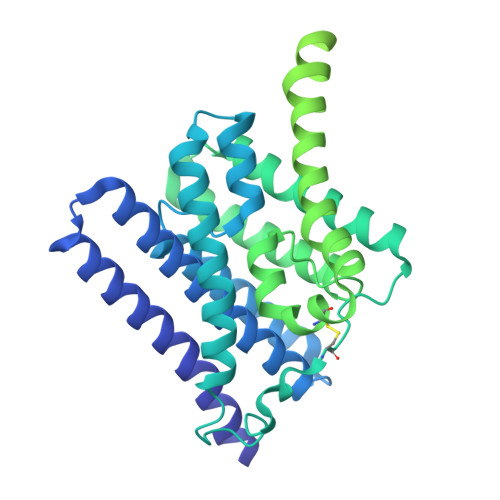
Cryo-EM structure of human AQP11 reveals a trimeric architecture with a large pore.
Suzuki, S., Kamegawa, A., Kozai, D., Nishikawa, K., Irie, K., Fujiyoshi, Y.(2026) Sci Adv 12: eaeb5769-eaeb5769
- PubMed: 41616064 Search on PubMedSearch on PubMed Central
- DOI: https://doi.org/10.1126/sciadv.aeb5769
- Primary Citation Related Structures:
9VXW - PubMed Abstract:
Aquaporin-11 (AQP-11) is an endoplasmic reticulum-localized water channel essential for renal development. Its structure and the molecular basis of its transport properties remained unknown. We analyzed the human AQP11 structure under cryo-electron microscopy at 2.3 Å resolution, revealing a trimeric architecture compared with other known tetrameric AQPs and a topology comprising seven transmembrane helices (Hs), including an additional N-terminal helix (H0). The channel pore is broader and more hydrophobic than that of canonical AQPs, and features a unique structure surrounding an Asn-Pro-Cys (NPC) sequence instead of the typical Asn-Pro-Ala (NPA) motif. These features provide a structural framework through which water and other small solutes can permeate AQP11. Our findings provide a blueprint for designing specific inhibitors to investigate the physiologic functions of AQP11.
- Advanced Research Initiative, Institute of Integrated Research, Institute of Science Tokyo, 1-5-45 Yushima Bunkyo-ku, Tokyo 113-8501, Japan.
Organizational Affiliation: