Download Mendeley
An intrinsic loop-mediated structural stability modulating inhibitor potency in the SADS-CoV and SARS-CoV-2 main proteases.
Zeng, R., Cui, S., Xia, X., Huang, C., Sun, J., Deng, X., Gui, Q., Fan, H., Liu, X., Yu, Y., Yang, S., Lei, J.(2026) PLoS Pathog 22: e1013981-e1013981
- PubMed: 41734227 Search on PubMedSearch on PubMed Central
- DOI: https://doi.org/10.1371/journal.ppat.1013981
- Primary Citation Related Structures:
9VUT, 9VUU, 9VUV, 9VUW, 9VUX - PubMed Abstract:
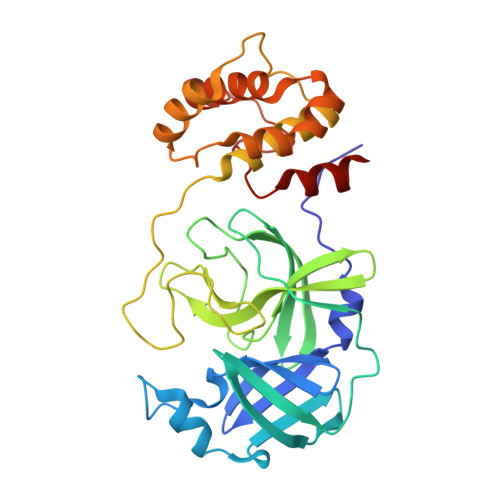
Swine acute diarrhea syndrome coronavirus (SADS-CoV) poses a significant zoonotic risk. The absence of the structure of SADS-CoV main protease (Mpro) severely impedes the development of effective antiviral therapeutics. Here, we present the high-resolution structures of SADS-CoV Mpro and its complexes with inhibitors 27h and SY110, respectively. These two compounds inhibit SADS-CoV Mpro through a novel inhibition mechanism. Residues 40-53 of SADS-CoV Mpro adopt a single-helix conformation, in contrast to a coiled coil formed by two consecutive alpha-helices observed in SARS-CoV-2 Mpro. These structural differences contribute to the varying inhibitor potency between Alphacoronavirus (α-CoV) and Betacoronavirus (β-CoV) Mpros. We subsequently demonstrate that the absence of residue '51' in α-CoV Mpros plays a key role in these conformational changes. Furthermore, 27h was proved to efficiently suppress SADS-CoV replication in both cell-based assays and porcine intestinal organoids-marking the first such assessment. Overall, these findings reveal that intrinsic Mpro dynamics influence inhibitor potency and provide insights for designing broad-spectrum Mpro inhibitors.
- National Clinical Research Center for Geriatrics, and State Key Laboratory of Biotherapy, West China Hospital, Sichuan University, Chengdu, Sichuan, China.
Organizational Affiliation: