9VTP | pdb_00009vtp

Target DNA-bound type I-F3 TniQ-Cascade of Vibrio parahaemolyticus in partial R-loop state


Experimental Data Snapshot

  • Method: ELECTRON MICROSCOPY
  • Resolution: 2.68 Å
  • Aggregation State: PARTICLE 
  • Reconstruction Method: SINGLE PARTICLE 

Starting Models: in silico
View more details

wwPDB Validation   3D Report Full Report


This is version 1.0 of the entry. See complete history


Literature

Sequential structural rearrangements at the PAM-distal site of a type I-F3 CRISPR-Cas effector enabling RNA-guided DNA transposition.

Ishihara, K.Matsumoto, S.Gerle, C.Gopalasingam, C.C.Shigematsu, H.Shirai, T.Numata, T.

(2026) Nucleic Acids Res 54

  • DOI: https://doi.org/10.1093/nar/gkaf1415
  • Primary Citation of Related Structures:  
    9VTP, 9VTQ, 9VTR

  • PubMed Abstract: 

    Some prokaryotes carry CRISPR-associated transposons (CASTs), Tn7-like elements that incorporate genes encoding CRISPR-Cas effectors. CAST insertion is directed by CRISPR-Cas effectors through RNA-guided DNA binding and interactions with transposition-associated proteins. Although efficient sequence-specific DNA integration requires both precise target DNA recognition and coordinated interactions between effectors and transposition-associated proteins, the underlying mechanism remains elusive. Here, we determined three cryo-EM structures of target DNA-bound type I-F3 TniQ-Cascade from Vibrio parahaemolyticus, revealing how Cas8/5 recognizes the protospacer adjacent motif (PAM) and identifying a key residue responsible for the cytidine preference at position -2 of the PAM. We revealed mismatch tolerance at the PAM-proximal site. Structural analyses showed that correct base pairing at the PAM-distal site correlates with conformational changes in the Cas8/5 helical bundle and TniQ, bending the DNA to guide its downstream region toward the transposition machinery. Together, these dynamic rearrangements at the PAM-distal region provide insights into the licensing mechanism of type I-F3 CAST transposition and highlight its potential for genome engineering applications.


  • Organizational Affiliation
    • Department of Bioscience and Biotechnology, Graduate School of Bioresource and Bioenvironmental Sciences, Kyushu University, Fukuoka 819-0395, Japan.

Macromolecules

Find similar proteins by:  (by identity cutoff)  |  3D Structure
Entity ID: 4
MoleculeChains Sequence LengthOrganismDetailsImage
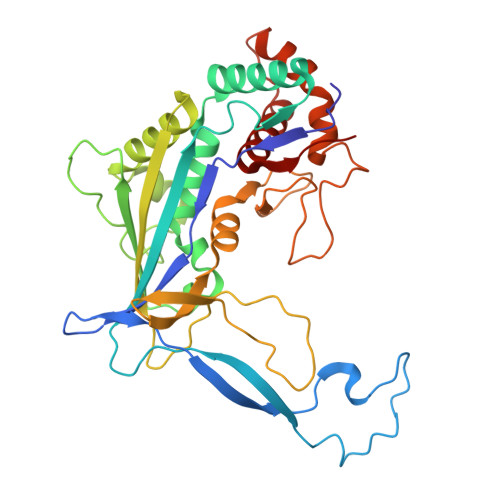
Type I-F CRISPR-associated protein Csy3347Vibrio parahaemolyticus RIMD 2210633Mutation(s): 0 
Gene Names: VPA1389
UniProt
Find proteins for Q87GC8 (Vibrio parahaemolyticus serotype O3:K6 (strain RIMD 2210633))
Explore Q87GC8 
Go to UniProtKB:  Q87GC8
Entity Groups  
Sequence Clusters30% Identity50% Identity70% Identity90% Identity95% Identity100% Identity
UniProt GroupQ87GC8
Sequence Annotations
Expand
  • Reference Sequence
Find similar proteins by:  (by identity cutoff)  |  3D Structure
Entity ID: 5
MoleculeChains Sequence LengthOrganismDetailsImage
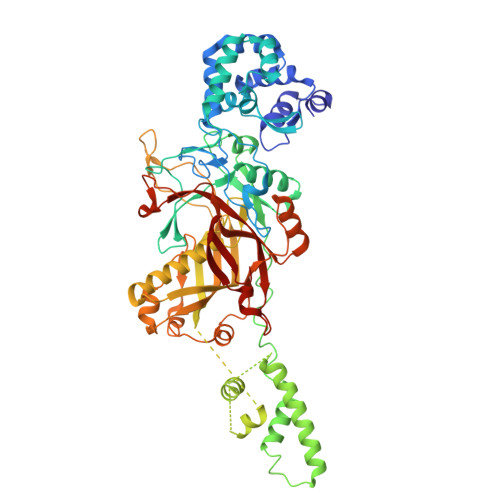
CRISPR-associated protein Csy2J [auth G]640Vibrio parahaemolyticus RIMD 2210633Mutation(s): 0 
Gene Names: VPA1388
UniProt
Find proteins for Q87GC9 (Vibrio parahaemolyticus serotype O3:K6 (strain RIMD 2210633))
Explore Q87GC9 
Go to UniProtKB:  Q87GC9
Entity Groups  
Sequence Clusters30% Identity50% Identity70% Identity90% Identity95% Identity100% Identity
UniProt GroupQ87GC9
Sequence Annotations
Expand
  • Reference Sequence
Find similar proteins by:  (by identity cutoff)  |  3D Structure
Entity ID: 6
MoleculeChains Sequence LengthOrganismDetailsImage
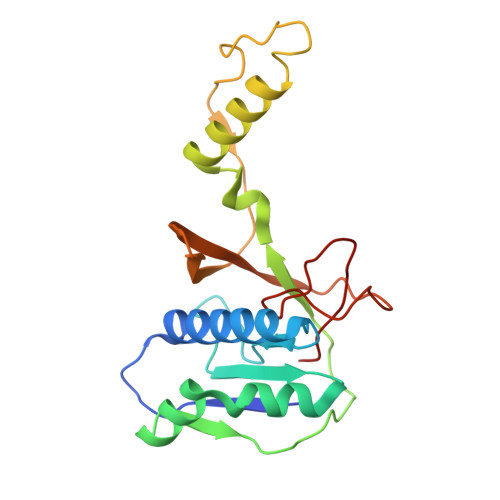
CRISPR-associated protein, Csy4 familyK [auth H]198Vibrio parahaemolyticus RIMD 2210633Mutation(s): 0 
Gene Names: VPA1390
UniProt
Find proteins for Q87GC7 (Vibrio parahaemolyticus serotype O3:K6 (strain RIMD 2210633))
Explore Q87GC7 
Go to UniProtKB:  Q87GC7
Entity Groups  
Sequence Clusters30% Identity50% Identity70% Identity90% Identity95% Identity100% Identity
UniProt GroupQ87GC7
Sequence Annotations
Expand
  • Reference Sequence
Find similar proteins by:  (by identity cutoff)  |  3D Structure
Entity ID: 7
MoleculeChains Sequence LengthOrganismDetailsImage
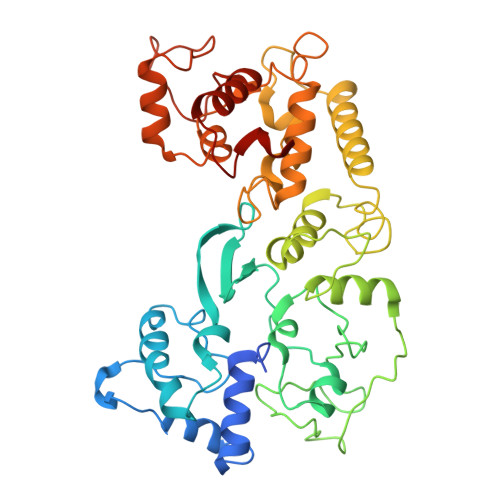
TniQL [auth I],
M [auth J]
406Vibrio parahaemolyticus RIMD 2210633Mutation(s): 0 
Gene Names: VPA1387
UniProt
Find proteins for Q87GD0 (Vibrio parahaemolyticus serotype O3:K6 (strain RIMD 2210633))
Explore Q87GD0 
Go to UniProtKB:  Q87GD0
Entity Groups  
Sequence Clusters30% Identity50% Identity70% Identity90% Identity95% Identity100% Identity
UniProt GroupQ87GD0
Sequence Annotations
Expand
  • Reference Sequence
Find similar nucleic acids by:  (by identity cutoff)  |  3D Structure
Entity ID: 1
MoleculeChains LengthOrganismImage
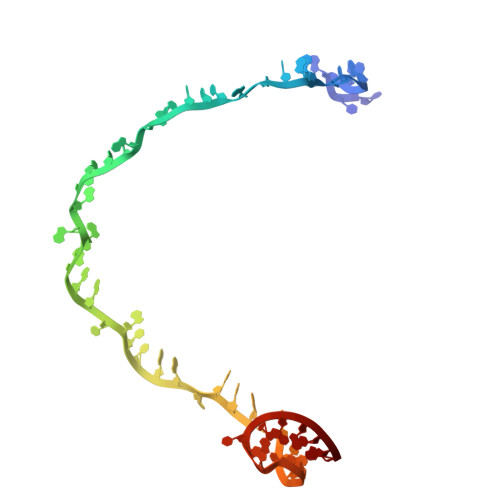
crRNA from Vibrio parahaemolyticusA [auth 1]60Vibrio parahaemolyticus RIMD 2210633
Sequence Annotations
Expand
  • Reference Sequence
Find similar nucleic acids by:  (by identity cutoff)  |  3D Structure
Entity ID: 2
MoleculeChains LengthOrganismImage
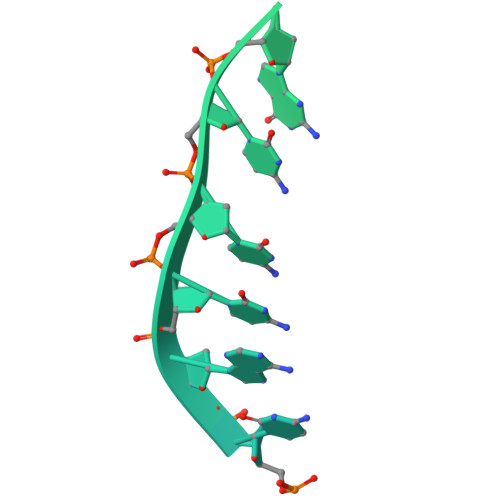
Target strand DNA from Vibrio alginolyticus K08M03 plasmid pL300B [auth 2]75Vibrio alginolyticus
Sequence Annotations
Expand
  • Reference Sequence
Find similar nucleic acids by:  (by identity cutoff)  |  3D Structure
Entity ID: 3
MoleculeChains LengthOrganismImage
Non-target strand DNA from Vibrio alginolyticus strain K08M3 plasmid pL300C [auth 3]75Vibrio alginolyticus
Sequence Annotations
Expand
  • Reference Sequence
Small Molecules
Ligands 1 Unique
IDChains Name / Formula / InChI Key2D Diagram3D Interactions
MG
Query on MG

Download Ideal Coordinates CCD File 
N [auth 1]MAGNESIUM ION
Mg
JLVVSXFLKOJNIY-UHFFFAOYSA-N
Experimental Data & Validation

Experimental Data

  • Method: ELECTRON MICROSCOPY
  • Resolution: 2.68 Å
  • Aggregation State: PARTICLE 
  • Reconstruction Method: SINGLE PARTICLE 

Structure Validation

View Full Validation Report


Entry History & Funding Information

Deposition Data


Funding OrganizationLocationGrant Number
Japan Society for the Promotion of Science (JSPS)Japan20H02916
Japan Society for the Promotion of Science (JSPS)Japan24H00505
Japan Society for the Promotion of Science (JSPS)Japan23KJ1734

Revision History  (Full details and data files)

  • Version 1.0: 2026-02-11
    Type: Initial release