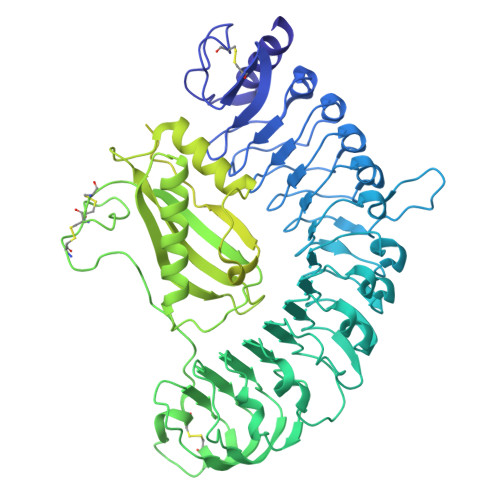
9VBD | pdb_00009vbd

Cryo-EM structure of CARD1 ectodomain


Experimental Data Snapshot

  • Method: ELECTRON MICROSCOPY
  • Resolution: 3.26 Å
  • Aggregation State: PARTICLE 
  • Reconstruction Method: SINGLE PARTICLE 

Starting Model: in silico
View more details

wwPDB Validation 3D Report Full Report

Validation slider image for 9VBD

This is version 1.1 of the entry. See complete history

Literature

A copper-dependent redox-based hydrogen peroxide perception in plants.

Ishihama, N.Fukuda, Y.Shirano, Y.Fujimoto, K.J.Takizawa, K.Hiroyama, R.Ito, H.Nishimura, M.Yanai, T.Inoue, T.Shirasu, K.Laohavisit, A.

(2026) Nat Commun 17

  • DOI: https://doi.org/10.1038/s41467-026-72573-8
  • Primary Citation Related Structures: 
    9VBD, 9VBV

  • PubMed Abstract: 

    Redox-related molecules, such as quinones and reactive oxygen species (ROS), are important signaling molecules for all living organisms. A plant-specific leucine-rich repeat receptor-like kinase (LRR-RLK) CANNOT RESPOND TO DMBQ 1 (CARD1), also known as HYDROGEN-PEROXIDE-INDUCED Ca 2+ INCREASES (HPCA1), perceives both quinones and ROS, but the mechanism by which it distinguishes between these two types of signals remains unclear. Here, we determine the structure of the CARD1 ectodomain and uncover its unique features. Structural studies, coupled with genetics and biochemical analysis, demonstrate that previously identified unique cysteine residues are not essential for signal perception in CARD1. Interestingly, CARD1 harbors a copper ion on the surface of the ectodomain via histidine-coordination that is crucial for hydrogen peroxide signaling. Our work reports a unique copper-dependent redox perception in plants and provides insight into interactions between receptors and non-peptide stimuli during perception.


  • Organizational Affiliation
    • RIKEN Center for Sustainable Resource Science, Yokohama, Japan.

Macromolecule Content 

  • Total Structure Weight: 101.31 kDa 
  • Atom Count: 4,243 
  • Modeled Residue Count: 521 
  • Deposited Residue Count: 893 
  • Unique protein chains: 1

Macromolecules

Find similar proteins by:|  3D Structure
Entity ID: 1
MoleculeChains  Sequence LengthOrganismDetailsImage
Leucine-rich repeat receptor protein kinase HPCA1,Maltose/maltodextrin-binding periplasmic protein893Arabidopsis thalianaEscherichia coli K-12
This entity is chimeric
Mutation(s): 0 
Gene Names: HPCA1At5g49760K2I5malEb4034JW3994
EC: 2.7.11.1
UniProt
Find proteins for P0AEX9 (Escherichia coli (strain K12))
Explore P0AEX9 
Go to UniProtKB:  P0AEX9
Find proteins for Q8GZ99 (Arabidopsis thaliana)
Explore Q8GZ99 
Go to UniProtKB:  Q8GZ99
Entity Groups
Sequence Clusters30% Identity50% Identity70% Identity90% Identity95% Identity100% Identity
UniProt GroupsQ8GZ99P0AEX9
Glycosylation
Glycosylation Sites: 8
Sequence Annotations
Expand
Reference Sequence

Oligosaccharides

Help  
Entity ID: 2
MoleculeChains Length2D Diagram GlycosylationD Interactions
2-acetamido-2-deoxy-beta-D-glucopyranose-(1-4)-2-acetamido-2-deoxy-beta-D-glucopyranose
B, C, D, F
2N-Glycosylation
Glycosylation Resources
GlyTouCan: G42666HT
GlyCosmos: G42666HT
GlyGen: G42666HT
Entity ID: 3
MoleculeChains Length2D Diagram GlycosylationD Interactions
beta-D-mannopyranose-(1-6)-beta-D-mannopyranose-(1-4)-2-acetamido-2-deoxy-beta-D-glucopyranose-(1-4)-2-acetamido-2-deoxy-beta-D-glucopyranose
E
4N-Glycosylation
Glycosylation Resources
GlyTouCan: G40894EI
GlyCosmos: G40894EI
GlyGen: G40894EI

Experimental Data & Validation

Experimental Data

  • Method: ELECTRON MICROSCOPY
  • Resolution: 3.26 Å
  • Aggregation State: PARTICLE 
  • Reconstruction Method: SINGLE PARTICLE 
EM Software:
TaskSoftware PackageVersion
RECONSTRUCTIONcryoSPARC3.2
MODEL REFINEMENTPHENIX1.21.2

Structure Validation

View Full Validation Report


Entry History 

& Funding Information

Deposition Data


Funding OrganizationLocationGrant Number
Japan Society for the Promotion of Science (JSPS)Japan--

Revision History  (Full details and data files)

  • Version 1.0: 2026-04-08
    Type: Initial release
  • Version 1.1: 2026-06-03
    Changes: Data collection, Database references