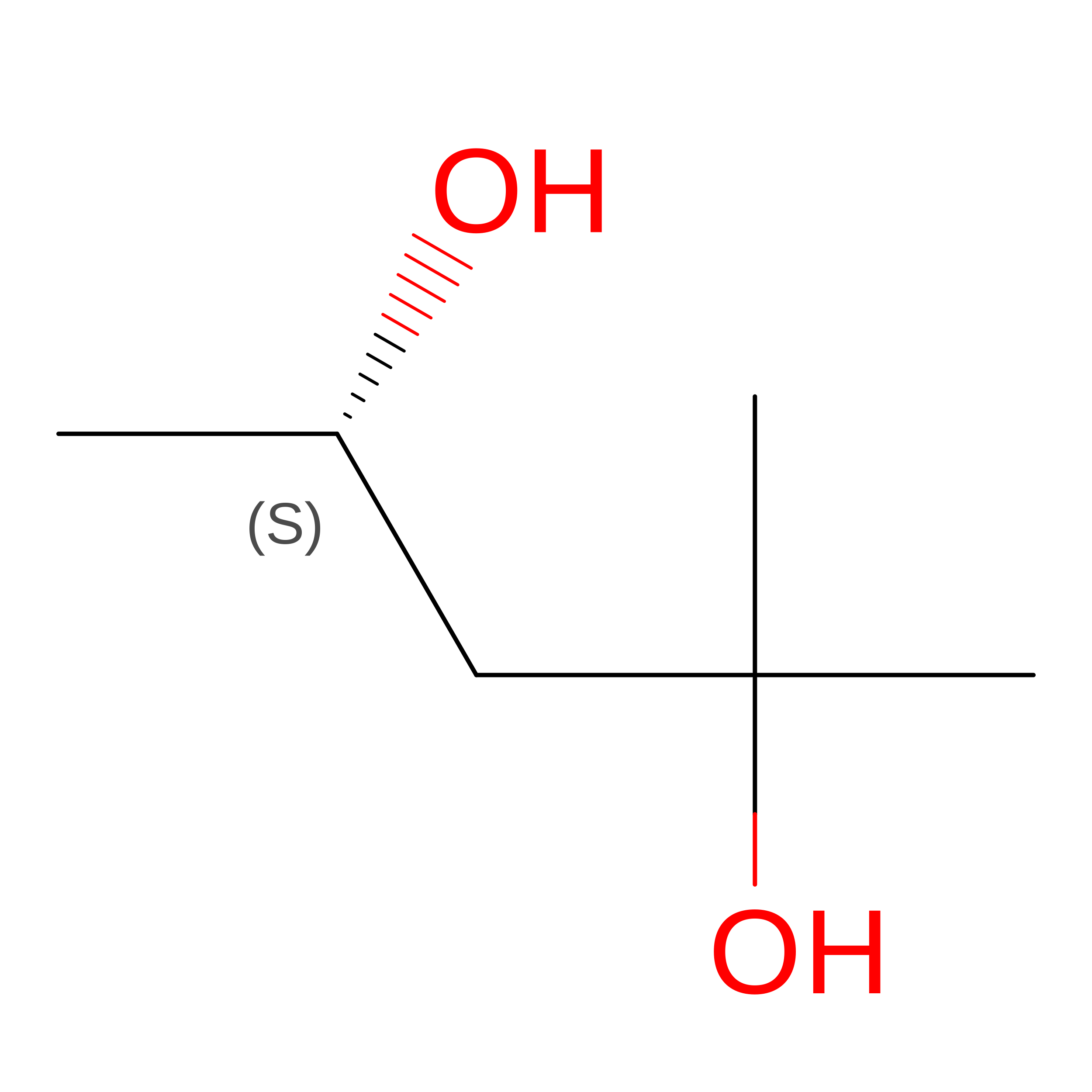
9V89 | pdb_00009v89

Crystal structure of d(CGTTAACG)2 with a five-carbon linker containing quinoxaline-acridine asymmetric intercalator compound

  • Classification: DNA
  • Organism(s): synthetic construct
  • Mutation(s): No 

  • Deposited: 2025-05-29 Released: 2026-06-03 
  • Deposition Author(s): Wang, S.C., Hou, M.H.
  • Funding Organization(s): Ministry of Science and Technology (MoST, Taiwan)

Experimental Data Snapshot

  • Method: X-RAY DIFFRACTION
  • Resolution: 1.27 Å
  • R-Value Free: 
    0.230 (Depositor), 0.233 (DCC) 
  • R-Value Work: 
    0.212 (Depositor), 0.213 (DCC) 
  • R-Value Observed: 
    0.214 (Depositor) 

Starting Model: experimental
View more details

wwPDB Validation 3D Report Full Report

Validation slider image for 9V89

Ligand Structure Quality Assessment 


This is version 1.1 of the entry. See complete history

Literature

Structural basis for asymmetric bis-intercalator targeting of DNA triplex junctions enabling dual inhibition of topoisomerase I and oncogene transcription.

Wang, S.C.Hsieh, C.C.Yuan, T.C.Lin, S.M.Chen, C.W.Chang, C.C.Huang, S.C.Wang, E.C.Huang, Y.J.Chiang, M.H.Horng, Y.C.Hou, M.H.

(2026) Nucleic Acids Res 54

  • DOI: https://doi.org/10.1093/nar/gkag520
  • Primary Citation Related Structures: 
    9V87, 9V88, 9V89

  • PubMed Abstract: 

    Achieving multi-pathway suppression with minimal toxicity remains a major goal in anticancer drug design. Here, we present the structural and mechanistic basis for asymmetric bis-intercalators QA4 and QA5, which integrate weak (quinoxaline) and strong (acridine) chromophores through optimized alkyl linkers to achieve preference recognition of non-canonical DNA triplex junctions. High-resolution crystal structures reveal a spermine-stabilized triplex junction comprising minor-groove-mediated C:G-G triplets and sheared G-G interactions, distinct from classical Hoogsteen triplexes. QA compounds engage this topology via CpG step bis-intercalation, disrupting junction integrity and inducing localized DNA deformation. QA4, with a four-carbon linker, provides optimal spacing for dual chromophore engagement, producing pronounced helical distortion. Structure-function analyses indicate that acridine-mediated DNA distortion preferentially suppresses topoisomerase I, whereas quinoxaline-induced groove deformation is correlated with transcriptional repression of multiple oncogenes, including CEACAM6. In colorectal and lung cancer xenograft models, QA4 demonstrates potent antitumor activity with negligible hepatotoxicity. These findings define the structural principles underlying topology-driven DNA recognition and establish DNA triplex junctions as druggable targets for dual-function anticancer therapeutics.


  • Organizational Affiliation
    • Doctoral Program in Medical Biotechnology, National Chung Hsing University, Taichung 402, Taiwan.

Macromolecule Content 

  • Total Structure Weight: 5.52 kDa 
  • Atom Count: 451 
  • Modeled Residue Count: 16 
  • Deposited Residue Count: 16 
  • Unique nucleic acid chains: 1

Macromolecules

Find similar nucleic acids by:  Sequence
Entity ID: 1
MoleculeChains LengthOrganismImage
DNA (5'-D(P*CP*GP*TP*TP*AP*AP*CP*G)-3')
A, B
8synthetic construct
Sequence Annotations
Expand
Reference Sequence

Experimental Data & Validation

Experimental Data

  • Method: X-RAY DIFFRACTION
  • Resolution: 1.27 Å
  • R-Value Free:  0.230 (Depositor), 0.233 (DCC) 
  • R-Value Work:  0.212 (Depositor), 0.213 (DCC) 
  • R-Value Observed: 0.214 (Depositor) 
Space Group: P 21 21 21
Unit Cell:
Length ( Å )Angle ( ˚ )
a = 23.835α = 90
b = 34.948β = 90
c = 47.901γ = 90
Software Package:
Software NamePurpose
PHENIXrefinement
HKL-2000data scaling
HKL-2000data reduction
PHENIXphasing

Structure Validation

View Full Validation Report


Ligand Structure Quality Assessment 


Entry History 

& Funding Information

Deposition Data


Funding OrganizationLocationGrant Number
Ministry of Science and Technology (MoST, Taiwan)Taiwan109-2628-M-005-001-MY4
Ministry of Science and Technology (MoST, Taiwan)Taiwan109-2311-B-005-007-MY3

Revision History  (Full details and data files)

  • Version 1.0: 2026-06-03
    Type: Initial release
  • Version 1.1: 2026-06-10
    Changes: Database references