9V3F | pdb_00009v3f

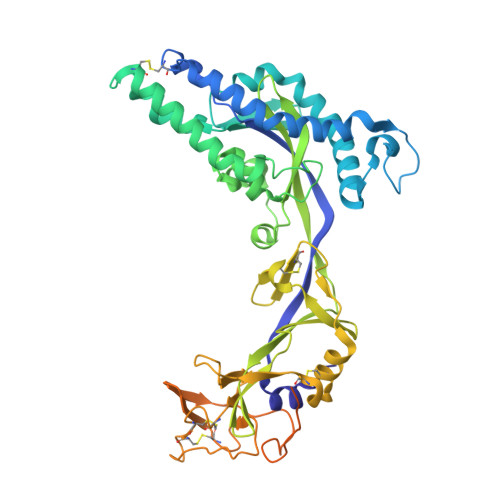
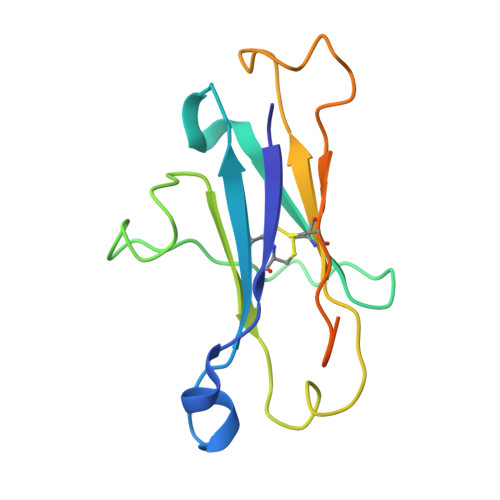
A neutralizing antibody targeting the F protein of NiV


Experimental Data Snapshot

  • Method: ELECTRON MICROSCOPY
  • Resolution: 2.80 Å
  • Aggregation State: PARTICLE 
  • Reconstruction Method: SINGLE PARTICLE 

wwPDB Validation 3D Report Full Report

Validation slider image for 9V3F

This is version 1.1 of the entry. See complete history. 

Literature

Highly potent C-type nanoantibodies neutralize Nipah and Hendra viruses by cavity filling on fusion glycoprotein.

Wang, S., Rao, G., Zhang, X., Yao, Y., Chen, L., Chen, S., Zhang, H., Liu, H., Chen, M., Li, W., Cao, S., Chiu, S., Gong, R.

(2026) Nat Commun 17

  • DOI: https://doi.org/10.1038/s41467-026-73406-4
  • Primary Citation Related Structures: 
    9V3E, 9V3F

  • PubMed Abstract: 

    Nipah (NiV) and Hendra (HeV) viruses pose a serious threat, causing global outbreaks with high fatality rates. The fusion (F) glycoprotein, located on the viral surface, presents a conserved and promising neutralizing target. Here, we identify two C-type nanoantibodies (C-Nabs), 1A1-3-22 and 2A1-3-8, targeting F protein. 2A1-3-8 exhibits cross-reactivity against both viruses, whereas 1A1-3-22 shows specificity to NiV. The half-life-extended 2A1-3-8 provides 100% protection against NiV lethal challenge in female hamsters. Cryo-EM analysis reveals that 1A1-3-22 and 2A1-3-8 target similar funnel-like epitopes. Based on the unique "cavity-filling" mechanism, we engineered 2A1-3-8 to exhibit enhanced neutralizing activity and converted 1A1-3-22 from a NiV-specific antibody into a broad-spectrum one. In addition, the affinity-matured 2A1-3-8 clones exhibit broad binding activity against F proteins spanning both the Henipavirus and Parahenipavirus genera. Our study not only demonstrates the potential of C-Nabs for clinical application against henipaviruses, but also provides critical epitope information for the future design and engineering of antibodies and the development of other antivirals.


  • Organizational Affiliation: 
    • State Key Laboratory of Virology and Biosafety, Wuhan Institute of Virology, Chinese Academy of Sciences, Wuhan, China.

Macromolecule Content 

  • Total Structure Weight: 214.16 kDa 
  • Atom Count: 12,535 
  • Modeled Residue Count: 1,596 
  • Deposited Residue Count: 1,899 
  • Unique protein chains: 2

Macromolecules

Find similar proteins by:|  3D Structure
Entity ID: 1
MoleculeChains  Sequence LengthOrganismDetailsImage
Fusion glycoprotein F0A,
C [auth B],
E [auth C]
502Henipavirus nipahenseMutation(s): 0 
UniProt
Find proteins for Q9IH63 (Nipah virus)
Explore Q9IH63 
Go to UniProtKB:  Q9IH63
Entity Groups
Sequence Clusters30% Identity50% Identity70% Identity90% Identity95% Identity100% Identity
UniProt GroupQ9IH63
Glycosylation
Glycosylation Sites: 2
Sequence Annotations
Expand
Reference Sequence
Find similar proteins by:|  3D Structure
Entity ID: 2
MoleculeChains  Sequence LengthOrganismDetailsImage
C-type nanoantibodyB [auth E],
D [auth F],
F [auth G]
131Homo sapiensMutation(s): 0 
Entity Groups
Sequence Clusters30% Identity50% Identity70% Identity90% Identity95% Identity100% Identity
Sequence Annotations
Expand
Reference Sequence

Small Molecules

Ligands 1 Unique
IDChains Name / Formula / InChI Key2D Diagram3D Interactions
NAG
(Subject of Investigation/LOI)

Query on NAG


Download:Ideal Coordinates CCD File
G [auth A]
H [auth A]
I [auth A]
J [auth B]
K [auth B]
G [auth A],
H [auth A],
I [auth A],
J [auth B],
K [auth B],
L [auth B],
M [auth C],
N [auth C],
O [auth C]
2-acetamido-2-deoxy-beta-D-glucopyranose
C8 H15 N O6
OVRNDRQMDRJTHS-FMDGEEDCSA-N

Experimental Data & Validation

Experimental Data

  • Method: ELECTRON MICROSCOPY
  • Resolution: 2.80 Å
  • Aggregation State: PARTICLE 
  • Reconstruction Method: SINGLE PARTICLE 
EM Software:
TaskSoftware PackageVersion
MODEL REFINEMENTPHENIX1.18.2_3874:

Structure Validation

View Full Validation Report


Entry History 

& Funding Information

Deposition Data


Funding OrganizationLocationGrant Number
Ministry of Science and Technology (MoST, China)China2022YFC2303300

Revision History  (Full details and data files)

  • Version 1.0: 2026-04-08
    Type: Initial release
  • Version 1.1: 2026-10-28
    Changes: Data collection, Database references