Download Mendeley
Molecular basis of antagonism of the dimeric human arginine vasopressin receptor 1A.
Zhong, P., Chu, B., Yu, Z., Qiao, Y., Ding, Y., Zhang, Y., Wu, X.(2026) Nat Commun 17: 1622-1622
- PubMed: 41545407 Search on PubMed
- DOI: https://doi.org/10.1038/s41467-026-68331-5
- Primary Citation Related Structures:
9UWI, 9UWJ, 9UWL, 9XB1 - PubMed Abstract:
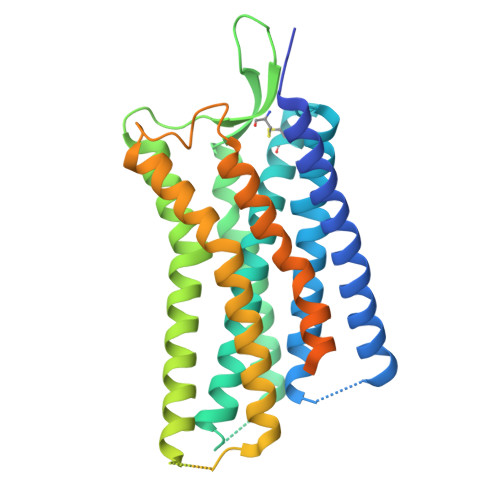
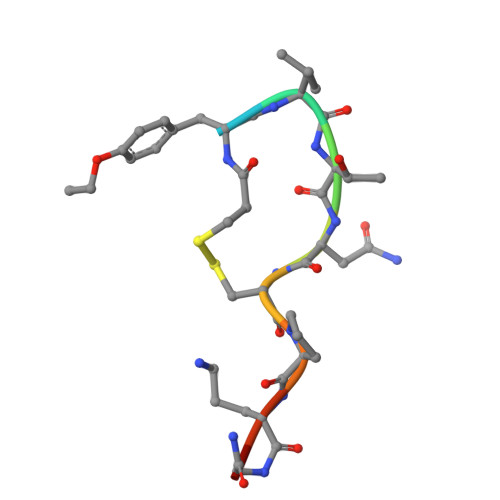
Arginine vasopressin (AVP) and oxytocin (OT) are peptide hormones critical for various physiological processes. Vasopressin receptor 1 A (V1aR), a primary AVP target, is promising for central nervous system (CNS) disorders therapies, yet the mechanisms of antagonism and oligomerization remain poorly understood. Here, we present structures of human V1aR in its apo state and in complexes with antagonists: atosiban, balovaptan, and SRX246. Structural analyses reveal a dimeric V1aR assembly, validated by functional assays and imaging in cells. The apo structure shows a flat extracellular loop 2 (ECL2) with unpaired cysteines, undergoing significant conformational changes upon ligand binding. Antagonist-bound structures, combined with mutagenesis and radioligand binding assays, uncover distinct binding modes and key determinants for antagonism and selectivity. These findings provide a comprehensive understanding of V1aR assembly and dynamic regulation, offering valuable insights for structure-guided development of new antagonists targeting dimeric V1aR for CNS disorders.
- Fudan University, Shanghai, China.
Organizational Affiliation: