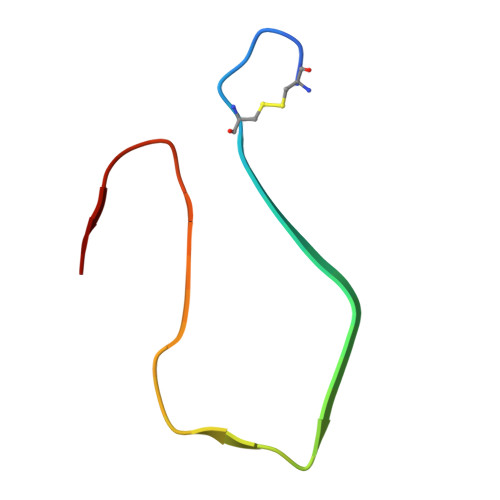
9ULZ | pdb_00009ulz

Cryo-EM structure of hIAPP fibrils extracted from a donor with T2D and pancreatic cancer

  • Classification: PROTEIN FIBRIL
  • Organism(s): Homo sapiens
  • Mutation(s): No 

  • Deposited: 2025-04-21 Released: 2026-01-14 
  • Deposition Author(s): Cao, Q., Liu, W., Han, J.
  • Funding Organization(s): National Natural Science Foundation of China (NSFC)

Experimental Data Snapshot

  • Method: ELECTRON MICROSCOPY
  • Resolution: 2.90 Å
  • Aggregation State: FILAMENT 
  • Reconstruction Method: HELICAL 

wwPDB Validation 3D Report Full Report

Validation slider image for 9ULZ

This is version 1.1 of the entry. See complete history

Literature

Structure of pancreatic hIAPP fibrils derived from patients with type 2 diabetes.

Liu, W.Han, J.Gong, W.Zhang, F.Cao, Q.

(2026) Cell 189: 1201

  • DOI: https://doi.org/10.1016/j.cell.2025.12.001
  • Primary Citation Related Structures: 
    9ULZ

  • PubMed Abstract: 

    Type 2 diabetes (T2D) impacts the quality of life and lifespan of nearly 10% of the global population. Human islet amyloid polypeptide (hIAPP) constitutes a major component of islet amyloid deposition in patients with T2D, with hIAPP fibrils believed to play a key role in the pathogenesis of T2D. In this study, we determined the cryo-electron microscopy (cryo-EM) structure of hIAPP fibrils extracted from surgically resected pancreases of three donors with T2D. These fibrils exhibit a uniform morphology, comprising two symmetrical protofilaments encompassing residues 2-37 of hIAPP and adopting an Ω-shaped fold. The structure of pancreatic hIAPP fibrils differs from that of fibrils formed in vitro. Additional densities were observed in the pancreatic hIAPP fibrils, suggesting ligand binding that may play significant roles in the pathogenesis of T2D. Collectively, our study presents the atomic structure of pathological hIAPP fibrils, contributing to the therapeutic and mechanistic exploration of T2D.


  • Organizational Affiliation
    • Bio-X Institutes, Key Laboratory for the Genetics of Developmental and Neuropsychiatric Disorders, Ministry of Education, Shanghai Jiao Tong University, Shanghai 200030, China.

Macromolecule Content 

  • Total Structure Weight: 46.91 kDa 
  • Atom Count: 3,168 
  • Modeled Residue Count: 432 
  • Deposited Residue Count: 444 
  • Unique protein chains: 1

Macromolecules

Find similar proteins by:|  3D Structure
Entity ID: 1
MoleculeChains  Sequence LengthOrganismDetailsImage
Islet amyloid polypeptide
A, B, C, D, E
A, B, C, D, E, F, G, H, I, J, K, L
37Homo sapiensMutation(s): 0 
UniProt & NIH Common Fund Data Resources
Find proteins for P10997 (Homo sapiens)
Explore P10997 
Go to UniProtKB:  P10997
PHAROS:  P10997
GTEx:  ENSG00000121351 
Entity Groups
Sequence Clusters30% Identity50% Identity70% Identity90% Identity95% Identity100% Identity
UniProt GroupP10997
Sequence Annotations
Expand
Reference Sequence

Experimental Data & Validation

Experimental Data

  • Method: ELECTRON MICROSCOPY
  • Resolution: 2.90 Å
  • Aggregation State: FILAMENT 
  • Reconstruction Method: HELICAL 
EM Software:
TaskSoftware PackageVersion
MODEL REFINEMENTPHENIX1.20.1_4487:

Structure Validation

View Full Validation Report


Entry History 

& Funding Information

Deposition Data


Funding OrganizationLocationGrant Number
National Natural Science Foundation of China (NSFC)China--

Revision History  (Full details and data files)

  • Version 1.0: 2026-01-14
    Type: Initial release
  • Version 1.1: 2026-03-11
    Changes: Data collection, Database references