Download Mendeley
A Dynamic Gate Enables Regioselective Hydroxylation of Free Arginine by a Non-Canonical Heme Enzyme.
Sun, Y., Dou, C., Yan, W., Chen, P., Zhang, L., Zhou, D., Zheng, Y., Long, Z., Li, S., Xu, X., Huang, Q., Zhu, X., Cheng, W.(2026) Adv Sci (Weinh) 13: e13032-e13032
- PubMed: 41221789 Search on PubMedSearch on PubMed Central
- DOI: https://doi.org/10.1002/advs.202513032
- Primary Citation Related Structures:
9UB3, 9UB5, 9UBA, 9UBB, 9UBS, 9UBT - PubMed Abstract:
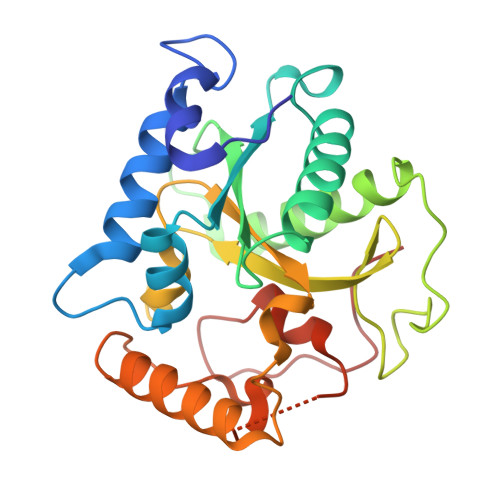
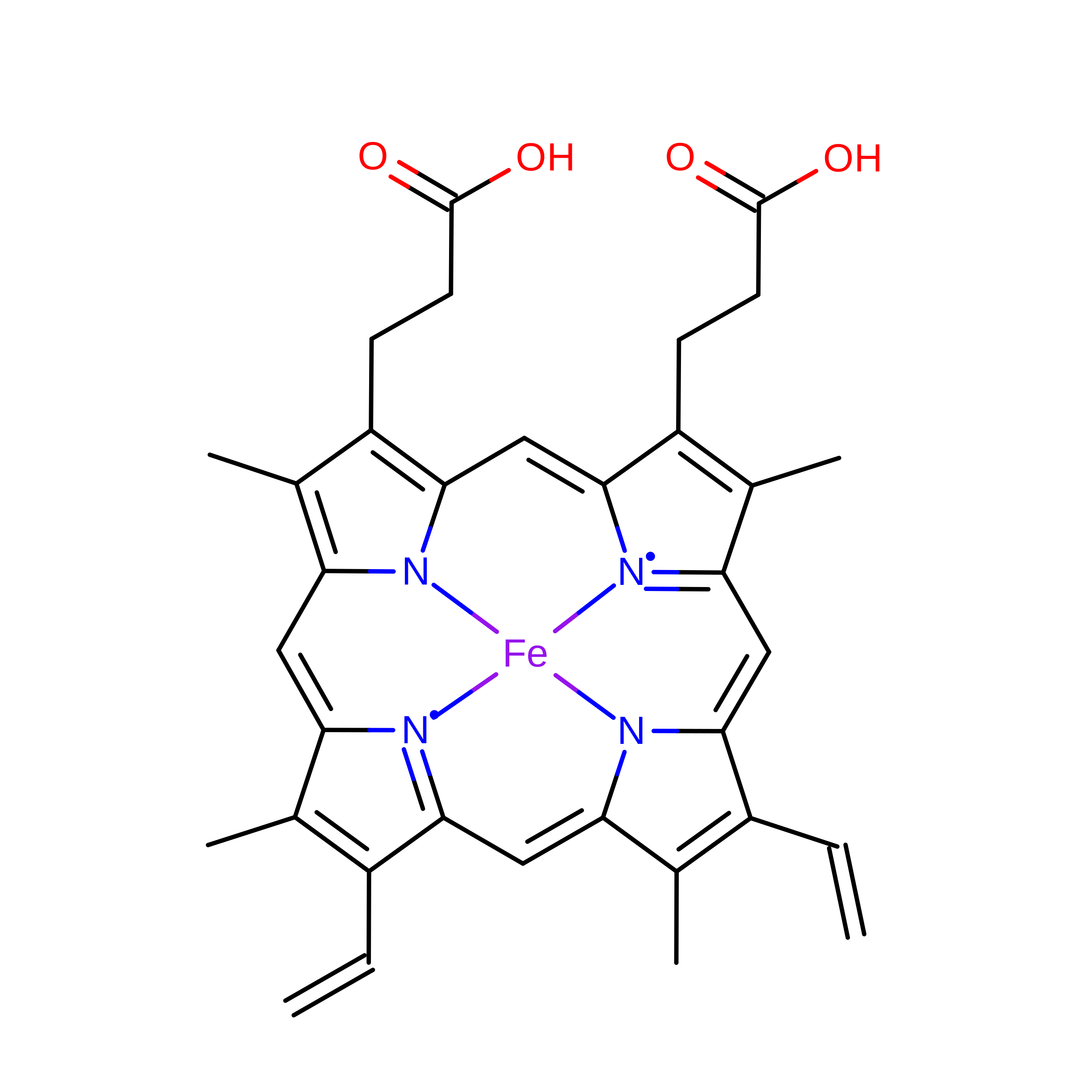
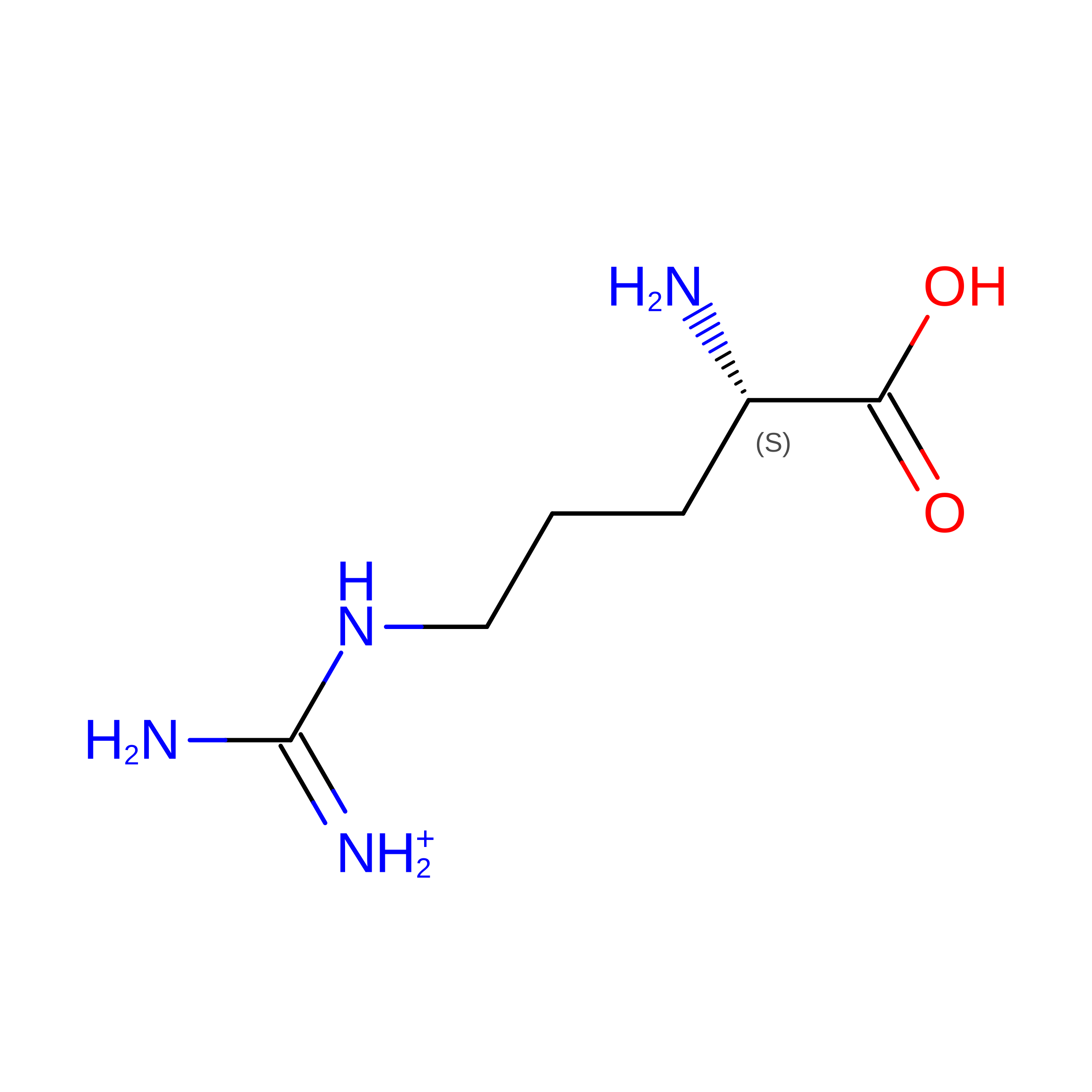
The YqcI/YcgG family of heme-dependent enzymes catalyzes guanidine N-H hydroxylation, a critical yet enigmatic step in bioactive natural product biosynthesis. Here, this mechanistic puzzle is resolved through high-resolution structural snapshots of AglA, a prototypical YqcI/YcgG member, revealing a non-canonical heme-binding "sandwich" fold. A dynamic regiochemical gating mechanism is uncovered: substrate-induced remodeling of loop L2 and key residues (Phe152, Arg179, Phe182) spatially constrains the guanidine group of aminomethylphosphonate-linked arginine (AMPn-Arg), enforcing exclusive internal N ε hydroxylation. Single-site mutations rewire hydrogen-bond networks to enable hydroxylation of free L-arginine with controllable regioselectivity (internal N δ vs terminal N ω ) while preserving native internal N ε selectivity for AMPn-Arg. Crystal structures of engineered variants with free arginine, together with MD simulations, explain how subtle rearrangements of loop L2 and residues Phe152/Arg179/Phe182 pivot the guanidinium group relative to the heme Fe(IV) = O intermediate. Fusing AglA to its native PDR/VanB reductase yields a self-sufficient chimera with improved catalytic efficiency. This work establishes a structural blueprint for tuning guanidino N-H hydroxylation and demonstrates proof-of-principle control of regioselectivity in a non-canonical heme enzyme, thereby advancing the synthesis of arginine-based antibiotics and precision-functionalized therapeutics.
- Department of Pulmonary and Critical Care Medicine, Respiratory Infection and Intervention Laboratory of Frontiers Science Center for Disease-related Molecular Network, and State Key Laboratory of Biotherapy, West China Hospital of Sichuan University, Chengdu, 610041, China.
Organizational Affiliation: