Download Mendeley
SA-XV, a 15-amino acid fragment of host defense peptide S100A12, targets mitochondria and is protective against fungal infections.
Agarwal, R., Biswas, K., Agrawal, A., Shankar, N.N., Kundu, S., Roy, D., Son, D., Harikishore, A., Yennamalli, R.M., Lee, D., Bhunia, A., Roy, S.(2025) J Biological Chem 301: 110743-110743
- PubMed: 40975173 Search on PubMed
- DOI: https://doi.org/10.1016/j.jbc.2025.110743
- Primary Citation Related Structures:
9U7M - PubMed Abstract:
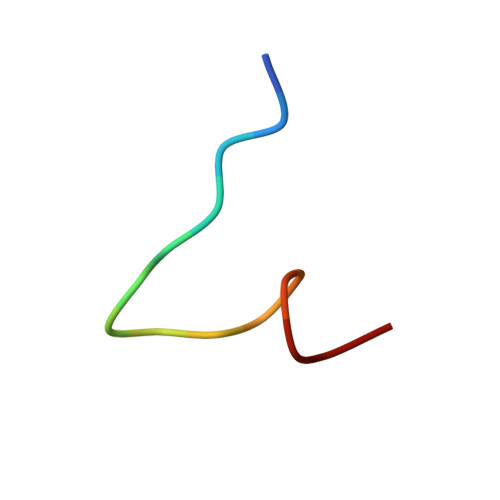
Fungal infections are huge emerging crisis with more than two million people infected worldwide annually. Corneal infections caused by fungus is the major cause of vision loss and often warrants corneal transplantation. Both Fusarium spp. and Candida spp. are critical etiological agents of fungal keratitis and also common cause for invasive fungal infections with high mortality rates. In previous work we described growth inhibition of Fusarium spp. by S100A12, a host antimicrobial peptide. Here, to optimize a potential therapeutic, we have studied a 15 amino acid fragment of S100A12, SA-XV. Interestingly, SA-XV demonstrated remarkable antifungal activities, similar to the parent peptide, against both Fusarium spp. and Candida spp. SA-XV is a cell penetrating peptide, and once internalized, it binds to fungal DNA, halts cell cycle, and disrupts mitochondria leading to generation of reactive oxygen species and cell damage. Atomistic structure of the peptide determined by NMR reveals that SA-XV associates with fungal membrane. The structural changes in SA-XV from α-helical to random coil conformation was observed in all-atom simulations. Additionally, SA-XV aids in wound healing of corneal epithelial cells and attenuate the fungal burden in a murine model of fungal keratitis. Our results clearly demonstrate SA-XV as a promising antifungal candidate that targets both filamentous and non-filamentous fungus for alternative therapeutic interventions.
- Prof. Brien Holden Eye Research Centre, LV Prasad Eye Institute, Hyderabad 500034, India; Dr. Chigurupati Nageswara Rao Ocular Pharmacology Research Centre, LV Prasad Eye Institute, India; Graduate Studies, Manipal Academy of Higher Education, Manipal, India.
Organizational Affiliation: