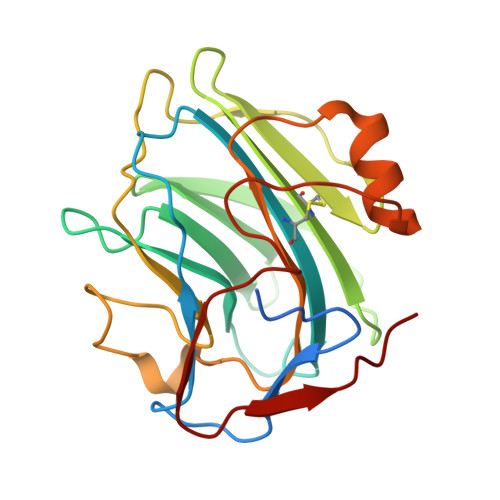
9U4E | pdb_00009u4e

Cryo-EM structure of the human CRP-CPS23F complex


Experimental Data Snapshot

  • Method: ELECTRON MICROSCOPY
  • Resolution: 2.78 Å
  • Aggregation State: PARTICLE 
  • Reconstruction Method: SINGLE PARTICLE 

wwPDB Validation 3D Report Full Report

Validation slider image for 9U4E

This is version 1.1 of the entry. See complete history

Literature

C-reactive protein is a broad-spectrum capsule-binding receptor for hepatic capture of blood-borne bacteria.

Chen, D.Hu, J.Zhu, M.Xie, Y.Yao, H.An, H.Meng, Y.Wang, J.Huang, X.Liu, Y.Shao, Z.Xiang, Y.Qi, J.Gao, G.F.Zhang, J.R.

(2025) EMBO J 44: 7364-7394

  • DOI: https://doi.org/10.1038/s44318-025-00623-w
  • Primary Citation Related Structures: 
    9U4E

  • PubMed Abstract: 

    Plasma C-reactive protein (CRP) is widely used as a biomarker for bacterial infections due to its massive induction during infections. However, the biological function of CRP remains largely undefined. Here we show that CRP enables liver resident macrophages (Kupffer cells) to capture and eliminate a wide range of invasive bacteria from the bloodstream of mice, and thereby provides rapid and sterilizing immunity. Mechanistically, CRP binds to at least 20 capsule types of Gram-positive and -negative pathogens, and shuffles the encapsulated bacteria to Kupffer cells embedded in the lining of the liver sinusoidal vasculatures by the complement-dependent and -independent pathways. The complement-dependent mode involves the activation of complement C3 at the bacterial surface, and the capture of the C3-opsonized bacteria by the CRIg and CR3 complement receptors on Kupffer cells. Cryo-electron microscopy analysis revealed a flexible structural framework for CRP's recognition of structurally diverse capsular polysaccharides. Because human CRP also possesses the broad capsule-binding activities, our findings provide a biological reason for the massive rise of plasma CRP during bacterial infections.


  • Organizational Affiliation
    • Center for Infection Biology, School of Basic Medical Sciences, Tsinghua University, Beijing, 100084, China.

Macromolecule Content 

  • Total Structure Weight: 129.65 kDa 
  • Atom Count: 8,425 
  • Modeled Residue Count: 1,030 
  • Deposited Residue Count: 1,120 
  • Unique protein chains: 1

Macromolecules

Find similar proteins by:|  3D Structure
Entity ID: 1
MoleculeChains  Sequence LengthOrganismDetailsImage
C-reactive protein
A, B, C, D, E
224Homo sapiensMutation(s): 0 
Gene Names: CRPPTX1
UniProt & NIH Common Fund Data Resources
Find proteins for P02741 (Homo sapiens)
Explore P02741 
Go to UniProtKB:  P02741
PHAROS:  P02741
GTEx:  ENSG00000132693 
Entity Groups
Sequence Clusters30% Identity50% Identity70% Identity90% Identity95% Identity100% Identity
UniProt GroupP02741
Sequence Annotations
Expand
Reference Sequence

Oligosaccharides

Help  
Entity ID: 2
MoleculeChains Length2D Diagram GlycosylationD Interactions
alpha-L-rhamnopyranose-(1-2)-1,3-bis(oxidanyl)propan-2-yl [(2~{R},3~{S},4~{S},5~{R})-2-(hydroxymethyl)-3,5,6-tris(oxidanyl)oxan-4-yl] hydrogen phosphate-(1-4)-beta-L-rhamnopyranose-(1-4)-beta-D-glucopyranose
F, G, H, I, J
4N/AN/A

Small Molecules

Ligands 1 Unique
IDChains Name / Formula / InChI Key2D Diagram3D Interactions
CA
(Subject of Investigation/LOI)

Query on CA


Download:Ideal Coordinates CCD File
K [auth A]
L [auth A]
M [auth B]
N [auth B]
O [auth C]
K [auth A],
L [auth A],
M [auth B],
N [auth B],
O [auth C],
P [auth C],
Q [auth D],
R [auth D],
S [auth E],
T [auth E]
CALCIUM ION
Ca
BHPQYMZQTOCNFJ-UHFFFAOYSA-N

Experimental Data & Validation

Experimental Data

  • Method: ELECTRON MICROSCOPY
  • Resolution: 2.78 Å
  • Aggregation State: PARTICLE 
  • Reconstruction Method: SINGLE PARTICLE 
EM Software:
TaskSoftware PackageVersion
MODEL REFINEMENTPHENIX1.20.1_4487

Structure Validation

View Full Validation Report


Entry History 

& Funding Information

Deposition Data


Funding OrganizationLocationGrant Number
National Natural Science Foundation of China (NSFC)China--

Revision History  (Full details and data files)

  • Version 1.0: 2025-09-24
    Type: Initial release
  • Version 1.1: 2026-04-08
    Changes: Data collection, Database references