9TC9 | pdb_00009tc9

Active-state structure of the GPR55-N171Q mutant in complex with G13 and BI-6229


Experimental Data Snapshot

  • Method: ELECTRON MICROSCOPY
  • Resolution: 2.88 Å
  • Aggregation State: PARTICLE 
  • Reconstruction Method: SINGLE PARTICLE 

wwPDB Validation 3D Report Full Report

Validation slider image for 9TC9

This is version 1.0 of the entry. See complete history. 

Literature

Molecular insights into GPR55 modulation reveal an atypical activation mechanism and glycosylation-dependent efficacy regulation.

Claff, T., Demalgiriya-Gamage, C., Mahardhika, A.B., Stamos, N.A., Bangnowski, F., Sun, X., Durr, K.L., Robinson, C.V., Haney, R., Frego, L., Nar, H., Muller, C.E., Ebenhoch, R., Kley, J.T., Weichert, D.

(2026) Nat Commun 17

  • DOI: https://doi.org/10.1038/s41467-026-78538-1
  • Primary Citation Related Structures: 
    9TC7, 9TC8, 9TC9

  • PubMed Abstract: 

    GPR55 is a lipid-activated G protein-coupled receptor (GPCR) implicated in metabolism, inflammation, and neurodegeneration. Lysophosphatidylinositol (LPI) species are proposed as endogenous agonists, but progress in understanding GPR55 function has still been limited by suboptimal chemical probes. Here, we present cryo-electron microscopy (cryo-EM) structures of GPR55 in both inactive and active states. The inactive-state structure bound to the inverse agonist CID16020046 facilitated the rational design of an improved in vitro tool compound, BI-8310. Surprisingly, mutation of a glycosylation site in extracellular loop 2 converted CID16020046 into a potent agonist, enabling co-structure determination of the active, G 13 -bound receptor. Comparative analysis of both states bound to the same ligand provides insights into an atypical activation mechanism that diverges from the typical helix VI outward movement observed in other GPCRs. Functional mutagenesis, N-glycoproteomics, and hydrogen-deuterium exchange mass spectrometry (HDX-MS) substantiate the findings. These results establish a basis for targeted modulation of GPR55 in pathophysiological conditions.


  • Organizational Affiliation: 
    • Boehringer Ingelheim Pharma GmbH & Co. KG, Global Medicinal Chemistry, Birkendorfer Str. 65, Biberach an der Riß, Germany. tclaff@uni-bonn.de.

Macromolecule Content 

  • Total Structure Weight: 180.69 kDa 
  • Atom Count: 8,228 
  • Modeled Residue Count: 1,035 
  • Deposited Residue Count: 1,622 
  • Unique protein chains: 5

Macromolecules

Find similar proteins by:|  3D Structure
Entity ID: 1
MoleculeChains  Sequence LengthOrganismDetailsImage
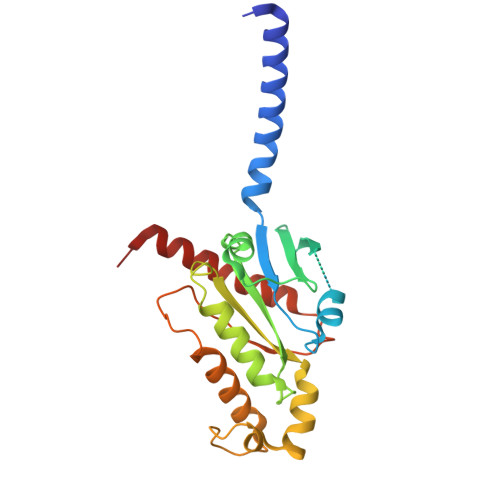
Guanine nucleotide-binding protein G(i) subunit alpha-2,Guanine nucleotide-binding protein subunit alpha-13230Homo sapiensMutation(s): 8 
Gene Names: GNAI2, GNAI2B, GNA13
EC: 3.6.5
UniProt & NIH Common Fund Data Resources
Find proteins for P04899 (Homo sapiens)
Explore P04899 
Go to UniProtKB:  P04899
PHAROS:  P04899
GTEx:  ENSG00000114353 
Find proteins for Q14344 (Homo sapiens)
Explore Q14344 
Go to UniProtKB:  Q14344
PHAROS:  Q14344
GTEx:  ENSG00000120063 
Entity Groups
Sequence Clusters30% Identity50% Identity70% Identity90% Identity95% Identity100% Identity
UniProt GroupsP04899Q14344
Sequence Annotations
Expand
Reference Sequence
Find similar proteins by:|  3D Structure
Entity ID: 2
MoleculeChains  Sequence LengthOrganismDetailsImage
Guanine nucleotide-binding protein G(I)/G(S)/G(T) subunit beta-1358Homo sapiensMutation(s): 0 
Gene Names: GNB1
UniProt & NIH Common Fund Data Resources
Find proteins for P62873 (Homo sapiens)
Explore P62873 
Go to UniProtKB:  P62873
PHAROS:  P62873
GTEx:  ENSG00000078369 
Entity Groups
Sequence Clusters30% Identity50% Identity70% Identity90% Identity95% Identity100% Identity
UniProt GroupP62873
Sequence Annotations
Expand
Reference Sequence
Find similar proteins by:|  3D Structure
Entity ID: 3
MoleculeChains  Sequence LengthOrganismDetailsImage
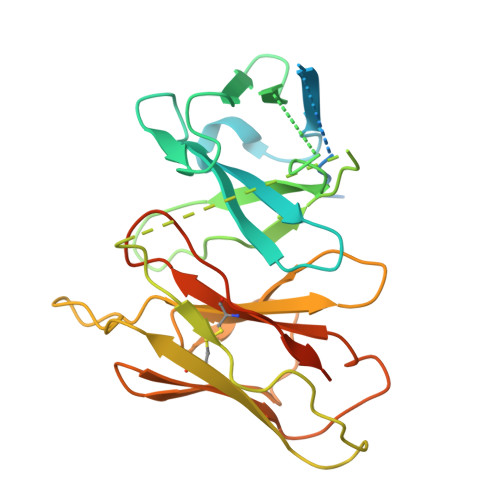
ScFv16C [auth F]304synthetic constructMutation(s): 0 
Entity Groups
Sequence Clusters30% Identity50% Identity70% Identity90% Identity95% Identity100% Identity
Sequence Annotations
Expand
Reference Sequence
Find similar proteins by:|  3D Structure
Entity ID: 4
MoleculeChains  Sequence LengthOrganismDetailsImage
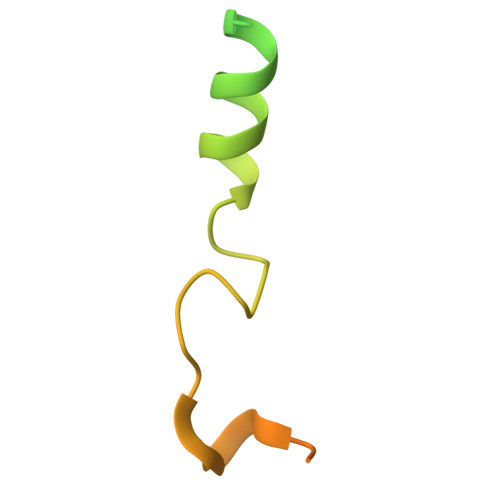
Guanine nucleotide-binding protein G(I)/G(S)/G(O) subunit gamma-2D [auth G]80Homo sapiensMutation(s): 0 
Gene Names: GNG2
UniProt & NIH Common Fund Data Resources
Find proteins for P59768 (Homo sapiens)
Explore P59768 
Go to UniProtKB:  P59768
PHAROS:  P59768
GTEx:  ENSG00000186469 
Entity Groups
Sequence Clusters30% Identity50% Identity70% Identity90% Identity95% Identity100% Identity
UniProt GroupP59768
Sequence Annotations
Expand
Reference Sequence
Find similar proteins by:|  3D Structure
Entity ID: 5
MoleculeChains  Sequence LengthOrganismDetailsImage
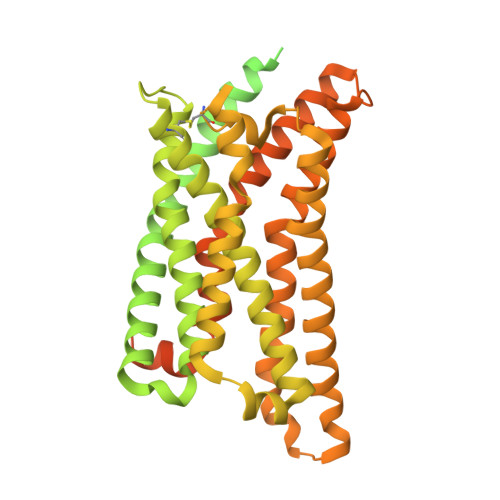
Green fluorescent protein,G-protein coupled receptor 55E [auth R]650Aequorea victoria, Homo sapiens
This entity is chimeric
Mutation(s): 9 
Gene Names: GFP, GPR55
UniProt & NIH Common Fund Data Resources
Find proteins for P42212 (Aequorea victoria)
Explore P42212 
Go to UniProtKB:  P42212
Find proteins for Q9Y2T6 (Homo sapiens)
Explore Q9Y2T6 
Go to UniProtKB:  Q9Y2T6
PHAROS:  Q9Y2T6
GTEx:  ENSG00000135898 
Entity Groups
Sequence Clusters30% Identity50% Identity70% Identity90% Identity95% Identity100% Identity
UniProt GroupsQ9Y2T6P42212
Sequence Annotations
Expand
Reference Sequence

Small Molecules

Ligands 1 Unique
IDChains Name / Formula / InChI Key2D Diagram3D Interactions
A1JU1
(Subject of Investigation/LOI)

Query on A1JU1


Download:Ideal Coordinates CCD File
F [auth R]4-[(4~{S})-4-(3-hydroxyphenyl)-3-(4-methylphenyl)-6-oxidanylidene-1,4-dihydropyrrolo[3,4-c]pyrazol-5-yl]benzoic acid
C25 H19 N3 O4
VGUQVYZXABOXCX-QHCPKHFHSA-N

Experimental Data & Validation

Experimental Data

  • Method: ELECTRON MICROSCOPY
  • Resolution: 2.88 Å
  • Aggregation State: PARTICLE 
  • Reconstruction Method: SINGLE PARTICLE 
EM Software:
TaskSoftware PackageVersion
MODEL REFINEMENTPHENIX1.21.2_5419
RECONSTRUCTIONcryoSPARC

Structure Validation

View Full Validation Report


Entry History 

& Funding Information

Deposition Data


Funding OrganizationLocationGrant Number
Not funded--

Revision History  (Full details and data files)

  • Version 1.0: 2026-11-04
    Type: Initial release