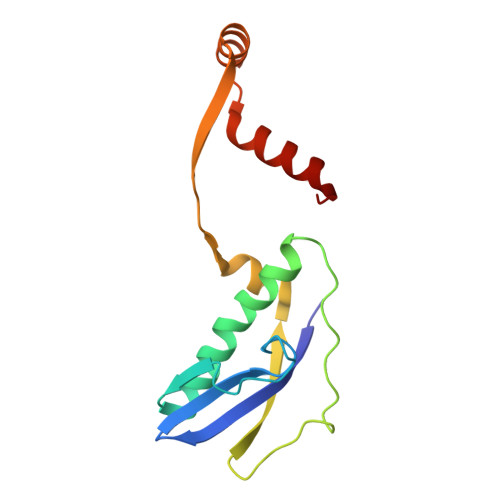
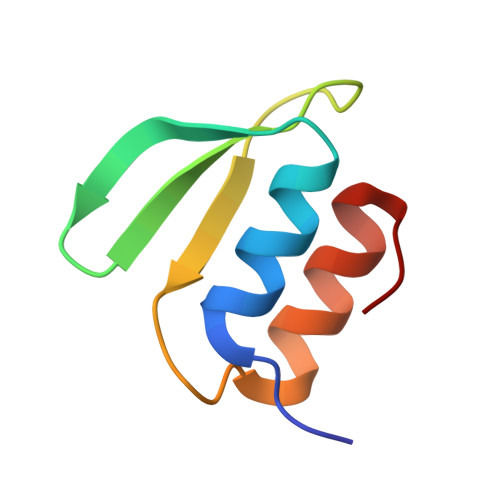
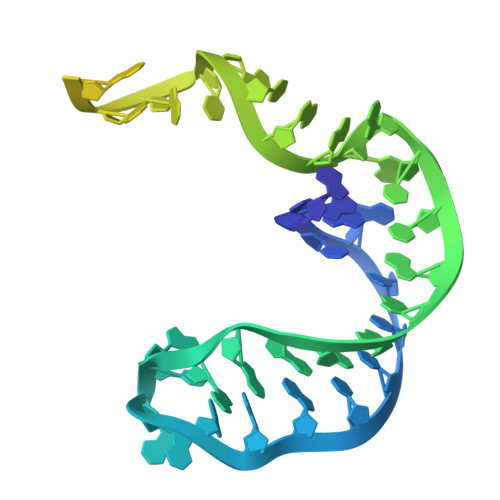
9SVK | pdb_00009svk

cryo-EM structure of LwHicAB-crRNA


Experimental Data Snapshot

  • Method: ELECTRON MICROSCOPY
  • Resolution: 3.40 Å
  • Aggregation State: 3D ARRAY 
  • Reconstruction Method: SINGLE PARTICLE 

wwPDB Validation 3D Report Full Report

Validation slider image for 9SVK

This is version 1.0 of the entry. See complete history

Literature

Potential role of a CRISPR-Cas-activated toxin-antitoxin system in bacterial immunity.

Chen, J.Huang, L.Chen, H.Li, X.Lin, X.Guo, C.Liu, X.Fu, G.Chen, Y.Liu, L.

(2026) Nat Commun 17

  • DOI: https://doi.org/10.1038/s41467-026-74930-z
  • Primary Citation Related Structures: 
    9SVK

  • PubMed Abstract: 

    CRISPR-Cas and toxin-antitoxin systems can serve as antiviral defense mechanisms in prokaryotes. In typical toxin-antitoxin systems, toxin activation can limit phage propagation by inducing growth arrest or reduced cellular fitness, while the antitoxin neutralizes toxin activity. Here, we study potential functional synergy between a CRISPR-Cas13a system and a type II toxin-antitoxin module (HicAB) from a Leptotrichia bacterium, when heterologously expressed in E. coli, as well as in biochemical and structural analyses. We show that the antitoxin HicB exhibits toxic properties, and Cas13a directly activates HicB, triggering growth inhibition and conferring protection against bacteriophages. Structural analyses reveal that Cas13a binding promotes the spatial proximity of HicB tetramers, likely enabling its activation. The toxin HicA competitively binds to HicB, thereby inhibiting Cas13a-mediated HicB activation. Importantly, both CRISPR RNA and HicB independently suppress HicA toxicity. Structural evidence indicates that CRISPR RNA forms a hetero-tetradecameric complex with HicAB, occluding HicA's active site and neutralizing its toxic function. Thus, our findings indicate functional synergy between distinct bacterial immune strategies.


  • Organizational Affiliation
    • State Key Laboratory of Cellular Stress Biology, School of Life Sciences, Faculty of Medicine and Life Sciences, Xiamen University, Xiamen, China. chenjiyun@xmu.edu.cn.

Macromolecule Content 

  • Total Structure Weight: 193.02 kDa 
  • Atom Count: 11,986 
  • Modeled Residue Count: 1,404 
  • Deposited Residue Count: 1,472 
  • Unique protein chains: 2
  • Unique nucleic acid chains: 1

Macromolecules


Find similar proteins by:|  3D Structure
Entity ID: 1
MoleculeChains  Sequence LengthOrganismDetailsImage
Toxin-antitoxin system, antitoxin component, HicB family138Leptotrichia wadei F0279Mutation(s): 0 
Gene Names: HMPREF9015_01859
UniProt
Find proteins for U2RCH0 (Leptotrichia wadei (strain F0279))
Explore U2RCH0 
Go to UniProtKB:  U2RCH0
Entity Groups
Sequence Clusters30% Identity50% Identity70% Identity90% Identity95% Identity100% Identity
UniProt GroupU2RCH0
Sequence Annotations
Expand
Reference Sequence
Find similar proteins by:|  3D Structure
Entity ID: 2
MoleculeChains  Sequence LengthOrganismDetailsImage
Toxin-antitoxin system, toxin component, HicA familyC [auth A],
F,
I,
L
63Leptotrichia wadei F0279Mutation(s): 0 
Gene Names: HMPREF9015_01860
UniProt
Find proteins for U2R460 (Leptotrichia wadei (strain F0279))
Explore U2R460 
Go to UniProtKB:  U2R460
Entity Groups
Sequence Clusters30% Identity50% Identity70% Identity90% Identity95% Identity100% Identity
UniProt GroupU2R460
Sequence Annotations
Expand
Reference Sequence
Find similar nucleic acids by:  (by identity cutoff) 
Entity ID: 3
MoleculeChains LengthOrganismImage
RNA (58-MER)
M, N
58Leptotrichia wadei F0279
Sequence Annotations
Expand
Reference Sequence

Experimental Data & Validation

Experimental Data

  • Method: ELECTRON MICROSCOPY
  • Resolution: 3.40 Å
  • Aggregation State: 3D ARRAY 
  • Reconstruction Method: SINGLE PARTICLE 
EM Software:
TaskSoftware PackageVersion
RECONSTRUCTIONRELION
MODEL REFINEMENTPHENIX1.17.1_3660:

Structure Validation

View Full Validation Report


Entry History 

& Funding Information

Deposition Data


Funding OrganizationLocationGrant Number
UK Research and Innovation (UKRI)United KingdomMC_U105184332
Wellcome TrustUnited KingdomWT096570
European Molecular Biology Organization (EMBO)European UnionALTF 937-2022

Revision History  (Full details and data files)

  • Version 1.0: 2026-09-09
    Type: Initial release