9SMK | pdb_00009smk

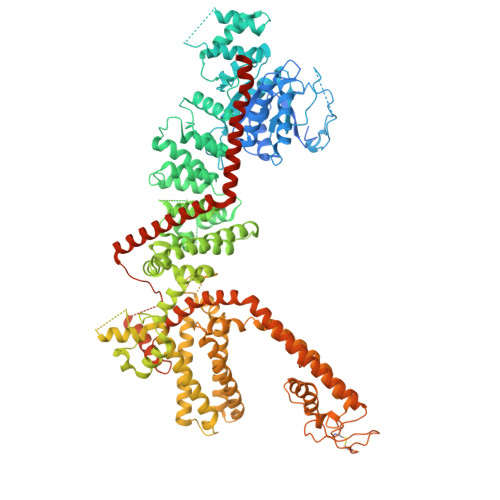
Human TRPM4 ion channel in MSP2N2 lipid nanodisc in a calcium-bound state


Experimental Data Snapshot

  • Method: ELECTRON MICROSCOPY
  • Resolution: 3.80 Å
  • Aggregation State: PARTICLE 
  • Reconstruction Method: SINGLE PARTICLE 

Starting Model: experimental
View more details

wwPDB Validation   3D Report Full Report


This is version 1.0 of the entry. See complete history


Literature

MAASTY: a (dis)ordered copolymer for structural determination of human membrane proteins in native nanodiscs.

Pugh, C.F.Feilen, L.P.Zivkovic, D.Praestegaard, K.F.Sideris, C.Borthwick, N.J.de Lichtenberg, C.Bolla, J.R.Autzen, A.A.A.Autzen, H.E.

(2025) Nat Commun 16: 11399-11399

  • DOI: https://doi.org/10.1038/s41467-025-66208-7
  • Primary Citation of Related Structures:  
    9I3R, 9SMK

  • PubMed Abstract: 

    Amphiphilic copolymers capable of extracting membrane proteins directly from cellular membranes into "native nanodiscs" offer a simplified approach for preparing membrane proteins in lipid nanodiscs compared to approaches that rely on detergent. Copolymer amphiphilicity, length, and composition influence their performance, in addition to the protein itself and the purification conditions used. Here, we report a copolymer composed of methacrylic acid and styrene, which we term MAASTY, leveraging the inherent monomer reactivity ratios to create an anionic copolymer with a statistical distribution of monomers. We show that MAASTY can be used for high-resolution structural determination of a human membrane protein by single particle cryo-electron microscopy, preserving endogenous lipids including cholesterol and exhibiting an enrichment of phosphatidylinositol. Moreover, MAASTY copolymers effectively solubilize a broad range of lipid species and a wide range of different, eukaryotic membrane proteins from mammalian cells. We find that MAASTY copolymers are promising as effective solubilizers of membrane proteins and offer a chemical platform for structural and functional characterization of membrane proteins in native nanodiscs.


  • Organizational Affiliation
    • Department of Biomedical Sciences, University of Copenhagen, Copenhagen, N, DK-2200, Denmark.

Macromolecules
Find similar proteins by:  (by identity cutoff)  |  3D Structure
Entity ID: 1
MoleculeChains Sequence LengthOrganismDetailsImage
Transient receptor potential cation channel subfamily M member 4
A, B, C, D
1,218Homo sapiensMutation(s): 0 
Gene Names: TRPM4LTRPC4
UniProt & NIH Common Fund Data Resources
Find proteins for Q8TD43 (Homo sapiens)
Explore Q8TD43 
Go to UniProtKB:  Q8TD43
PHAROS:  Q8TD43
GTEx:  ENSG00000130529 
Entity Groups  
Sequence Clusters30% Identity50% Identity70% Identity90% Identity95% Identity100% Identity
UniProt GroupQ8TD43
Sequence Annotations
Expand
  • Reference Sequence
Small Molecules
Ligands 2 Unique
IDChains Name / Formula / InChI Key2D Diagram3D Interactions
Y01
Query on Y01

Download Ideal Coordinates CCD File 
F [auth A]
G [auth A]
H [auth A]
J [auth B]
K [auth B]
F [auth A],
G [auth A],
H [auth A],
J [auth B],
K [auth B],
L [auth B],
M [auth C],
O [auth C],
P [auth C],
Q [auth D],
S [auth D],
T [auth D]
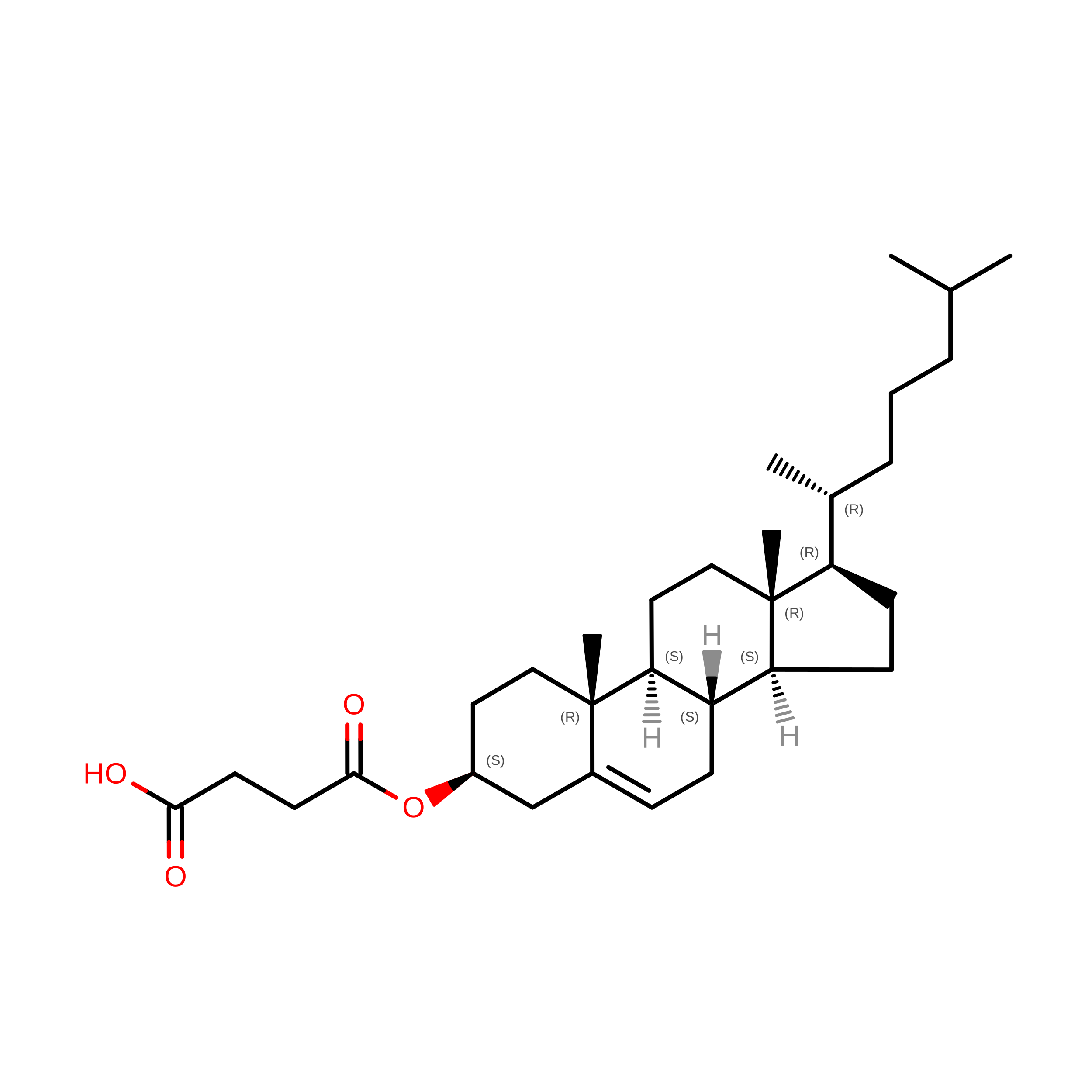
CHOLESTEROL HEMISUCCINATE
C31 H50 O4
WLNARFZDISHUGS-MIXBDBMTSA-N
CA
Query on CA

Download Ideal Coordinates CCD File 
E [auth A],
I [auth B],
N [auth C],
R [auth D]
CALCIUM ION
Ca
BHPQYMZQTOCNFJ-UHFFFAOYSA-N
Experimental Data & Validation

Experimental Data

  • Method: ELECTRON MICROSCOPY
  • Resolution: 3.80 Å
  • Aggregation State: PARTICLE 
  • Reconstruction Method: SINGLE PARTICLE 
EM Software:
TaskSoftware PackageVersion
RECONSTRUCTIONRELION5.0
MODEL REFINEMENTPHENIX1.21.1-5286
MODEL REFINEMENTCoot0.9.8.94

Structure Validation

View Full Validation Report


Entry History & Funding Information

Deposition Data


Funding OrganizationLocationGrant Number
Novo Nordisk FoundationDenmark--

Revision History  (Full details and data files)

  • Version 1.0: 2026-02-25
    Type: Initial release