9SHX | pdb_00009shx

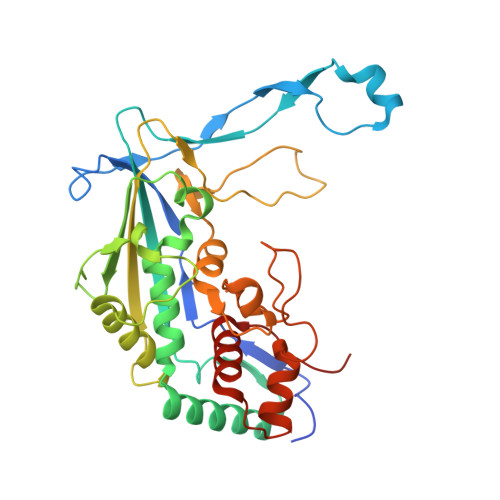
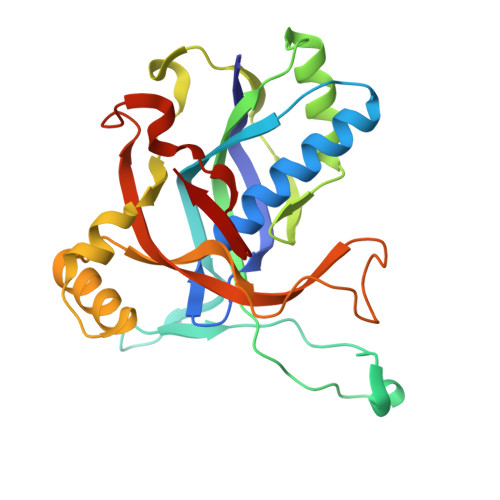
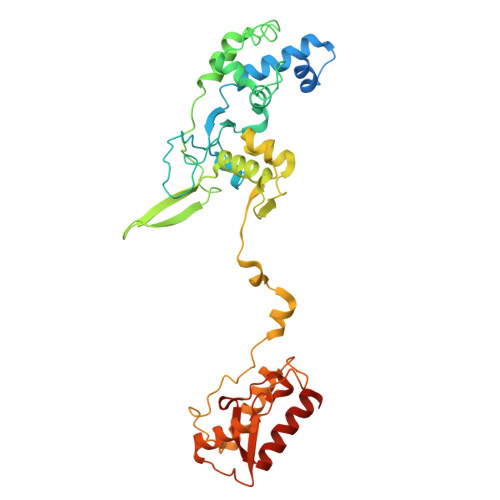
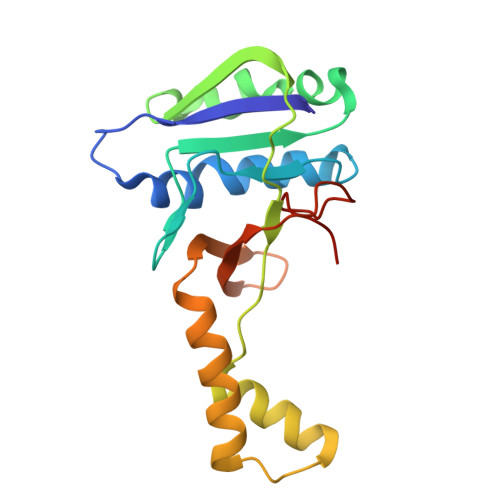
Type I-F_HNH variant Cascade bound to dsDNA, HNH domain in middle position


Experimental Data Snapshot

  • Method: ELECTRON MICROSCOPY
  • Resolution: 2.40 Å
  • Aggregation State: PARTICLE 
  • Reconstruction Method: SINGLE PARTICLE 

wwPDB Validation 3D Report Full Report

Validation slider image for 9SHX

This is version 1.1 of the entry. See complete history

Literature

Conformational dynamics of CRISPR-Cas type I-F-HNH inform nickase engineering in a cascade scaffold.

Fuglsang, A.Rout, S.S.Koutna, E.B.Sofos, N.Gallego, A.R.Montoya, G.

(2026) Nucleic Acids Res 54

  • DOI: https://doi.org/10.1093/nar/gkag053
  • Primary Citation Related Structures: 
    9SHX, 9SIT, 9SIU, 9SJC, 9SJD, 9SJL, 9SJM, 9SJN, 9SJO

  • PubMed Abstract: 

    The type I-FHNH CRISPR-Cas system is a non-canonical Class 1 effector complex distinguished by the replacement of the Cas3 recruitment domain with a catalytic HNH domain in Cas8, enabling autonomous DNA cleavage without accessory nucleases. Using cryo-EM, we determined high-resolution structures of the effector complex in three catalytic states-precatalytic, NTS-cleaved, and post-catalytic-revealing a dynamic trajectory of the HNH domain through inward, middle, and outward conformations. Biochemical assays demonstrated that the complex cleaves the nontarget strand (NTS) prior to the target strand (TS), consistent with a sequential cleavage mechanism similar to Cas12 effectors but notably lacking trans-cleavage activity on single-stranded DNA. Structural comparisons confirmed a minimal PAM requirement (5'-CN) and a constrained HNH catalytic site poised for precise strand scission. We engineered a ΔLinker variant of Cas8 that repositions the HNH domain, selectively abolishing TS cleavage and converting the system into a programmable NTS-specific nickase. Importantly, we validated the functionality of both wild-type and mutant complexes in human cells. While the wild-type system induced indels and base substitutions, the ΔLinker variant triggered targeted single-strand nicks without double-stranded breaks. Together, our work establishes type I-FHNH as a compact and precise genome editing platform with in vivo efficacy.


  • Organizational Affiliation
    • Structural Molecular Biology Group, Novo Nordisk Foundation Centre for Protein Research, Department of Cellular and Molecular Medicine, Faculty of Health and Medical Sciences University of Copenhagen, Blegdamsvej 3B, Copenhagen, 2200, Denmark.

Macromolecule Content 

  • Total Structure Weight: 373.17 kDa 
  • Atom Count: 24,015 
  • Modeled Residue Count: 2,791 
  • Deposited Residue Count: 2,982 
  • Unique protein chains: 4
  • Unique nucleic acid chains: 3

Macromolecules


Find similar proteins by:|  3D Structure
Entity ID: 1
MoleculeChains  Sequence LengthOrganismDetailsImage
Cas7f335Selenomonas sp.Mutation(s): 0 
UniProt
Find proteins for A0AAX7FM28 (Selenomonas sp)
Explore A0AAX7FM28 
Go to UniProtKB:  A0AAX7FM28
Entity Groups
Sequence Clusters30% Identity50% Identity70% Identity90% Identity95% Identity100% Identity
UniProt GroupA0AAX7FM28
Sequence Annotations
Expand
Reference Sequence
Find similar proteins by:|  3D Structure
Entity ID: 2
MoleculeChains  Sequence LengthOrganismDetailsImage
Cas5fF [auth B]255Selenomonas sp.Mutation(s): 0 
UniProt
Find proteins for A0AAX7FM22 (Selenomonas sp)
Explore A0AAX7FM22 
Go to UniProtKB:  A0AAX7FM22
Entity Groups
Sequence Clusters30% Identity50% Identity70% Identity90% Identity95% Identity100% Identity
UniProt GroupA0AAX7FM22
Sequence Annotations
Expand
Reference Sequence
Find similar proteins by:|  3D Structure
Entity ID: 3
MoleculeChains  Sequence LengthOrganismDetailsImage
Cas8f fusion with HNHH [auth A]384Selenomonas sp.Mutation(s): 0 
UniProt
Find proteins for A0AAX7FM29 (Selenomonas sp)
Explore A0AAX7FM29 
Go to UniProtKB:  A0AAX7FM29
Entity Groups
Sequence Clusters30% Identity50% Identity70% Identity90% Identity95% Identity100% Identity
UniProt GroupA0AAX7FM29
Sequence Annotations
Expand
Reference Sequence
Find similar proteins by:|  3D Structure
Entity ID: 4
MoleculeChains  Sequence LengthOrganismDetailsImage
Cas6f181Selenomonas sp.Mutation(s): 0 
UniProt
Find proteins for A0AAX7FM27 (Selenomonas sp)
Explore A0AAX7FM27 
Go to UniProtKB:  A0AAX7FM27
Entity Groups
Sequence Clusters30% Identity50% Identity70% Identity90% Identity95% Identity100% Identity
UniProt GroupA0AAX7FM27
Sequence Annotations
Expand
Reference Sequence
Find similar nucleic acids by:  (by identity cutoff) 
Entity ID: 5
MoleculeChains LengthOrganismImage
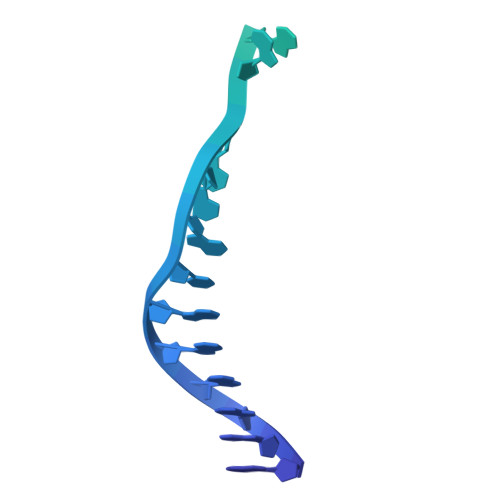
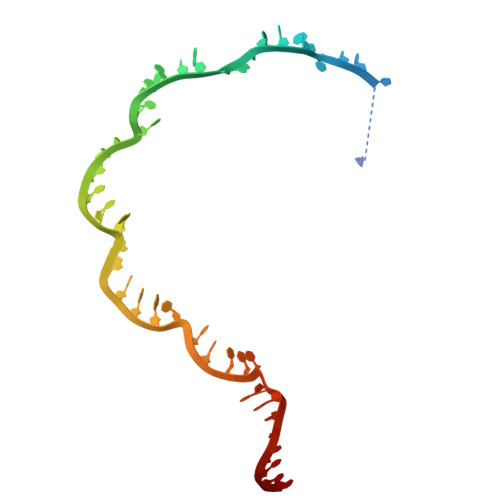
Non-target strandJ [auth L]46Selenomonas sp.
Sequence Annotations
Expand
Reference Sequence
Find similar nucleic acids by:  (by identity cutoff) 
Entity ID: 6
MoleculeChains LengthOrganismImage
Target strand46Selenomonas sp.
Sequence Annotations
Expand
Reference Sequence
Find similar nucleic acids by:  (by identity cutoff) 
Entity ID: 7
MoleculeChains LengthOrganismImage
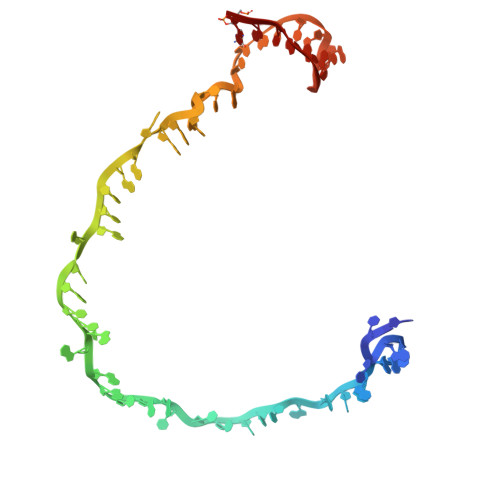
crRNAL [auth J]60Selenomonas sp.
Sequence Annotations
Expand
Reference Sequence

Small Molecules

Ligands 1 Unique
IDChains Name / Formula / InChI Key2D Diagram3D Interactions
MG
(Subject of Investigation/LOI)

Query on MG


Download:Ideal Coordinates CCD File
M [auth A]MAGNESIUM ION
Mg
JLVVSXFLKOJNIY-UHFFFAOYSA-N

Experimental Data & Validation

Experimental Data

  • Method: ELECTRON MICROSCOPY
  • Resolution: 2.40 Å
  • Aggregation State: PARTICLE 
  • Reconstruction Method: SINGLE PARTICLE 
EM Software:
TaskSoftware PackageVersion
MODEL REFINEMENTPHENIX1.21.2_5419
RECONSTRUCTIONcryoSPARC

Structure Validation

View Full Validation Report


Entry History 

& Funding Information

Deposition Data


Funding OrganizationLocationGrant Number
Novo Nordisk FoundationDenmarkNNF14CC0001

Revision History  (Full details and data files)

  • Version 1.0: 2026-02-04
    Type: Initial release
  • Version 1.1: 2026-02-18
    Changes: Data collection, Database references