9RXL | pdb_00009rxl

SARS-CoV-2 nucleocapsid C-terminal domain in complex with BCY00018176


Experimental Data Snapshot

  • Method: X-RAY DIFFRACTION
  • Resolution: 1.46 Å
  • R-Value Free: 
    0.214 (Depositor), 0.219 (DCC) 
  • R-Value Work: 
    0.183 (Depositor), 0.189 (DCC) 
  • R-Value Observed: 
    0.184 (Depositor) 

wwPDB Validation   3D Report Full Report


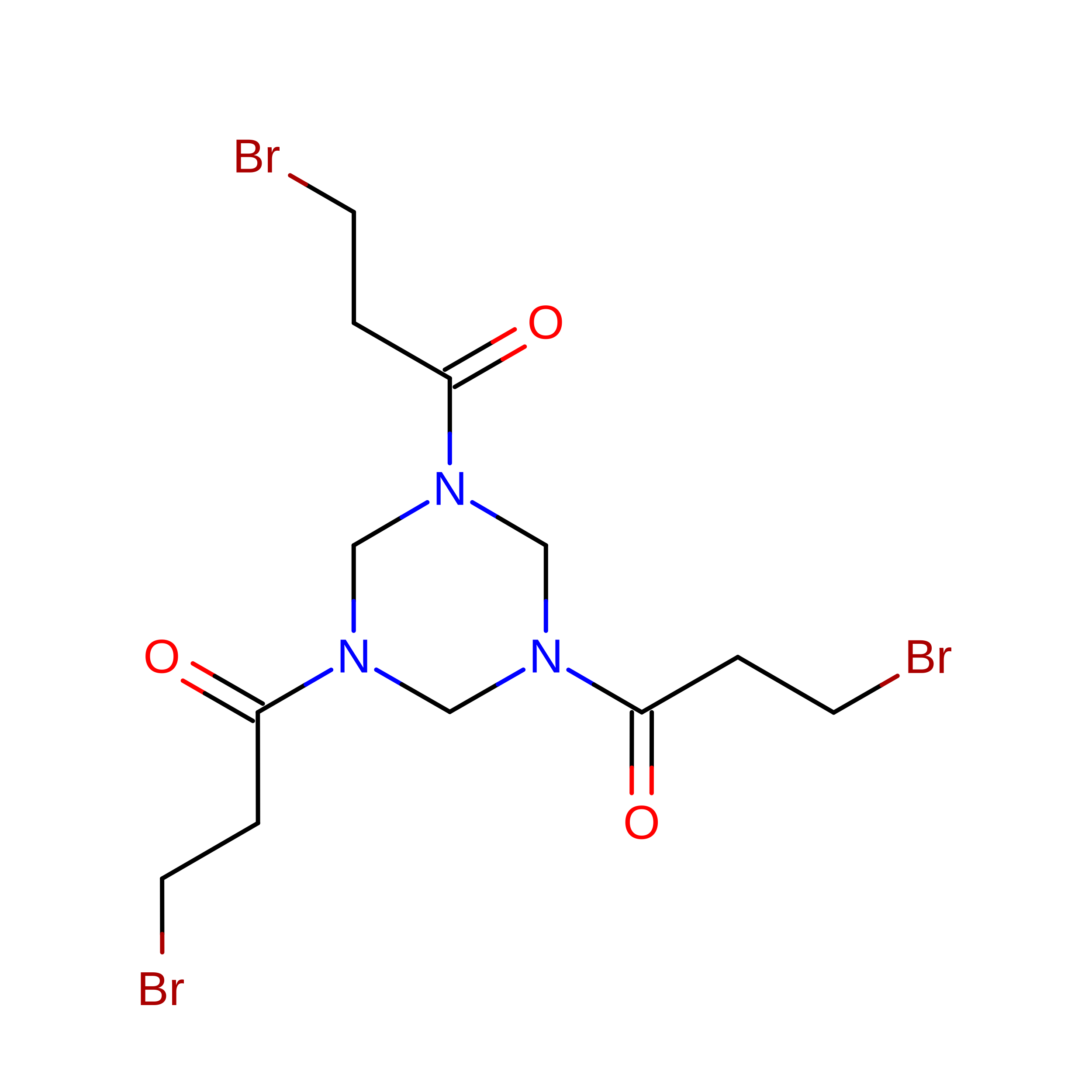
Ligand Structure Quality Assessment 


This is version 1.0 of the entry. See complete history


Literature

Utilizing Constrained Bicyclic Peptides for In Vitro Diagnostics.

Shamsabadi, A.Creamer, A.Sadler, C.J.Abdelwahed, A.Gaynor, K.U.Demydchuk, Y.Ivanova-Berndt, G.Van Rietschoten, K.Beswick, P.Chen, L.Arruda Bezerra, G.Lulla, A.Brear, P.Hyvonen, M.Skynner, M.J.Stevens, M.M.

(2026) ACS Nano 

  • DOI: https://doi.org/10.1021/acsnano.5c19041
  • Primary Citation of Related Structures:  
    9RXL, 9S3N

  • PubMed Abstract: 

    Constrained bicyclic peptides ( Bicycle molecules ) with high affinity for biological targets have emerged as potentially powerful therapeutic agents, particularly for the in vivo targeting of cancer receptors. However, their antibody-mimetic properties have yet to be explored for use in diagnostic immunoassays. These synthetically derived compounds serve as biorecognition scaffolds that allow for facile site-selective modification and large-scale production. A phage display screen against various constructs of the SARS-CoV-2 nucleocapsid (N) protein identified several Bicycle molecules with binding affinities ranging from the micromolar to the low nanomolar range. These Bicycle molecules were validated in the development of enzyme- and nanozyme-linked immunosorbent assays, as well as enzymatic and colorimetric nanoparticle-based lateral flow immunoassays (LFIA) for the detection of ultralow concentrations of the SARS-CoV-2 N protein. We envision that these moieties enable robust, cost-effective, and large-scale development of ultrasensitive biosensors for a diverse range of biomarkers by leveraging their high binding affinity, minimalistic scaffold, and synthetic accessibility.


  • Organizational Affiliation
    • Department of Materials, Department of Bioengineering and Institute of Biomedical Engineering, Imperial College London, London SW7 2AZ, U.K.

Macromolecules

Find similar proteins by:  Sequence   |   3D Structure  

Entity ID: 1
MoleculeChains Sequence LengthOrganismDetailsImage
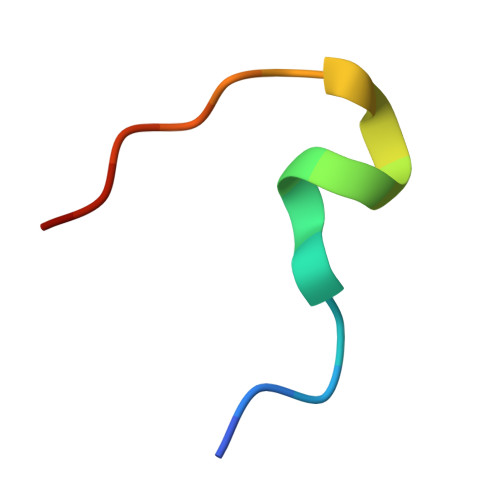
BCY00018176
A, B
18Homo sapiensMutation(s): 0 
Entity Groups  
Sequence Clusters30% Identity50% Identity70% Identity90% Identity95% Identity100% Identity
Sequence Annotations
Expand
  • Reference Sequence
Find similar proteins by:  (by identity cutoff)  |  3D Structure
Entity ID: 2
MoleculeChains Sequence LengthOrganismDetailsImage
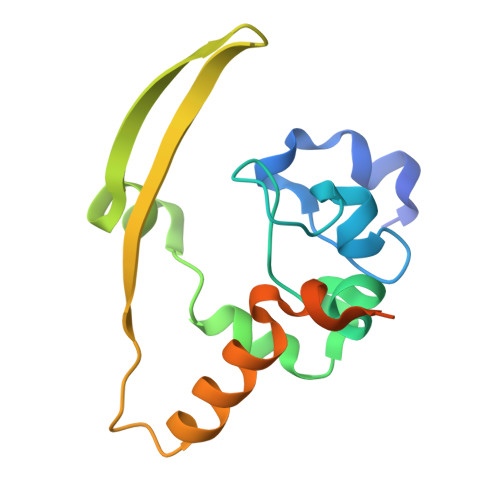
Nucleoprotein
C, D
139Severe acute respiratory syndrome coronavirus 2Mutation(s): 0 
UniProt
Find proteins for P0DTC9 (Severe acute respiratory syndrome coronavirus 2)
Explore P0DTC9 
Go to UniProtKB:  P0DTC9
Entity Groups  
Sequence Clusters30% Identity50% Identity70% Identity90% Identity95% Identity100% Identity
UniProt GroupP0DTC9
Sequence Annotations
Expand
  • Reference Sequence
Experimental Data & Validation

Experimental Data

  • Method: X-RAY DIFFRACTION
  • Resolution: 1.46 Å
  • R-Value Free:  0.214 (Depositor), 0.219 (DCC) 
  • R-Value Work:  0.183 (Depositor), 0.189 (DCC) 
  • R-Value Observed: 0.184 (Depositor) 
Space Group: P 43 21 2
Unit Cell:
Length ( Å )Angle ( ˚ )
a = 73.043α = 90
b = 73.043β = 90
c = 116.864γ = 90
Software Package:
Software NamePurpose
REFMACrefinement
BUSTERrefinement
Aimlessdata scaling
XDSdata reduction
PHASERphasing
PDB_EXTRACTdata extraction

Structure Validation

View Full Validation Report


Ligand Structure Quality Assessment 


Entry History & Funding Information

Deposition Data


Funding OrganizationLocationGrant Number
Other privateUnited Kingdom--

Revision History  (Full details and data files)

  • Version 1.0: 2026-03-04
    Type: Initial release