Download Mendeley
Protein thermostabilization with Protposer: Pushing the stability limits and folding reversibility of a highly-stabilized apoflavodoxin.
Hidalgo-Toledo, A., Bazco, D., Correa-Perez, V., Martinez-Julvez, M., Sancho, J.(2025) Int J Biol Macromol 331: 148333-148333
- PubMed: 41106744 Search on PubMed
- DOI: https://doi.org/10.1016/j.ijbiomac.2025.148333
- Primary Citation Related Structures:
9RXF - PubMed Abstract:
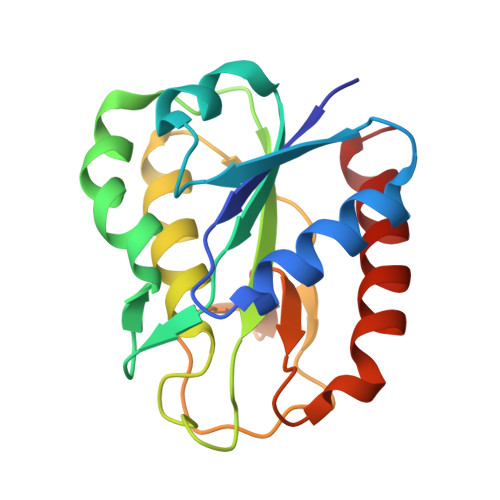
Enhancing the stability of highly stable proteins represents an interesting challenge in protein design. We have used the computational tool Protposer to rapidly achieve large additional stabilization of apoflavodoxin, a protein strongly thermostabilized over the years through protein engineering based on educated guesses. By rationally combining top-ranked mutations onto a previously stabilized variant (6 M), we have generated a series of new mutants and characterized their stability by thermal and chemical denaturation. Relative to the starting variant, the T m of 10 M apoflavodoxin is nearly 9 °C higher, while the simplified 3 M and 4 M mutants, showing improved refolding properties, display increases of 6/7.5 °C, respectively. The thermostabilizing effects of individual mutations are close to additive and translate into a large increase in conformational stability at 25.0 °C. Comparison of the x-ray structures of progressively stabilized WT, 6 M and 10 M flavodoxins reveals a concomitant mild trend toward shorter hydrogen bonds, reduced internal cavity volumes and narrower tunnels. Overall, these conformational changes are minor, and a functional assay confirms the mutants also preserve their catalytic activity. These findings demonstrate that even highly stable proteins can be further stabilized through rational design using a simple computational tool that automatically analyses PDB files and identifies stabilizing mutations.
- Biocomputation and Complex Systems Physics Institute (BIFI)-Joint Unit: GBsC-CSIC, University of Zaragoza, 50018 Zaragoza, Spain; Departamento de Bioquímica y Biología Molecular y Celular, Faculty of Science, University of Zaragoza, 50009 Zaragoza, Spain.
Organizational Affiliation: