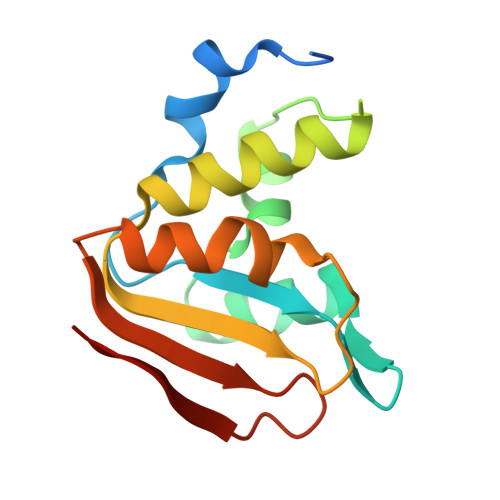
9RO8 | pdb_00009ro8

Pantoea ananatis encodes an antibacterial and anti-eukaryotic human CD38 homologue T6SS ADP-ribosyl cyclase polymorphic toxin


Experimental Data Snapshot

  • Method: X-RAY DIFFRACTION
  • Resolution: 1.59 Å
  • R-Value Free: 
    0.216 (Depositor), 0.216 (DCC) 
  • R-Value Work: 
    0.183 (Depositor), 0.183 (DCC) 
  • R-Value Observed: 
    0.185 (Depositor) 

Starting Model: in silico
View more details

wwPDB Validation 3D Report Full Report

Validation slider image for 9RO8

This is version 1.2 of the entry. See complete history

Literature

Widespread deployment of the human CD38 ADP-ribosyl cyclase fold in antibacterial and anti-eukaryotic polymorphic toxins.

Martinkus, J.Terradot, L.Jurenas, D.Cascales, E.

(2025) J Biological Chem 301: 110775-110775

  • DOI: https://doi.org/10.1016/j.jbc.2025.110775
  • Primary Citation Related Structures: 
    9RO8

  • PubMed Abstract: 

    Bacterial polymorphic toxins are modular weapons that mediate inter-microbial competition and host interactions by delivering diverse cytotoxic domains through specialized secretion systems. Here, we identify and characterize a novel toxin domain in Pantoea ananatis that displays remarkable structural and functional conservation with the human enzyme CD38. This bacterial toxin, fused to a type VI secretion system (T6SS) PAAR domain, harbors a C-terminal ADP-ribosyl cyclase (ARC) domain that hydrolyzes NAD + and NADP + in vitro and in vivo, leading to growth inhibition in both bacterial and eukaryotic cells. The 1.6-Å resolution structure of ARC reveals that it adopts a globular fold nearly identical to the human CD38 ADP ribosyl cyclase, with key catalytic residues conserved. Comparative genomics reveals that CD38-like ARC domains are widespread in bacteria, fused to diverse delivery modules including T6SS, T7SS, and CDI systems. Functional assays demonstrate that these domains act as NAD-depleting toxins, with cross-immunity observed between non-cognate toxin-immunity pairs. Taken together, our findings identify a bacterial NAD + hydrolase fold with strong similarity to human CD38 and define a novel class of metabolic toxins, expanding the functional scope of polymorphic effectors and illustrating how enzymes can be co-opted for microbial warfare.


  • Organizational Affiliation
    • Laboratoire d'Ingénierie des Systèmes Macromoléculaires (LISM), Aix-Marseille Université, CNRS, UMR 7255, Marseille, France.

Macromolecule Content 

  • Total Structure Weight: 32.85 kDa 
  • Atom Count: 2,308 
  • Modeled Residue Count: 258 
  • Deposited Residue Count: 298 
  • Unique protein chains: 1

Macromolecules

Find similar proteins by:|  3D Structure
Entity ID: 1
MoleculeChains  Sequence LengthOrganismDetailsImage
ADP-ribosylcyclase toxin
A, B
149Pantoea ananatis LMG 20103Mutation(s): 0 
Gene Names: PANA_2924
UniProt
Find proteins for D4GKQ2 (Pantoea ananatis (strain LMG 20103))
Explore D4GKQ2 
Go to UniProtKB:  D4GKQ2
Entity Groups
Sequence Clusters30% Identity50% Identity70% Identity90% Identity95% Identity100% Identity
UniProt GroupD4GKQ2
Sequence Annotations
Expand
Reference Sequence

Experimental Data & Validation

Experimental Data

  • Method: X-RAY DIFFRACTION
  • Resolution: 1.59 Å
  • R-Value Free:  0.216 (Depositor), 0.216 (DCC) 
  • R-Value Work:  0.183 (Depositor), 0.183 (DCC) 
  • R-Value Observed: 0.185 (Depositor) 
Space Group: P 21 21 21
Unit Cell:
Length ( Å )Angle ( ˚ )
a = 44.23α = 90
b = 70.213β = 90
c = 96.119γ = 90
Software Package:
Software NamePurpose
PHENIXrefinement
XDSdata reduction
Aimlessdata scaling
PHENIXphasing

Structure Validation

View Full Validation Report


Entry History 

& Funding Information

Deposition Data


Funding OrganizationLocationGrant Number
Fonds National de la Recherche Scientifique (FNRS)BelgiumFNRS-MIS F4526.23
Walloon Excellence in Lifesciences & BIOtechnology (WELBIO)BelgiumSTG-X.251
Agence Nationale de la Recherche (ANR)FranceANR-20-CE11-0017
Fondation pour la Recherche Medicale (FRM)FranceDEQ20180339165

Revision History  (Full details and data files)

  • Version 1.0: 2025-10-01
    Type: Initial release
  • Version 1.1: 2025-10-08
    Changes: Database references
  • Version 1.2: 2025-11-12
    Changes: Database references