Download Mendeley
In silico docking yields small molecule negative allosteric modulators targeting the core of Frizzled 7.
Scharf, M.M., Kinsolving, J., Gratz, L., Voss, J.H., Carrasco-Busturia, D., Forsberg, B., Kolb, P., Schulte, G.(2025) Nat Commun 16: 11138-11138
- PubMed: 41392205 Search on PubMedSearch on PubMed Central
- DOI: https://doi.org/10.1038/s41467-025-67147-z
- Primary Citation Related Structures:
9RHG - PubMed Abstract:
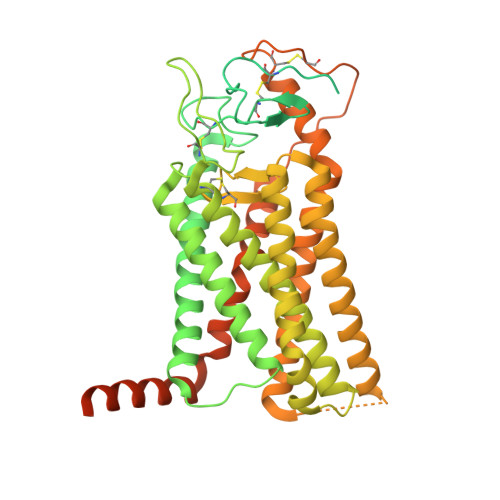
Targeting the Frizzled family (FZD 1-10 ) of WNT receptors pharmacologically has, despite substantial therapeutic potential, proven difficult. Given an almost complete lack of validated, effective small molecules targeting FZDs, no putative ligand binding site has so far been identified. In order to target FZD 7 , a potential target for the treatment of intestinal tumors, we combine an approach of adapted docking setups and large molecular library docking screens, identifying compound C407. Applying pharmacological assays, genetically-encoded biosensors, site-directed mutagenesis, cryo-electron microscopy and molecular dynamics simulations, the compound binding site in the core of the seven transmembrane bundle is validated and C407 is confirmed as a negative allosteric modulator of WNT-induced and FZD-mediated WNT/β-catenin signaling. In summary, we provide here the proof-of-principle that targeting FZDs with small molecule compounds is possible and effective. Future hit optimization and functional validation in disease-relevant in vitro and in vivo models will pave the way towards clinical exploration.
- Department of Physiology & Pharmacology, Sec Receptor Biology & Signaling, Biomedicum, Karolinska Institute, Stockholm, Sweden.
Organizational Affiliation: