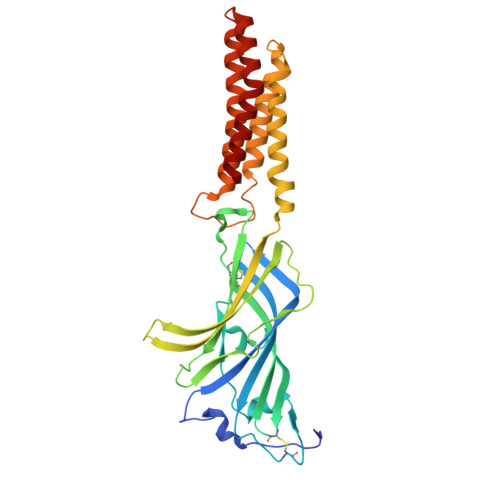
9RGN | pdb_00009rgn

SsCl at pH 6.5 + IVM - Partially opened


Experimental Data Snapshot

  • Method: ELECTRON MICROSCOPY
  • Resolution: 3.10 Å
  • Aggregation State: PARTICLE 
  • Reconstruction Method: SINGLE PARTICLE 

wwPDB Validation 3D Report Full Report

Validation slider image for 9RGN

This is version 1.2 of the entry. See complete history

Literature

Structure of a pH-sensitive pentameric ligand-gated ion channel from the Sarcoptes scabies mite.

Kleiz-Ferreira, J.Brams, M.Harrison, P.J.Gallagher, C.I.Nys, M.Donze, Y.Quigley, A.Bertrand, D.Ulens, C.

(2026) Nat Commun 17

  • DOI: https://doi.org/10.1038/s41467-026-70575-0
  • Primary Citation Related Structures: 
    9RGM, 9RGN, 9RGO, 9RGP

  • PubMed Abstract: 

    Scabies is a skin infestation caused by the mite Sarcoptes scabiei and represents a substantial global health burden exacerbated by emerging resistance to ivermectin. An anionic pentameric ligand-gated ion channel from the mite, SsCl, shows pH-sensitivity and is significantly modulated by ivermectin. Here, we use cryo-EM and electrophysiology to explore the pH-sensing mechanisms of SsCl and the impact of ivermectin on channel activity. Structures of SsCl were resolved in closed (pH 6.5) and desensitized (pH 9) states, alongside ivermectin-bound conformations. The desensitized structure adopts an unexpected hourglass conformation, suggesting a gating mechanism closer related to cation-selective channels. Structural analysis and mutagenesis identify extracellular histidine and glutamic acid residues that impact the pH-sensitivity, likely contributing to a broader pH-sensing network. Ivermectin-bound structures reveal pH-dependent modulation, enhancing open-state prevalence at pH 9 and enabling atypical activation at pH 6.5. These findings offer initial insights into SsCl's pH-sensitivity and ivermectin's activity, informing next-generation antiparasitic design.


  • Organizational Affiliation
    • Laboratory of Structural Neurobiology, Department of Cellular and Molecular Medicine, Faculty of Medicine, KU Leuven, Leuven, Belgium. jessica.kleiz@kuleuven.be.

Macromolecule Content 

  • Total Structure Weight: 203.2 kDa 
  • Atom Count: 14,256 
  • Modeled Residue Count: 1,655 
  • Deposited Residue Count: 1,665 
  • Unique protein chains: 1

Macromolecules

Find similar proteins by:|  3D Structure
Entity ID: 1
MoleculeChains  Sequence LengthOrganismDetailsImage
pH gated chloride channel
A, B, C, D, E
333Sarcoptes scabieiMutation(s): 0 
UniProt
Find proteins for A8SDP7 (Sarcoptes scabiei)
Explore A8SDP7 
Go to UniProtKB:  A8SDP7
Entity Groups
Sequence Clusters30% Identity50% Identity70% Identity90% Identity95% Identity100% Identity
UniProt GroupA8SDP7
Sequence Annotations
Expand
Reference Sequence

Small Molecules

Ligands 1 Unique
IDChains Name / Formula / InChI Key2D Diagram3D Interactions
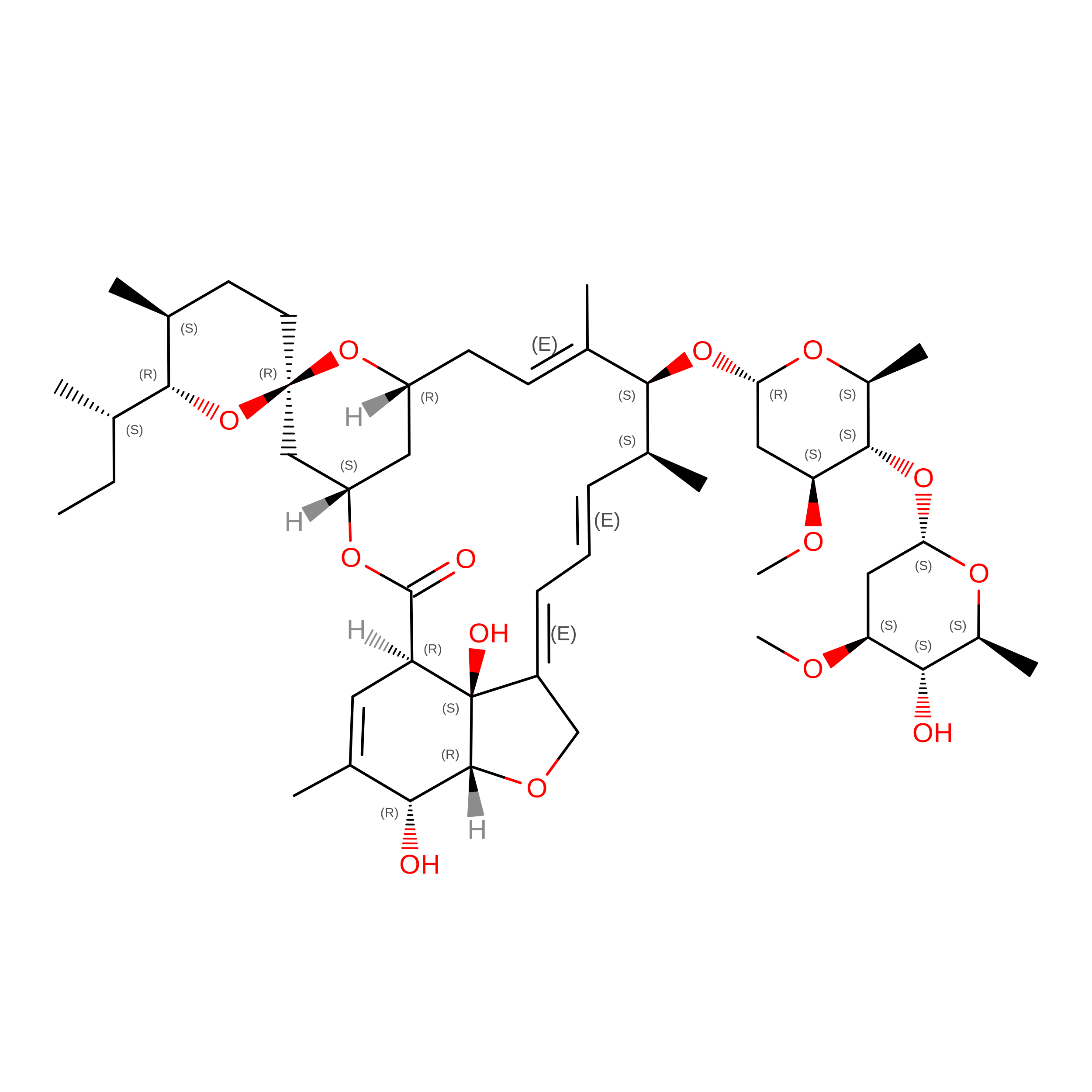
IVM
(Subject of Investigation/LOI)

Query on IVM


Download:Ideal Coordinates CCD File
F [auth A],
G [auth A],
H [auth B],
I [auth C],
J [auth D]
(2aE,4E,5'S,6S,6'R,7S,8E,11R,13R,15S,17aR,20R,20aR,20bS)-6'-[(2S)-butan-2-yl]-20,20b-dihydroxy-5',6,8,19-tetramethyl-17 -oxo-3',4',5',6,6',10,11,14,15,17,17a,20,20a,20b-tetradecahydro-2H,7H-spiro[11,15-methanofuro[4,3,2-pq][2,6]benzodioxacy clooctadecine-13,2'-pyran]-7-yl 2,6-dideoxy-4-O-(2,6-dideoxy-3-O-methyl-alpha-L-arabino-hexopyranosyl)-3-O-methyl-alpha-L-arabino-hexopyranoside
C48 H74 O14
AZSNMRSAGSSBNP-XPNPUAGNSA-N

Experimental Data & Validation

Experimental Data

  • Method: ELECTRON MICROSCOPY
  • Resolution: 3.10 Å
  • Aggregation State: PARTICLE 
  • Reconstruction Method: SINGLE PARTICLE 
EM Software:
TaskSoftware PackageVersion
RECONSTRUCTIONcryoSPARC

Structure Validation

View Full Validation Report


Entry History 

& Funding Information

Deposition Data


Funding OrganizationLocationGrant Number
KU LeuvenBelgiumC14/23/128
Research Foundation - Flanders (FWO)BelgiumG087921N

Revision History  (Full details and data files)

  • Version 1.0: 2026-03-18
    Type: Initial release
  • Version 1.1: 2026-03-25
    Changes: Data collection, Database references, Structure summary
  • Version 1.2: 2026-04-22
    Changes: Data collection, Database references