Download Mendeley
Structural mechanism and inhibitor discovery for DhhP, a Borrelia burgdorferi cyclic di-AMP phosphodiesterase with an Fe/Mn bimetallic center.
Klima, M., Dejmek, M., Palusova, A., Chalupska, D., Pachl, P., Huskova, A., Hranicek, J., Chalupsky, K., Moos, M., Nencka, R., Perner, J., Boura, E.(2026) Structure 34: 758-767.e4
- PubMed: 41742401 Search on PubMed
- DOI: https://doi.org/10.1016/j.str.2026.01.016
- Primary Citation Related Structures:
9R7O, 9R97, 9R98, 9R99 - PubMed Abstract:
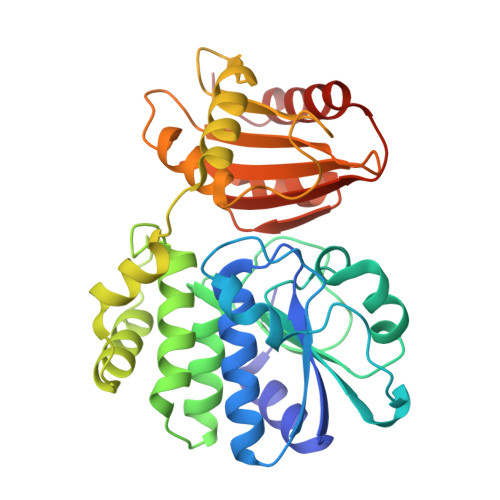
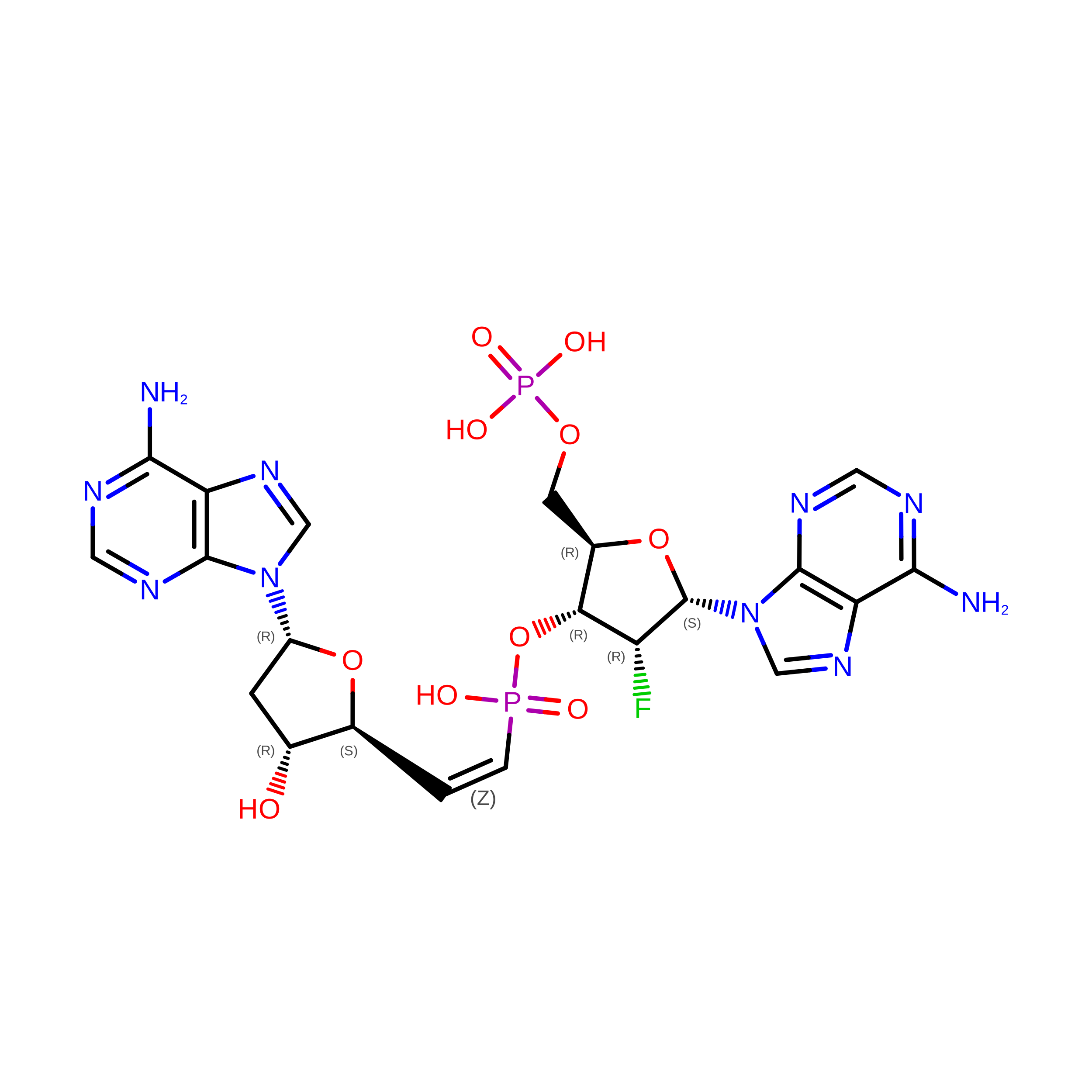
Second messenger signaling through cyclic dinucleotides regulates critical processes in pathogenic bacteria. DhhP is a phosphodiesterase that regulates levels of cyclic di-AMP (c-di-AMP), an essential second messenger, in Borrelia. Genetic inhibition of DhhP is lethal to Borrelia both in vitro and within a mammalian host. Here, we present the crystal structure of DhhP, revealing a heterobimetallic active site containing precisely positioned manganese and iron ions. We demonstrate specific binding sites for each metal, challenging the prevailing paradigm of homobimetallic active centers in bacterial c-di-AMP phosphodiesterases. The enzyme forms asymmetric dimers with coordinated open and closed conformations, suggesting an alternating mechanism for substrate processing. Additionally, we identified and characterized a series of small-molecule inhibitors of DhhP and demonstrated their ability to inhibit the growth of B. burgdorferi and disrupt spirochete morphology. These compounds establish proof of concept for specific targeting of bacterial c-di-AMP phosphodiesterases and further research of c-di-AMP roles in bacterial cells.
- Institute of Organic Chemistry and Biochemistry, Czech Academy of Sciences, Prague, Czech Republic. Electronic address: klima@uochb.cas.cz.
Organizational Affiliation: