Download Mendeley
A viral SAVED protein with ring nuclease activity degrades the CRISPR second messenger cA4.
Orzechowski, M., Hoikkala, V., Chi, H., McMahon, S., Gloster, T., White, M.F.(2025) Biochem J 482: 1707-1719
- PubMed: 41190788 Search on PubMed
- DOI: https://doi.org/10.1042/BCJ20253271
- Primary Citation Related Structures:
9R8S - PubMed Abstract:
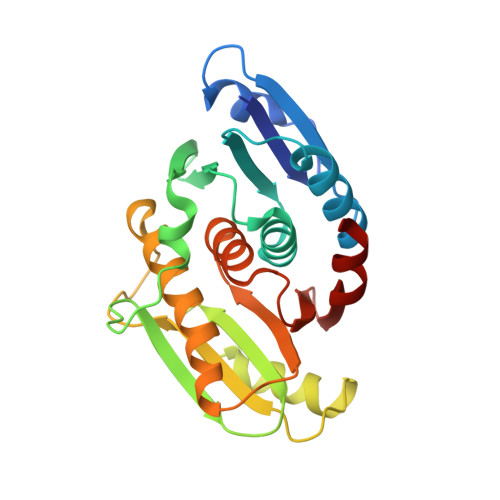
Type III CRISPR systems typically generate cyclic oligoadenylate second messengers such as cyclic tetra-adenylate (cA4) on detection of foreign RNA. These activate ancillary effector proteins which elicit a diverse range of immune responses. The Calp (CRISPR associated Lon protease) system elicits a transcriptional response to infection when CalpL (Calp Lon protease) binds cA4 in its SAVED (SMODS associated and fused to various effectors domain) sensor domain, resulting in filament formation and activation of the Lon protease domain, which cleaves the anti-Sigma factor CalpT, releasing the CalpS (Calp Sigma factor) for transcriptional remodelling. Here, we show that thermophilic viruses have appropriated the SAVED domain of CalpL as an anti-CRISPR, AcrIII-2 (second anti-CRISPR of type III systems), which they use to degrade cA4. AcrIII-2 dimers sandwich cA4, degrading it in a shared active site to short linear products, using a mechanism highly reminiscent of CalpL. This results in inhibition of a range of cA4 activated effectors in vitro. This is the first example of a virally encoded SAVED domain with ring nuclease activity, highlighting the complex interplay between viruses and cellular defences.
- School of Biology, University of St Andrews, North Haugh, St Andrews, KY16 9ST, U.K.
Organizational Affiliation: