Download Mendeley
Targeting autocrine retinoic acid signaling by ALDH1A2 inhibition enhances antitumor dendritic cell vaccine efficacy.
Fang, C., Esposito, M., Hars, U., Byrne, R.T., Song, B., Huang, J., Roichman, A., Shue, L., Cheng, X., Proudfoot, J., Zhao, D., Wei, Y., Cristea, I.M., Rabinowitz, J.D., Kang, Y.(2026) Nat Immunol 27: 250-264
- PubMed: 41491403 Search on PubMedSearch on PubMed Central
- DOI: https://doi.org/10.1038/s41590-025-02376-4
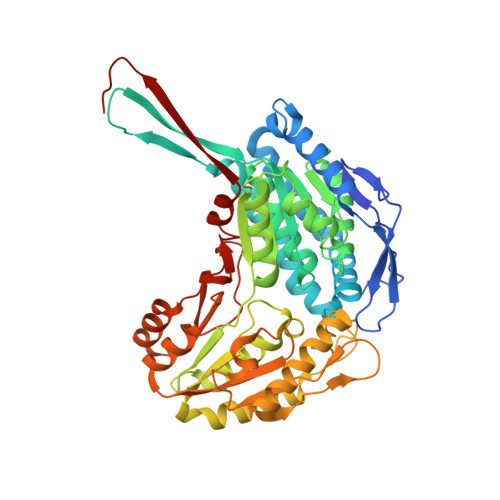
- Primary Citation Related Structures:
9R6N - PubMed Abstract:
Strategies to stimulate dendritic cell (DC) activity, such as ex vivo generation and priming of DC vaccines, have been explored as cancer immunotherapies owing to their potential to elicit antitumor T cell responses. Despite decades of research, the success of DC vaccines has been limited, potentially because of unidentified tolerance-enforcing mechanisms. Here we show that GM-CSF-IL-4-induced differentiating DCs express ALDH1A2 and produce retinoic acid, inhibiting DC maturation. Genetic knockout of Aldh1a2 releases this natural brake and enhances DC function. We further develop an ALDH1A2 inhibitor with high potency, favorable drug-like properties and no evidence of off-target effects. Treatment with this inhibitor promotes DC activity, which in turn enhances antigen-specific T cell responses, improving the efficacy of DC vaccines. Our study demonstrates the unique role of the ALDH1A2-retinoic acid axis in regulating DC functions and further presents a new small-molecule inhibitor of ALDH1A2 as a potential immunotherapeutic agent for cancer.
- Department of Molecular Biology, Princeton University, Princeton, NJ, USA.
Organizational Affiliation: