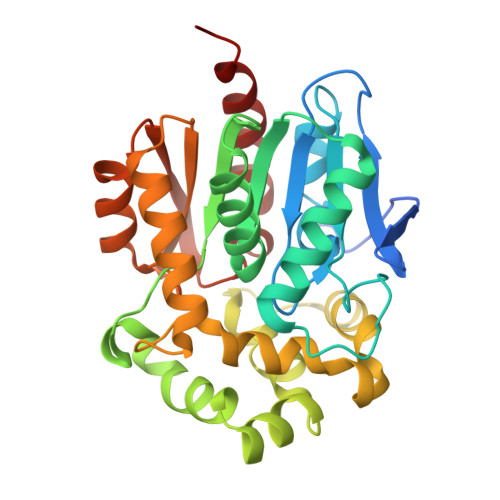
9R40 | pdb_00009r40

HaloTag bound to compound MRC71


Experimental Data Snapshot

  • Method: X-RAY DIFFRACTION
  • Resolution: 2.04 Å
  • R-Value Free: 
    0.286 (Depositor), 0.283 (DCC) 
  • R-Value Work: 
    0.237 (Depositor), 0.233 (DCC) 

Starting Model: experimental
View more details

wwPDB Validation 3D Report Full Report

Validation slider image for 9R40

Ligand Structure Quality Assessment 


This is version 2.0 of the entry. See complete history

Literature

State-selective small molecule degraders that preferentially remove aggregates and oligomers.

Luptak, J.Clift, D.Mukadam, A.Benn, J.Rhinesmith, T.McLaughlin, S.H.Dodds, A.C.Lapetaje, J.E.Sczaniecka-Clift, M.France, D.J.McEwan, W.A.James, L.C.

(2025) Nat Commun 16: 10486-10486

  • DOI: https://doi.org/10.1038/s41467-025-65454-z
  • Primary Citation Related Structures: 
    9Q9O, 9Q9P, 9Q9Q, 9Q9R, 9R40

  • PubMed Abstract: 

    TRIM21 is a unique E3 ligase that uses a clustering-based activation mechanism to degrade complex multimeric substrates. This activity underpins the targeted protein degradation technology Trim-Away and genetically encoded degraders that selectively target aggregated tau protein and prevent tauopathy. Here we describe small molecules that mimic TRIM21's natural epitope and function as either effective inhibitors or potent and selective degraders called TRIMTACs. TRIMTACs mediate degradation as rapidly as PROTACs but can also selectively degrade specific protein pools depending on assembly state. We demonstrate the utility of this state-specific degradation by selectively removing the pro-inflammatory signalling protein Myd88 when assembled into the Myddosome and the cell-death protein RIPK3 when polymerised into the Necrosome. We further show that TRIMTACs can inhibit seeded tau aggregation under conditions where a PROTAC is ineffective. These results highlight that TRIM21's clustering-based activation can be exploited by small molecule degraders to carry out state-selective degradation of therapeutic targets.


  • Organizational Affiliation
    • MRC Laboratory of Molecular Biology, Francis Crick Avenue, Cambridge, UK.

Macromolecule Content 

  • Total Structure Weight: 35.66 kDa 
  • Atom Count: 2,459 
  • Modeled Residue Count: 293 
  • Deposited Residue Count: 306 
  • Unique protein chains: 1

Macromolecules

Find similar proteins by:|  3D Structure
Entity ID: 1
MoleculeChains  Sequence LengthOrganismDetailsImage
Haloalkane dehalogenase306Rhodococcus sp. (in: high G+C Gram-positive bacteria)Mutation(s): 0 
Gene Names: dhaA
EC: 3.8.1.5
UniProt
Find proteins for P0A3G3 (Rhodococcus sp)
Explore P0A3G3 
Go to UniProtKB:  P0A3G3
Entity Groups
Sequence Clusters30% Identity50% Identity70% Identity90% Identity95% Identity100% Identity
UniProt GroupP0A3G3
Sequence Annotations
Expand
Reference Sequence

Small Molecules

Ligands 2 Unique
IDChains Name / Formula / InChI Key2D Diagram3D Interactions
A1JC1
(Subject of Investigation/LOI)

Query on A1JC1


Download:Ideal Coordinates CCD File
C [auth A](2~{S},4~{S})-1-[(3~{S})-3-azanyl-3-(2-methoxyphenyl)propanoyl]-~{N}-[(2~{R})-1-[2-[2-[2-[2-(6-chloranylhexoxy)ethoxy]ethoxy]ethoxy]ethylamino]-1-oxidanylidene-3-pyridin-4-yl-propan-2-yl]-4-cyclohexyl-pyrrolidine-2-carboxamide
C43 H66 Cl N5 O8
NRBOBAOLCBJHID-ZACWFTDDSA-N
CL

Query on CL


Download:Ideal Coordinates CCD File
B [auth A]CHLORIDE ION
Cl
VEXZGXHMUGYJMC-UHFFFAOYSA-M

Experimental Data & Validation

Experimental Data

  • Method: X-RAY DIFFRACTION
  • Resolution: 2.04 Å
  • R-Value Free:  0.286 (Depositor), 0.283 (DCC) 
  • R-Value Work:  0.237 (Depositor), 0.233 (DCC) 
Space Group: P 43 21 2
Unit Cell:
Length ( Å )Angle ( ˚ )
a = 62.797α = 90
b = 62.797β = 90
c = 163.274γ = 90
Software Package:
Software NamePurpose
REFMACrefinement
xia2data reduction
xia2data scaling
PHASERphasing

Structure Validation

View Full Validation Report


Ligand Structure Quality Assessment 


Entry History 

& Funding Information

Deposition Data

  • Released Date: 2025-10-08 
  • Deposition Author(s): Luptak, J.

Funding OrganizationLocationGrant Number
Medical Research Council (MRC, United Kingdom)United Kingdom--

Revision History  (Full details and data files)

  • Version 1.0: 2025-10-08
    Type: Initial release
  • Version 2.0: 2026-04-22
    Changes: Atomic model, Database references