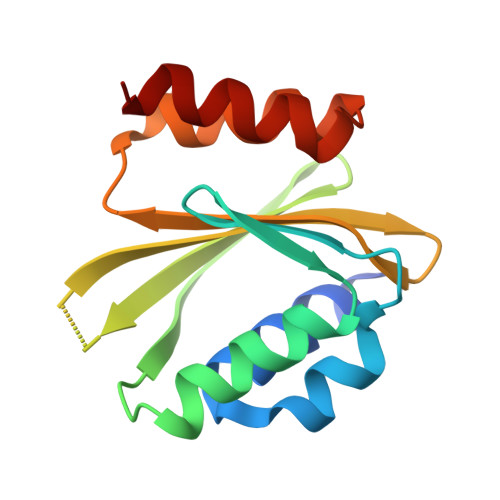
9R00 | pdb_00009r00

De novo NTF2-like protein with a 2-helix C-terminal extension.


Experimental Data Snapshot

  • Method: X-RAY DIFFRACTION
  • Resolution: 2.00 Å
  • R-Value Free: 
    0.264 (Depositor), 0.270 (DCC) 
  • R-Value Work: 
    0.216 (Depositor), 0.227 (DCC) 
  • R-Value Observed: 
    0.220 (Depositor) 

Starting Model: in silico
View more details

wwPDB Validation   3D Report Full Report


This is version 1.0 of the entry. See complete history


Literature

Buttressing ligand-binding pockets in de novo designed NTF2-like domains.

Nadal, M.Albi-Puig, J.Castellvi, A.Garcia-Franco, P.M.Vega, S.Velazquez-Campoy, A.Marcos, E.

(2025) Protein Sci 34: e70323-e70323

  • DOI: https://doi.org/10.1002/pro.70323
  • Primary Citation of Related Structures:  
    9QZD, 9R00, 9R0T, 9R0Z, 9R17

  • PubMed Abstract: 

    NTF2-like proteins are compact α + β fold domains with cone-shaped architectures and internal pockets, making them attractive scaffolds for the de novo design of small-molecule binders and enzymes. However, creating ligand-binding pockets often compromises folding stability, posing a key challenge in de novo protein design. Here, we introduce strategies to stabilize NTF2-like domains while preserving pocket geometry and accessibility. By expanding the hydrophobic core through computationally designed α-helical subdomains or homodimer interfaces buttressing the β-sheet's convex face, we enhance structural stability without blocking pocket access on the concave face. Biochemical, biophysical, and crystallographic analyses confirm that the designed buttressing elements maintain the intended fold and support diverse, well-formed hydrophobic ligand-binding pockets with increased preorganization. Our results demonstrate that structural stabilization and pocket optimization need not be mutually exclusive, providing a generalizable approach to create robust ligand-binding proteins. This framework addresses a major bottleneck in protein design and should fuel the development of NTF2-based scaffolds for applications in small-molecule biosensing and enzyme catalysis.


  • Organizational Affiliation
    • Protein Design and Modeling Lab, Department of Structural and Molecular Biology, Molecular Biology Institute of Barcelona (IBMB), CSIC, Barcelona, Spain.

Macromolecules
Find similar proteins by:  (by identity cutoff)  |  3D Structure
Entity ID: 1
MoleculeChains Sequence LengthOrganismDetailsImage
NTF2_HH138synthetic constructMutation(s): 0 
Entity Groups  
Sequence Clusters30% Identity50% Identity70% Identity90% Identity95% Identity100% Identity
Sequence Annotations
Expand
  • Reference Sequence
Small Molecules
Ligands 2 Unique
IDChains Name / Formula / InChI Key2D Diagram3D Interactions
CD
Query on CD

Download Ideal Coordinates CCD File 
B [auth A]
C [auth A]
D [auth A]
E [auth A]
F [auth A]
B [auth A],
C [auth A],
D [auth A],
E [auth A],
F [auth A],
G [auth A],
H [auth A]
CADMIUM ION
Cd
WLZRMCYVCSSEQC-UHFFFAOYSA-N
CL
Query on CL

Download Ideal Coordinates CCD File 
I [auth A],
J [auth A],
K [auth A],
L [auth A]
CHLORIDE ION
Cl
VEXZGXHMUGYJMC-UHFFFAOYSA-M
Experimental Data & Validation

Experimental Data

  • Method: X-RAY DIFFRACTION
  • Resolution: 2.00 Å
  • R-Value Free:  0.264 (Depositor), 0.270 (DCC) 
  • R-Value Work:  0.216 (Depositor), 0.227 (DCC) 
  • R-Value Observed: 0.220 (Depositor) 
Space Group: I 2 2 2
Unit Cell:
Length ( Å )Angle ( ˚ )
a = 40.397α = 90
b = 61.043β = 90
c = 96.117γ = 90
Software Package:
Software NamePurpose
REFMACrefinement
XDSdata reduction
Aimlessdata scaling
MOLREPphasing

Structure Validation

View Full Validation Report


Entry History & Funding Information

Deposition Data


Funding OrganizationLocationGrant Number
Spanish Ministry of Science, Innovation, and UniversitiesSpainRYC2018-025295-I
Spanish Ministry of Science, Innovation, and UniversitiesSpainEUR2020-112164
Spanish Ministry of Science, Innovation, and UniversitiesSpainCNS2023-144990

Revision History  (Full details and data files)

  • Version 1.0: 2025-10-22
    Type: Initial release