Download Mendeley
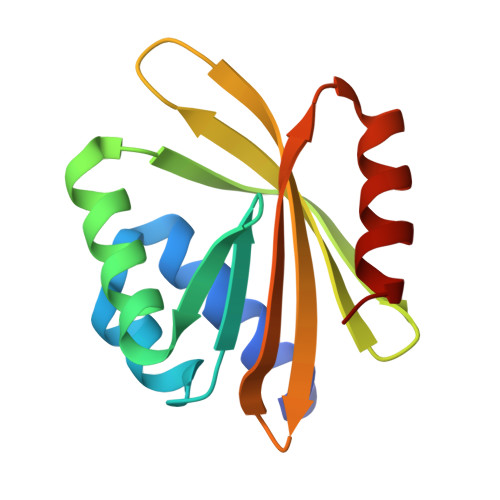
Buttressing ligand-binding pockets in de novo designed NTF2-like domains.
Nadal, M., Albi-Puig, J., Castellvi, A., Garcia-Franco, P.M., Vega, S., Velazquez-Campoy, A., Marcos, E.(2025) Protein Sci 34: e70323-e70323
- PubMed: 41074781 Search on PubMedSearch on PubMed Central
- DOI: https://doi.org/10.1002/pro.70323
- Primary Citation Related Structures:
9QZD, 9R00, 9R0T, 9R0Z, 9R17 - PubMed Abstract:
NTF2-like proteins are compact α + β fold domains with cone-shaped architectures and internal pockets, making them attractive scaffolds for the de novo design of small-molecule binders and enzymes. However, creating ligand-binding pockets often compromises folding stability, posing a key challenge in de novo protein design. Here, we introduce strategies to stabilize NTF2-like domains while preserving pocket geometry and accessibility. By expanding the hydrophobic core through computationally designed α-helical subdomains or homodimer interfaces buttressing the β-sheet's convex face, we enhance structural stability without blocking pocket access on the concave face. Biochemical, biophysical, and crystallographic analyses confirm that the designed buttressing elements maintain the intended fold and support diverse, well-formed hydrophobic ligand-binding pockets with increased preorganization. Our results demonstrate that structural stabilization and pocket optimization need not be mutually exclusive, providing a generalizable approach to create robust ligand-binding proteins. This framework addresses a major bottleneck in protein design and should fuel the development of NTF2-based scaffolds for applications in small-molecule biosensing and enzyme catalysis.
- Protein Design and Modeling Lab, Department of Structural and Molecular Biology, Molecular Biology Institute of Barcelona (IBMB), CSIC, Barcelona, Spain.
Organizational Affiliation: