Download Mendeley
C2 alpha-carbanion-protonating glutamate discloses tradeoffs between substrate accommodation and reaction rate in actinobacterial 2-hydroxyacyl-CoA lyase.
Zahn, M., Seroka, B., Lazny, R., Lotowski, Z., Rohwerder, T.(2026) FEBS Open Bio 16: 1314-1327
- PubMed: 41606311 Search on PubMedSearch on PubMed Central
- DOI: https://doi.org/10.1002/2211-5463.70199
- Primary Citation Related Structures:
9QZ4, 9QZ5, 9QZ6, 9QZ7 - PubMed Abstract:
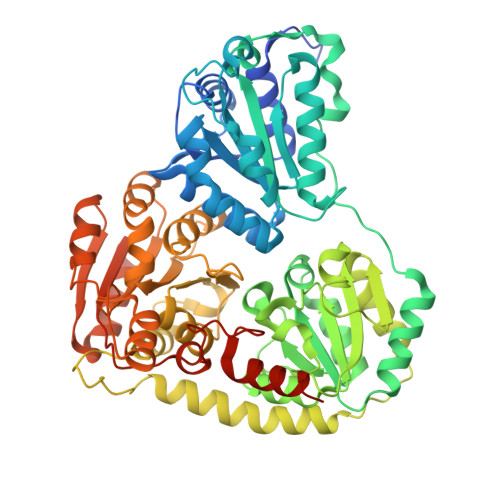
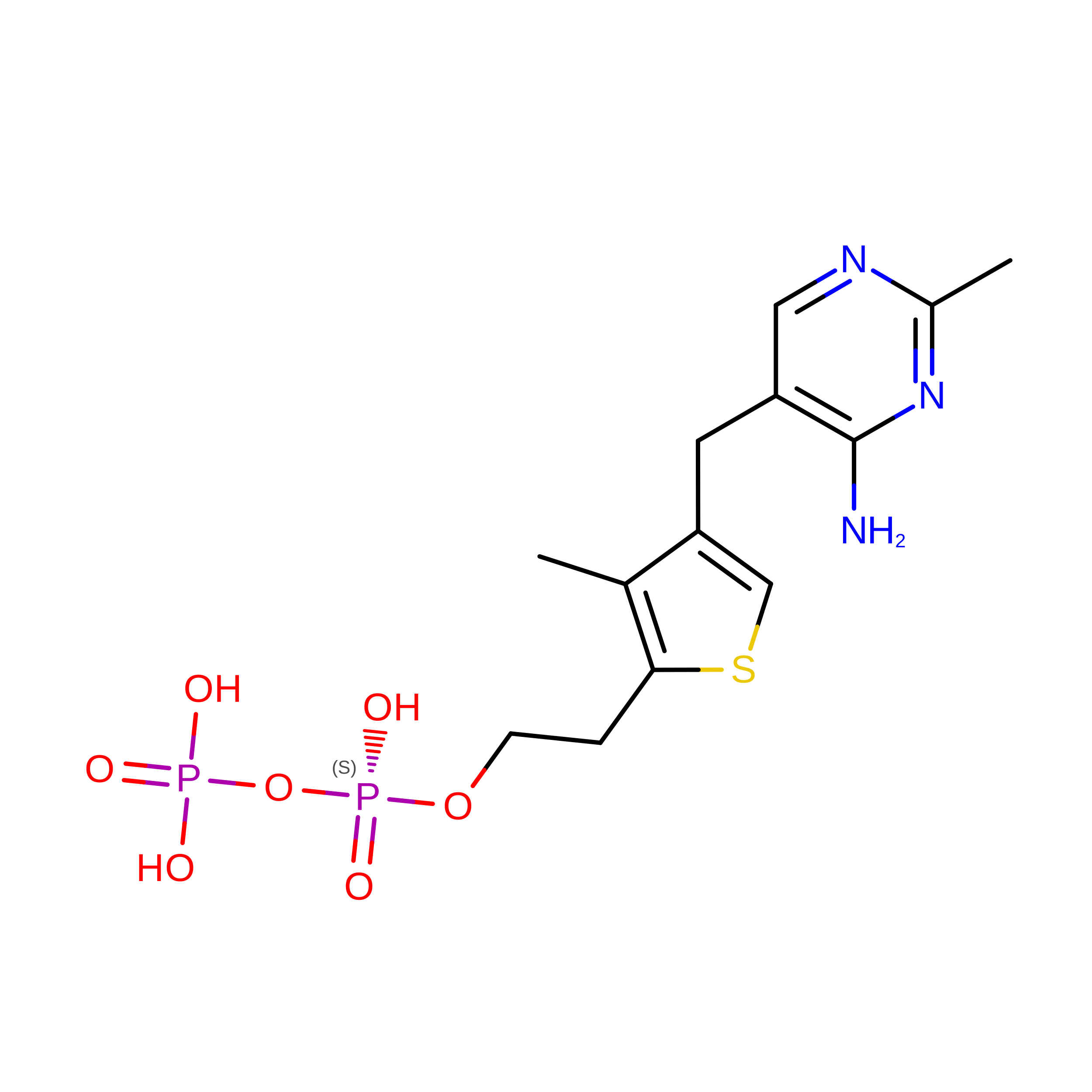
Thiamine-dependent actinobacterial 2-hydroxyacyl-CoA lyase (AcHACL) catalyzes the reversible cleavage of 2-hydroxyacyl-CoAs to formyl-CoA and carbonyl compounds. To exploit the enzyme's biotechnological potential, a deeper understanding of the catalysis is required. Previously, AcHACL E493 was identified as an important acid/base catalyst. Here, wild-type and E493 mutant crystal structures representing Michaelis complexes with 2-hydroxyisobutyryl-CoA and (S)-2-methylglyceryl-CoA are provided. Although E493 guarantees high rates of essential proton transfers in AcAHCL-catalyzed on-pathway cleavage of 2-hydroxyacyl-CoAs and off-pathway carboligations with short-chain aldehydes and ketones, wild-type substrate accommodation is suboptimal. Not E493D, but E493A and E493S mutations improved K M . However, k cat is substantially reduced in the mutants. These tradeoffs are discussed by comparing active sites of AcHACL and related enzymes either lacking or possessing an E493 homolog.
- Centre for Enzyme Innovation, School of the Environment and Life Sciences, University of Portsmouth, UK.
Organizational Affiliation: