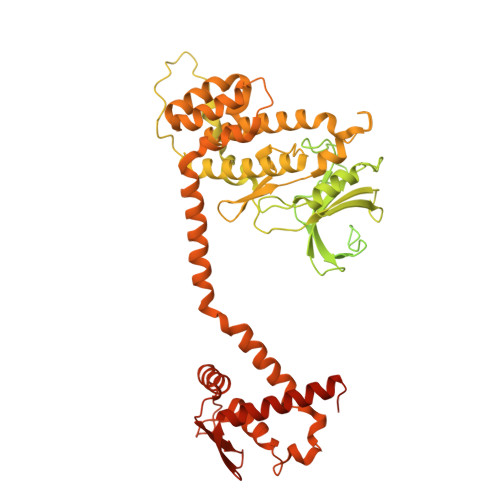
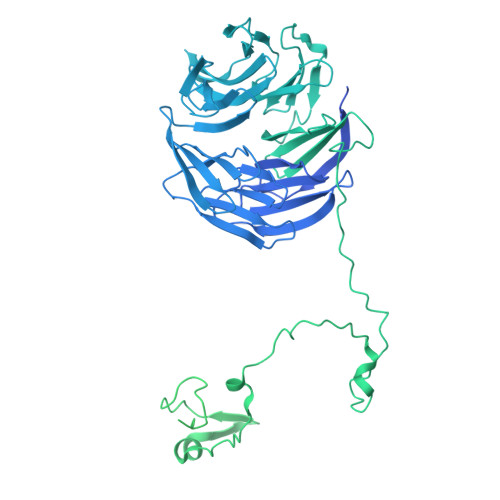
9QTU | pdb_00009qtu

human PAN2-PAN3 deadenylase complex in the apo state


Experimental Data Snapshot

  • Method: ELECTRON MICROSCOPY
  • Resolution: 4.60 Å
  • Aggregation State: PARTICLE 
  • Reconstruction Method: SINGLE PARTICLE 

Starting Model: in silico
View more details

wwPDB Validation   3D Report Full Report


This is version 1.0 of the entry. See complete history


Literature

Mechanisms governing poly(A)-tail-length specificity of the human PAN2-PAN3 deadenylase complex.

Albrecht, J.C.Reitinger, T.Basquin, J.Schussler, S.Riggi, M.Schafer, I.B.Conti, E.

(2025) Cell Rep 44: 116609-116609

  • DOI: https://doi.org/10.1016/j.celrep.2025.116609
  • Primary Citation of Related Structures:  
    9QTU

  • PubMed Abstract: 

    The lifespan of most eukaryotic mRNAs is modulated by the gradual shortening of the poly(A) tail and removal of the associated poly(A)-binding protein. The human PAN2-PAN3 complex catalyzes initial deadenylation by shortening long poly(A) tails associated with PABPC1. Both PAN2-PAN3 and PABPC1 are evolutionarily conserved from fungi to humans. How the human complex has adapted to recognize and act on longer poly(A) tails characteristic of mammalian mRNAs remains unclear. Here, we report a method to obtain homo-polymeric poly(A) RNAs up to 240 nt, mimicking the synthesis length of poly(A) tails in mammals. We recapitulate human deadenylation properties in vitro, with PAN2-PAN3 showing greater activity on long poly(A)-PABPC1 ribonucleoprotein substrates. Single-particle cryo-electron microscopy (cryo-EM) analyses of PAN2-PAN3 bound to poly(A)-PABPC1 ribonucleoproteins uncover a longer substrate-binding path in the case of the human deadenylase compared to fungi. Altogether, these data provide a rationale for the co-evolution of deadenylase properties and poly(A) tail lengths.


  • Organizational Affiliation
    • Department of Structural Cell Biology, Max Planck Institute of Biochemistry, Am Klopferspitz 18, Martinsried, 82152 Munich, Germany.

Macromolecules
Find similar proteins by:  (by identity cutoff)  |  3D Structure
Entity ID: 1
MoleculeChains Sequence LengthOrganismDetailsImage
Isoform 3 of PAN2-PAN3 deadenylation complex subunit PAN3
A, B
863Homo sapiensMutation(s): 0 
Gene Names: PAN3
UniProt & NIH Common Fund Data Resources
Find proteins for Q58A45 (Homo sapiens)
Explore Q58A45 
Go to UniProtKB:  Q58A45
PHAROS:  Q58A45
GTEx:  ENSG00000152520 
Entity Groups  
Sequence Clusters30% Identity50% Identity70% Identity90% Identity95% Identity100% Identity
UniProt GroupQ58A45
Sequence Annotations
Expand
  • Reference Sequence
Find similar proteins by:  (by identity cutoff)  |  3D Structure
Entity ID: 2
MoleculeChains Sequence LengthOrganismDetailsImage
PAN2-PAN3 deadenylation complex catalytic subunit PAN21,202Homo sapiensMutation(s): 1 
Gene Names: PAN2KIAA0710USP52
EC: 3.1.13.4
UniProt & NIH Common Fund Data Resources
Find proteins for Q504Q3 (Homo sapiens)
Explore Q504Q3 
Go to UniProtKB:  Q504Q3
PHAROS:  Q504Q3
GTEx:  ENSG00000135473 
Entity Groups  
Sequence Clusters30% Identity50% Identity70% Identity90% Identity95% Identity100% Identity
UniProt GroupQ504Q3
Sequence Annotations
Expand
  • Reference Sequence
Experimental Data & Validation

Experimental Data

  • Method: ELECTRON MICROSCOPY
  • Resolution: 4.60 Å
  • Aggregation State: PARTICLE 
  • Reconstruction Method: SINGLE PARTICLE 
EM Software:
TaskSoftware PackageVersion
MODEL REFINEMENTPHENIX1.21.2_5419
RECONSTRUCTIONcryoSPARC4

Structure Validation

View Full Validation Report


Entry History & Funding Information

Deposition Data


Funding OrganizationLocationGrant Number
European Research Council (ERC)European Union740329
European Research Council (ERC)European Union101054447
German Research Foundation (DFG)GermanySFB1035
Novo Nordisk FoundationDenmark31199
German Federal Ministry for Education and ResearchGermanyDZD

Revision History  (Full details and data files)

  • Version 1.0: 2025-12-10
    Type: Initial release