9PWQ | pdb_00009pwq

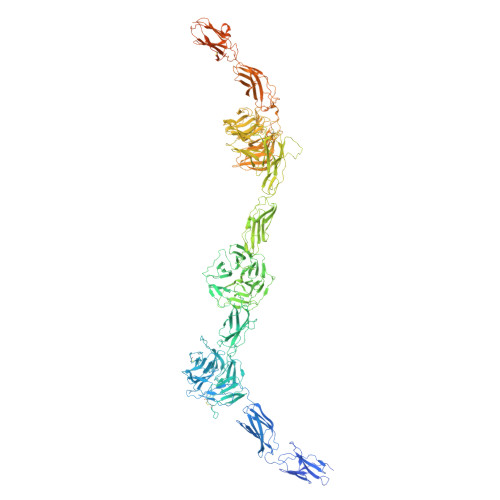
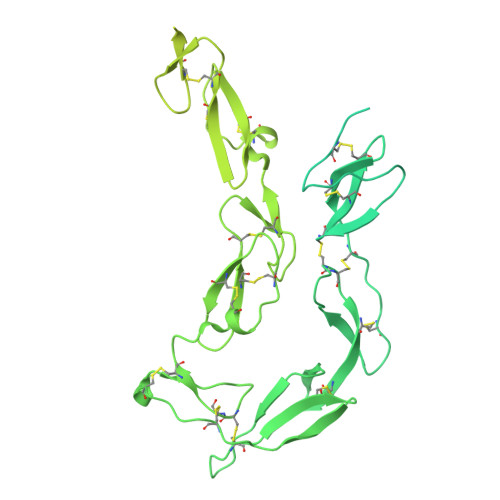
Cryo-EM structure of receptor tyrosine kinase ROS1 extracellular domain in complex with NELL2


Experimental Data Snapshot

  • Method: ELECTRON MICROSCOPY
  • Resolution: 4.45 Å
  • Aggregation State: PARTICLE 
  • Reconstruction Method: SINGLE PARTICLE 

wwPDB Validation   3D Report Full Report


This is version 1.1 of the entry. See complete history


Literature

Clustering and a conformational switch drive activation of the mammalian receptor tyrosine kinase ROS1.

Li, H.Zhang, J.Li, T.Wang, Y.Alarcon, C.R.Klein, D.E.

(2026) Nat Commun 

  • DOI: https://doi.org/10.1038/s41467-026-69630-7
  • Primary Citation Related Structures: 
    10FT, 10GH, 9DZ4, 9PVP, 9PWQ

  • PubMed Abstract: 

    Receptor tyrosine kinases (RTKs) are key regulators of cellular signaling and are often co-opted in cancer. ROS1 is an orphan RTK aberrantly expressed in multiple tumors, yet no approved biologic therapies target it, and its activation mechanism remains unknown. Here, we present Cryo-EM structures of mammalian ROS1 in ligand-free and NELL2-bound states, revealing how trimeric NELL2 induces both receptor clustering and a conformational switch that relieves receptor autoinhibition - both mechanisms are required for ROS1 activation. These structures, along with biochemical characterization, reflect a striking evolutionary divergence in regulatory logic compared to the invertebrate ortholog Sevenless (dROS1), highlighting how conserved RTKs can adopt fundamentally different activation strategies. Guided by these structural insights, we develop monoclonal antibodies that either block ligand binding or trap ROS1 in an inactive conformation. These agents potently suppress ROS1 signaling, representing distinct mechanistic classes of biologics that directly target ROS1 activity. Our findings elucidate a distinct mode of RTK regulation and establish a therapeutic framework for cancers driven by ROS1.


  • Organizational Affiliation
    • Department of Pharmacology, Yale School of Medicine, New Haven, CT, USA.

Macromolecules
Find similar proteins by:  (by identity cutoff)  |  3D Structure
Entity ID: 1
MoleculeChains Sequence LengthOrganismDetailsImage
Proto-oncogene tyrosine-protein kinase ROS1,853Mus musculusMutation(s): 0 
Gene Names: Ros1RosRos-1
EC: 2.7.10.1
UniProt
Find proteins for Q78DX7 (Mus musculus)
Explore Q78DX7 
Go to UniProtKB:  Q78DX7
Entity Groups  
Sequence Clusters30% Identity50% Identity70% Identity90% Identity95% Identity100% Identity
UniProt GroupQ78DX7
Glycosylation
Glycosylation Sites: 5Go to GlyGen: Q78DX7-1
Sequence Annotations
Expand
  • Reference Sequence
Find similar proteins by:  (by identity cutoff)  |  3D Structure
Entity ID: 2
MoleculeChains Sequence LengthOrganismDetailsImage
Protein kinase C-binding protein NELL2830Homo sapiensMutation(s): 0 
Gene Names: NELL2NRP2
UniProt & NIH Common Fund Data Resources
Find proteins for Q99435 (Homo sapiens)
Explore Q99435 
Go to UniProtKB:  Q99435
PHAROS:  Q99435
GTEx:  ENSG00000184613 
Entity Groups  
Sequence Clusters30% Identity50% Identity70% Identity90% Identity95% Identity100% Identity
UniProt GroupQ99435
Sequence Annotations
Expand
  • Reference Sequence
Small Molecules
Ligands 1 Unique
IDChains Name / Formula / InChI Key2D Diagram3D Interactions
NAG
Query on NAG

Download Ideal Coordinates CCD File 
C [auth A]
D [auth A]
E [auth A]
F [auth A]
G [auth A]
C [auth A],
D [auth A],
E [auth A],
F [auth A],
G [auth A],
H [auth A],
I [auth A],
J [auth A],
K [auth A],
L [auth A]
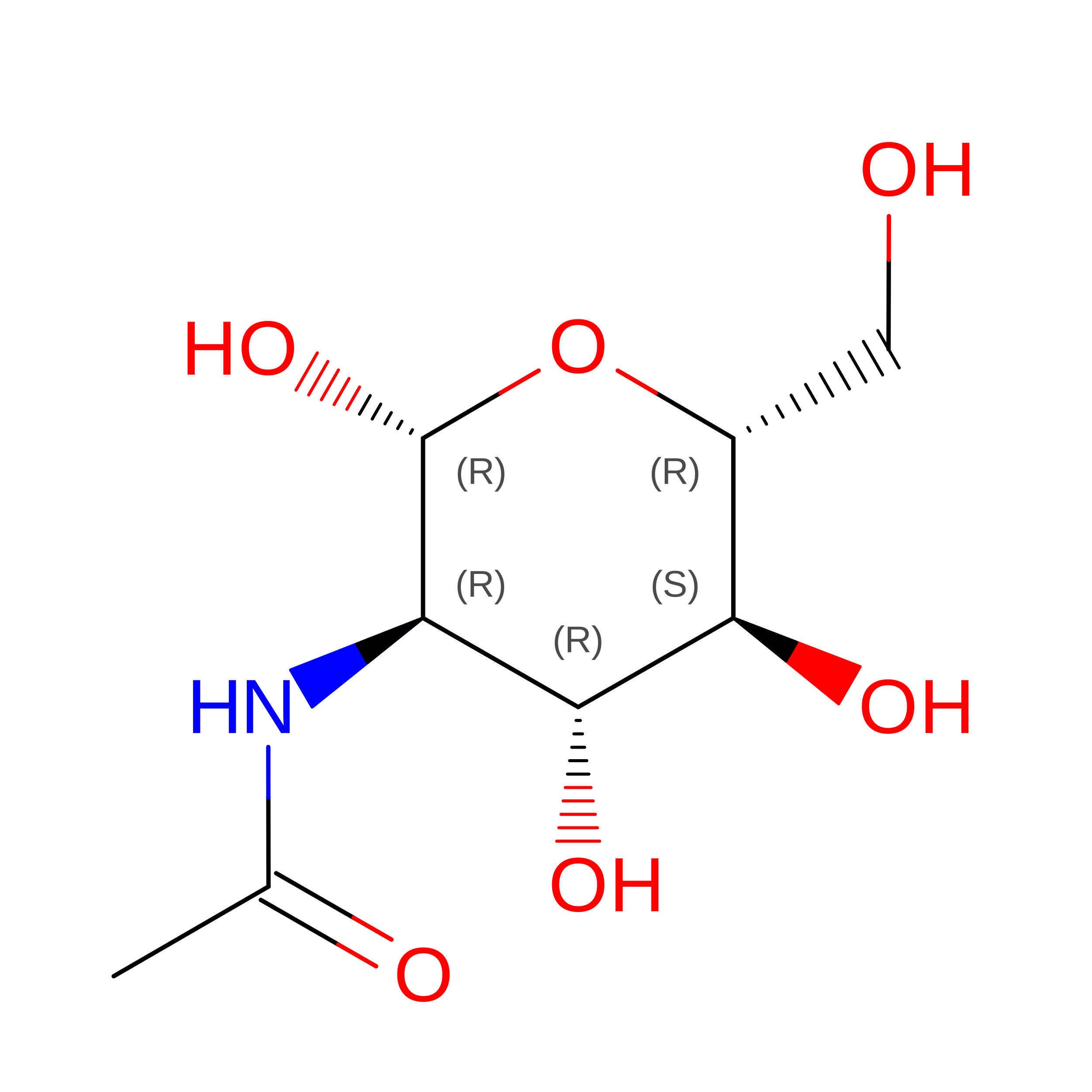
2-acetamido-2-deoxy-beta-D-glucopyranose
C8 H15 N O6
OVRNDRQMDRJTHS-FMDGEEDCSA-N
Experimental Data & Validation

Experimental Data

  • Method: ELECTRON MICROSCOPY
  • Resolution: 4.45 Å
  • Aggregation State: PARTICLE 
  • Reconstruction Method: SINGLE PARTICLE 
EM Software:
TaskSoftware PackageVersion
RECONSTRUCTIONcryoSPARC

Structure Validation

View Full Validation Report


Entry History & Funding Information

Deposition Data


Funding OrganizationLocationGrant Number
Not funded--

Revision History  (Full details and data files)

  • Version 1.0: 2026-02-25
    Type: Initial release
  • Version 1.1: 2026-03-04
    Changes: Data collection, Database references