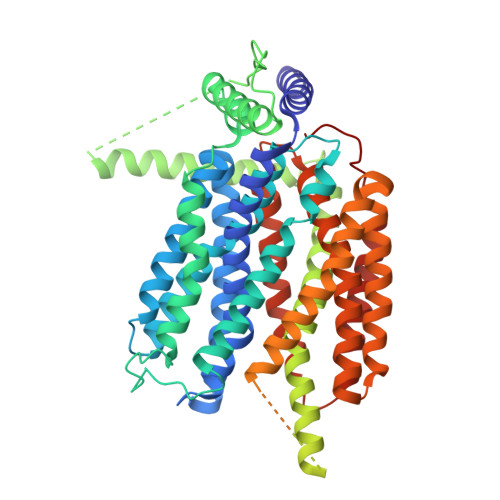
9PRS | pdb_00009prs

Cryo-EM structure of human SV2A in complex with Levetiracetam and UCB1244283


Experimental Data Snapshot

  • Method: ELECTRON MICROSCOPY
  • Resolution: 3.03 Å
  • Aggregation State: PARTICLE 
  • Reconstruction Method: SINGLE PARTICLE 

wwPDB Validation   3D Report Full Report


This is version 1.0 of the entry. See complete history


Literature

Structural pharmacology of SV2A reveals an allosteric modulation mechanism in the major facilitator superfamily.

Pidathala, S.Chen, X.Dai, Y.Nguyen, L.N.Gorgulla, C.Niu, Y.Liu, F.Lee, C.H.

(2025) Nat Commun 16: 10748-10748

  • DOI: https://doi.org/10.1038/s41467-025-65781-1
  • Primary Citation of Related Structures:  
    9OKF, 9OKG, 9OKH, 9OKI, 9OKJ, 9PRS

  • PubMed Abstract: 

    The synaptic vesicle glycoprotein 2A (SV2A), a member of the major facilitator superfamily (MFS), is a key target for antiseizure medications and a biomarker for synaptic density imaging. Despite its clinical importance, the mechanisms underlying SV2A ligand binding and modulation remain poorly understood. Here, we report sub-3 Å resolution cryo-electron microscopy (cryo-EM) structures of human SV2A in its apo form and in complex with FDA-approved antiseizure medication levetiracetam; PET imaging tracer UCB-J; experimental antiseizure drug padsevonil; and allosteric modulator UCB1244283. We find that levetiracetam and UCB-J induce vestibule occlusion, a hallmark conformational transition of MFS transporters that had not been observed in previous SV2A structures. UCB1244283 binds to an allosteric site and enhances orthosteric ligand engagement by stabilizing the occluded state and slowing ligand dissociation. Notably, padsevonil occupies both orthosteric and allosteric sites, functionally precluding modulation. These findings uncover an allosteric mechanism of regulation and provide a structural framework for the development of modulators targeting SV2A and related MFS transporters.


  • Organizational Affiliation
    • Department of Structural Biology, St. Jude Children's Research Hospital, Memphis, TN, USA.

Macromolecules
Find similar proteins by:  (by identity cutoff)  |  3D Structure
Entity ID: 1
MoleculeChains Sequence LengthOrganismDetailsImage
Synaptic vesicle glycoprotein 2A604Homo sapiensMutation(s): 0 
Gene Names: SV2AKIAA0736PSEC0174
UniProt & NIH Common Fund Data Resources
Find proteins for Q7L0J3 (Homo sapiens)
Explore Q7L0J3 
Go to UniProtKB:  Q7L0J3
PHAROS:  Q7L0J3
GTEx:  ENSG00000159164 
Entity Groups  
Sequence Clusters30% Identity50% Identity70% Identity90% Identity95% Identity100% Identity
UniProt GroupQ7L0J3
Sequence Annotations
Expand
  • Reference Sequence
Small Molecules
Ligands 2 Unique
IDChains Name / Formula / InChI Key2D Diagram3D Interactions
A1B1J (Subject of Investigation/LOI)
Query on A1B1J

Download Ideal Coordinates CCD File 
C [auth A](3R)-4-(3,5-dimethylphenyl)-N-(2-methoxyphenyl)-3-methylbutanamide
C20 H25 N O2
XJYBAKSVSQKCNC-MRXNPFEDSA-N
UKX (Subject of Investigation/LOI)
Query on UKX

Download Ideal Coordinates CCD File 
B [auth A](2S)-2-(2-oxidanylidenepyrrolidin-1-yl)butanamide
C8 H14 N2 O2
HPHUVLMMVZITSG-LURJTMIESA-N
Experimental Data & Validation

Experimental Data

  • Method: ELECTRON MICROSCOPY
  • Resolution: 3.03 Å
  • Aggregation State: PARTICLE 
  • Reconstruction Method: SINGLE PARTICLE 
EM Software:
TaskSoftware PackageVersion
MODEL REFINEMENTPHENIX
RECONSTRUCTIONcryoSPARC

Structure Validation

View Full Validation Report


Entry History & Funding Information

Deposition Data


Funding OrganizationLocationGrant Number
National Institutes of Health/National Institute of General Medical Sciences (NIH/NIGMS)United StatesGM143282

Revision History  (Full details and data files)

  • Version 1.0: 2025-12-10
    Type: Initial release