9PPQ | pdb_00009ppq

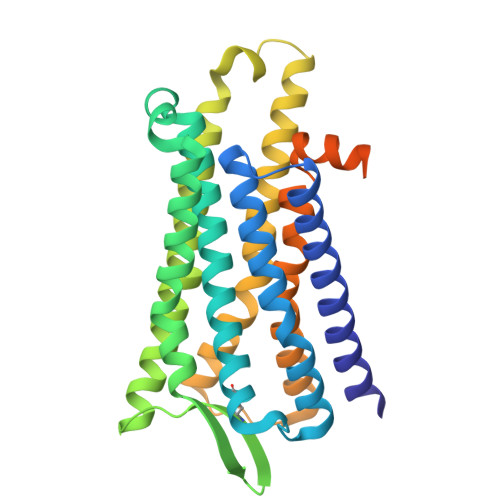
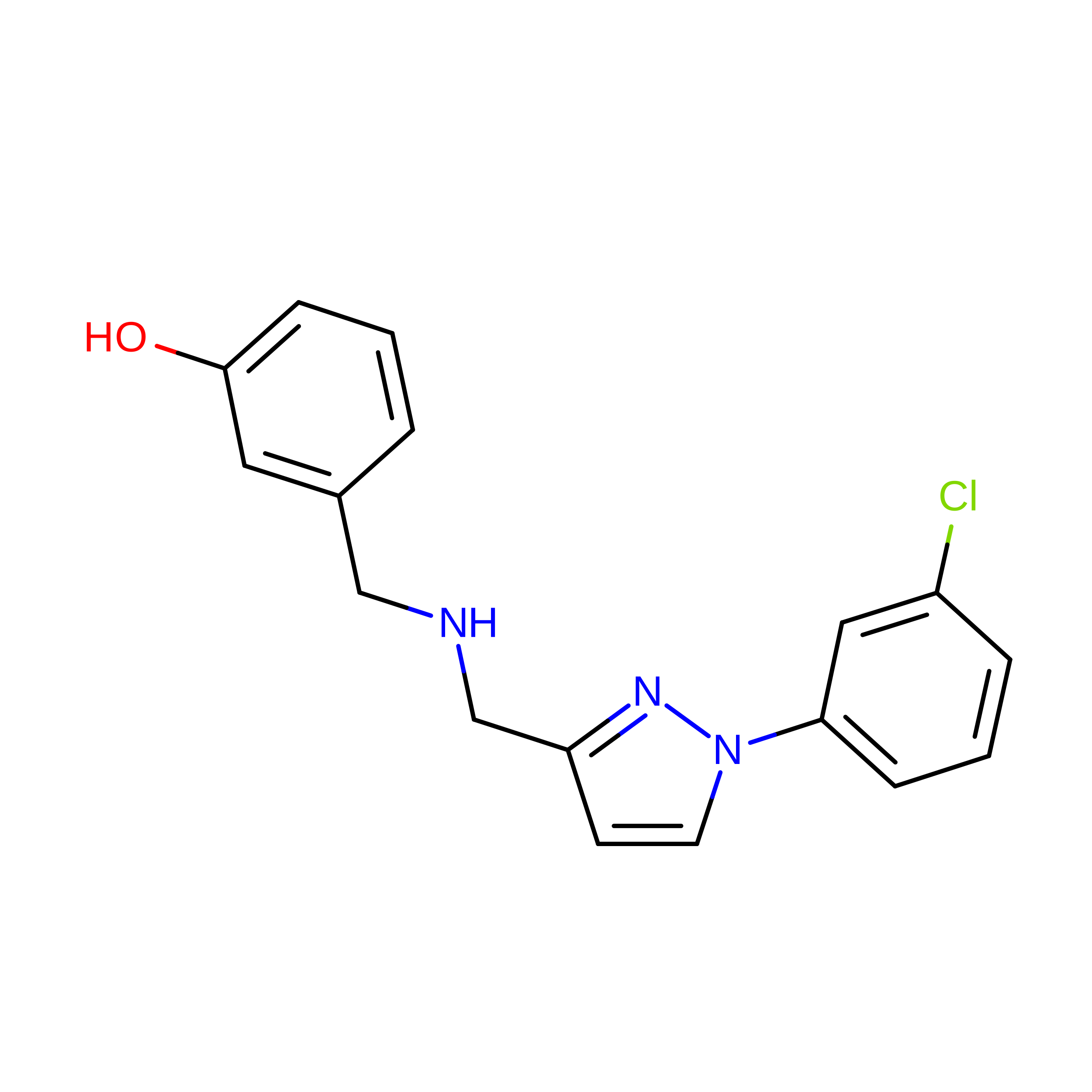
Locally-refined Mu-Opioid Receptor bound with novel compound 0505 (3-[({[(1P)-1-(3-chlorophenyl)-1H-pyrazol-3-yl]methyl}amino)methyl]phenol)


Experimental Data Snapshot

  • Method: ELECTRON MICROSCOPY
  • Resolution: 3.34 Å
  • Aggregation State: PARTICLE 
  • Reconstruction Method: SINGLE PARTICLE 

Starting Model: experimental
View more details

wwPDB Validation   3D Report Full Report


This is version 1.0 of the entry. See complete history


Literature

Large Library Docking for Polypharmacology.

Wu, Y.Vigneron, S.Braz, J.Srinivasan, K.Fink, E.A.Huang, X.P.Xu, X.Huebner, H.Kim, J.Y.Wang, J.Pfeiffer, T.Sakamoto, K.Radchenko, D.S.Rodriguiz, R.M.Moroz, Y.S.Irwin, J.J.Gmeiner, P.Billesboelle, C.Roth, B.L.Basbaum, A.I.Manglik, A.Wetsel, W.C.Shoichet, B.K.

(2026) J Med Chem 

  • DOI: https://doi.org/10.1021/acs.jmedchem.5c03810
  • Primary Citation of Related Structures:  
    9PNS, 9PPQ, 9PQD

  • PubMed Abstract: 

    Polypharmacological molecules are attractive for complex illnesses. Here, we explored large library docking for joint activity against target pairs. Retrospectively, as libraries grew, so too did the number of likely dual-activity molecules. In prospective docking of a 900-million molecule library against three target pairs (α 2A /SERT, MOR/SERT, and α 2A /MOR), we sought analgesic compounds. Both the α 2A /SERT and SERT/MOR campaigns led to dual binders with low μM to high nM activities with high hit rates; tetrahydropyridines from the α 2A /SERT campaign were also active against 5-HT 2A . However, even though cryo-EM structures confirmed the docking-predicted poses, optimization struggled to improve potency. Still, in mouse behavioral assays, the most potent α 2A /SERT compound (' z7149 ) was effective against pain without inducing conditioned place preference, and the molecule had potent antidepression and anxiolytic drug-like behavior, consistent with its SERT/5-HT 2A activities. This study reveals both advantages and challenges of docking for polypharmacology.


  • Organizational Affiliation
    • Department of Pharmaceutical Chemistry, University of California, San Francisco, 1700 fourth St., Byers Hall Suite 508D, San Francisco, California 94158, United States.

Macromolecules
Find similar proteins by:  (by identity cutoff)  |  3D Structure
Entity ID: 1
MoleculeChains Sequence LengthOrganismDetailsImage
Mu-type opioid receptorA [auth R]334Homo sapiensMutation(s): 0 
Gene Names: OPRM1MOR1
UniProt & NIH Common Fund Data Resources
Find proteins for P35372 (Homo sapiens)
Explore P35372 
Go to UniProtKB:  P35372
PHAROS:  P35372
GTEx:  ENSG00000112038 
Entity Groups  
Sequence Clusters30% Identity50% Identity70% Identity90% Identity95% Identity100% Identity
UniProt GroupP35372
Sequence Annotations
Expand
  • Reference Sequence
Small Molecules
Ligands 1 Unique
IDChains Name / Formula / InChI Key2D Diagram3D Interactions
A1CIX (Subject of Investigation/LOI)
Query on A1CIX

Download Ideal Coordinates CCD File 
B [auth R]3-[({[(1P)-1-(3-chlorophenyl)-1H-pyrazol-3-yl]methyl}amino)methyl]phenol
C17 H16 Cl N3 O
XIDYSLQGCOJZCS-UHFFFAOYSA-N
Experimental Data & Validation

Experimental Data

  • Method: ELECTRON MICROSCOPY
  • Resolution: 3.34 Å
  • Aggregation State: PARTICLE 
  • Reconstruction Method: SINGLE PARTICLE 
EM Software:
TaskSoftware PackageVersion
RECONSTRUCTIONcryoSPARC
MODEL REFINEMENTPHENIX1.21.1_5286:

Structure Validation

View Full Validation Report


Entry History & Funding Information

Deposition Data


Funding OrganizationLocationGrant Number
Defense Advanced Research Projects Agency (DARPA)United StatesHR0011-19-2-0020
ARPA-HUnited States1AY1AX000035

Revision History  (Full details and data files)

  • Version 1.0: 2026-03-04
    Type: Initial release