9PGX | pdb_00009pgx

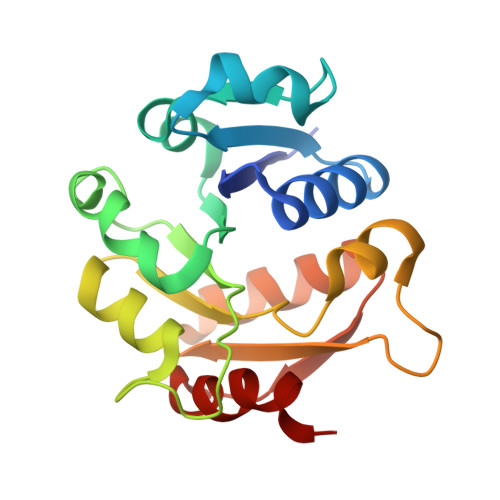
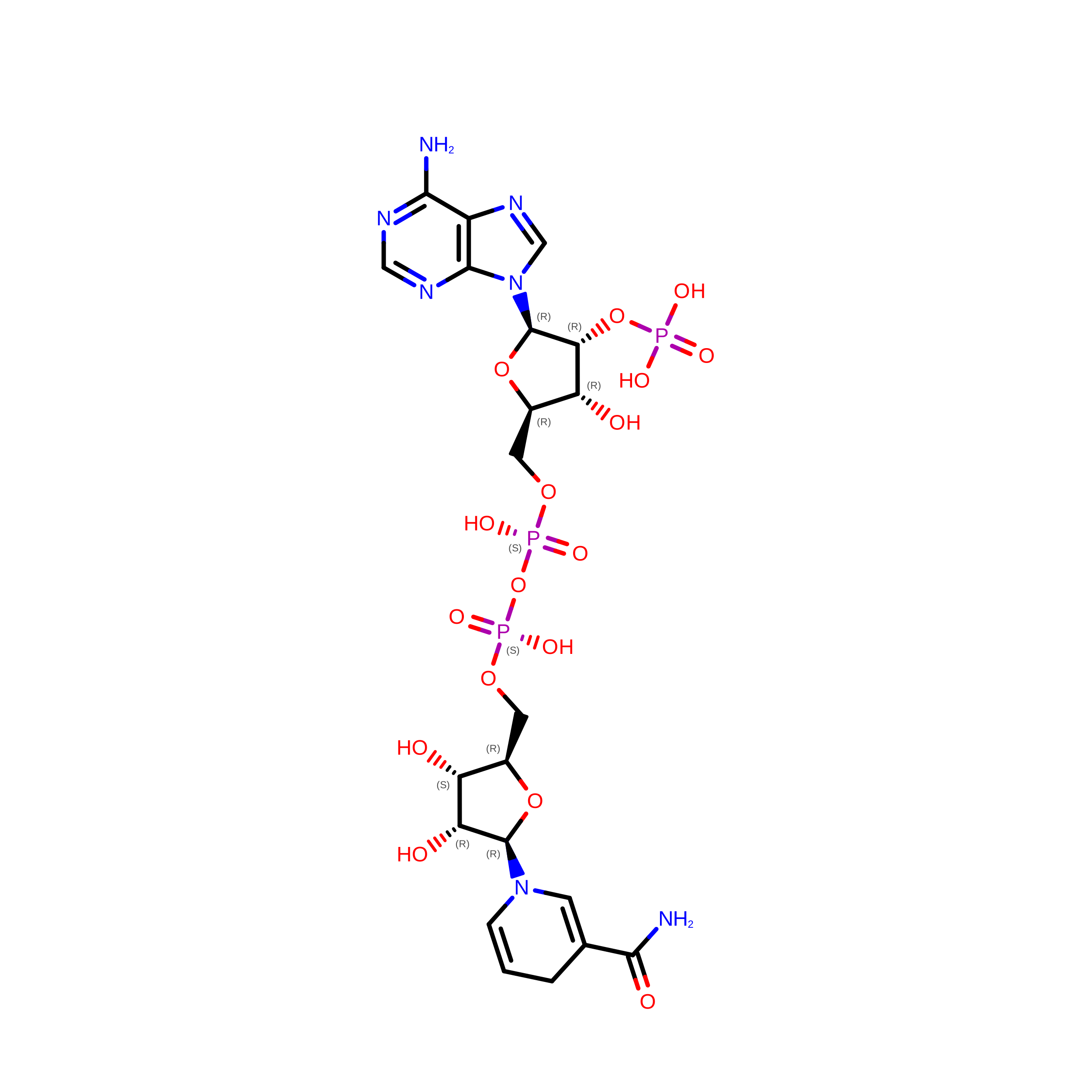
Crystal structure of STEAP2 N-domain soaked with NADP+


Experimental Data Snapshot

  • Method: X-RAY DIFFRACTION
  • Resolution: 1.46 Å
  • R-Value Free: 
    0.183 (Depositor), 0.195 (DCC) 
  • R-Value Work: 
    0.159 (Depositor) 
  • R-Value Observed: 
    0.160 (Depositor) 

Starting Model: experimental
View more details

wwPDB Validation 3D Report Full Report

Validation slider image for 9PGX

Ligand Structure Quality Assessment 


This is version 1.1 of the entry. See complete history

Literature

Structural and spectroscopic resolution of the NADPH redox state in the STEAP2 cytosolic oxidoreductase domain.

Shin, I.Sun, L.Z.Liu, A.

(2025) J Biological Chem 301: 110822-110822

  • DOI: https://doi.org/10.1016/j.jbc.2025.110822
  • Primary Citation Related Structures: 
    9PGW, 9PGX, 9PGY

  • PubMed Abstract: 

    The six-transmembrane epithelial antigen of prostate (STEAP) family of membrane proteins comprises four human metalloreductases essential for iron and copper homeostasis, redox balance, and cell proliferation. These enzymes transfer electrons from cytosolic NADPH to extracellular ferric and cupric ions via a FAD and heme-dependent pathway. STEAP2, 3, and four contain an N-terminal cytosolic oxidoreductase domain (OxRD) that enables electron input from NADPH, making STEAP2 ideal for studying redox-state cofactor or cosubstrate dynamics. While recent structures of STEAP proteins have been crucial, the redox state of bound NADPH has remained ambiguous in structural data, limiting mechanistic understanding. Here, we address this key missing piece of ambiguity for understanding the electron transfer pathway. We report high-resolution crystal structures of the STEAP2 OxRD with NADPH, in which the redox state of the cosubstrate is directly validated by single-crystal spectroscopy. Comparison with a recent cryoEM structure reveals conformational differences in the FAD-binding region, suggesting a plausible model in which domain reorientation between the N-terminal OxRD and C-terminal transmembrane domain (TMD) facilitates FADH 2 loading and FAD release. These findings resolve a key ambiguity in STEAP structural biology and underscore the importance of experimental redox-state verification in structural studies of redox enzymes.


  • Organizational Affiliation
    • Department of Chemistry, The University of Texas at San Antonio, San Antonio, Texas, USA.

Macromolecule Content 

  • Total Structure Weight: 21.52 kDa 
  • Atom Count: 1,707 
  • Modeled Residue Count: 179 
  • Deposited Residue Count: 182 
  • Unique protein chains: 1

Macromolecules

Find similar proteins by:|  3D Structure
Entity ID: 1
MoleculeChains  Sequence LengthOrganismDetailsImage
Metalloreductase STEAP2182Homo sapiensMutation(s): 3 
Gene Names: STEAP2PCANAP1STAMP1UNQ6507/PRO23203
EC: 1.16.1
UniProt & NIH Common Fund Data Resources
Find proteins for Q8NFT2 (Homo sapiens)
Explore Q8NFT2 
Go to UniProtKB:  Q8NFT2
PHAROS:  Q8NFT2
GTEx:  ENSG00000157214 
Entity Groups
Sequence Clusters30% Identity50% Identity70% Identity90% Identity95% Identity100% Identity
UniProt GroupQ8NFT2
Sequence Annotations
Expand
Reference Sequence

Experimental Data & Validation

Experimental Data

  • Method: X-RAY DIFFRACTION
  • Resolution: 1.46 Å
  • R-Value Free:  0.183 (Depositor), 0.195 (DCC) 
  • R-Value Work:  0.159 (Depositor) 
  • R-Value Observed: 0.160 (Depositor) 
Space Group: P 31 2 1
Unit Cell:
Length ( Å )Angle ( ˚ )
a = 68.104α = 90
b = 68.104β = 90
c = 95.201γ = 120
Software Package:
Software NamePurpose
PHENIXrefinement
HKL-3000data scaling
DENZOdata reduction
PHENIXphasing
PDB_EXTRACTdata extraction

Structure Validation

View Full Validation Report


Ligand Structure Quality Assessment 


Entry History 

& Funding Information

Deposition Data


Funding OrganizationLocationGrant Number
National Institutes of Health/National Cancer Institute (NIH/NCI)United StatesR01CA247379

Revision History  (Full details and data files)

  • Version 1.0: 2025-10-29
    Type: Initial release
  • Version 1.1: 2026-05-13
    Changes: Database references