9PDX | pdb_00009pdx

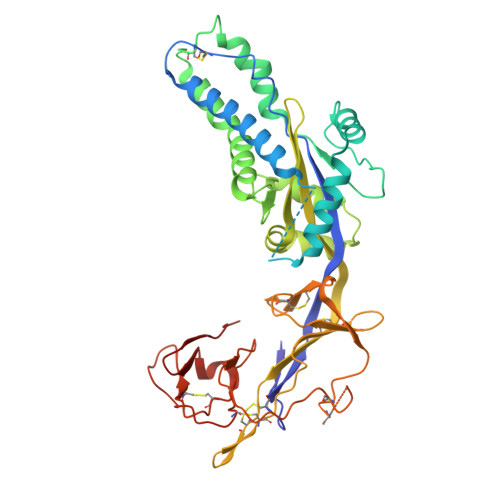
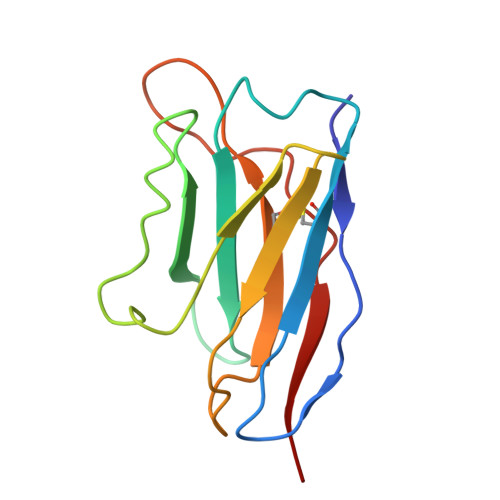
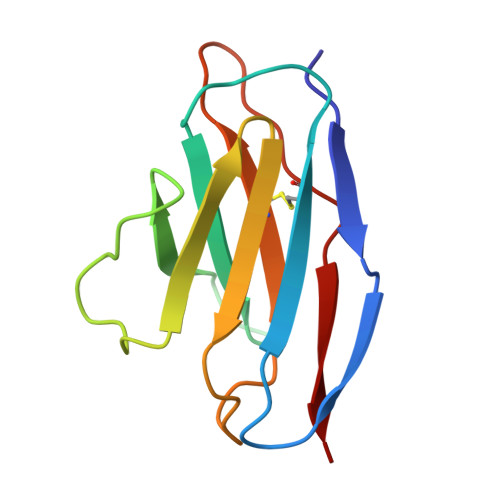
Human antibody Fab MPV513 bound to hMPV DsCav-ES2


Experimental Data Snapshot

  • Method: ELECTRON MICROSCOPY
  • Resolution: 3.94 Å
  • Aggregation State: PARTICLE 
  • Reconstruction Method: SINGLE PARTICLE 

wwPDB Validation   3D Report Full Report


This is version 2.1 of the entry. See complete history


Literature

Structural basis for childhood antibody recognition of the human metapneumovirus fusion protein.

Khalil, A.M.Ghazi Esfahani, B.Miller, R.J.Huang, J.Kuan, G.Balmaseda, A.Gordon, A.Mousa, J.J.

(2025) Nat Commun 17: 1267-1267

  • DOI: https://doi.org/10.1038/s41467-025-68021-8
  • Primary Citation of Related Structures:  
    9OS5, 9PDX, 9PDY

  • PubMed Abstract: 

    Human metapneumovirus (hMPV) is a significant cause of acute respiratory illness in children and older adults, with most children becoming seropositive by five years of age. The hMPV fusion (F) protein is the sole target of neutralizing antibodies, and while most common B-cell-targeted neutralizing epitopes on the hMPV F protein have been determined in hMPV-infected adults, the antibody response in hMPV-infected children remains undefined. We isolate five human monoclonal antibodies (mAbs) from hMPV-infected children, and evaluate their binding avidity, neutralization potency, epitope specificity, and in vivo efficacy. All mAbs are neutralizing, and epitope binning reveals four different epitopes targeted by the mAbs. Cryo-EM structures of four mAbs in complex with the hMPV F protein reveal epitopes on the hMPV F trimer surface as well as an intratrimer epitope located completely within the hMPV F trimer interface. Furthermore, we determine the prophylactic efficacy of the mAbs in protection against hMPV challenge in mice. These findings provide new insights into the immunodominant antigenic epitopes on the hMPV F protein in children and identify new mAbs for hMPV F disease prevention.


  • Organizational Affiliation
    • Department of Biomedical Sciences, College of Medicine, Florida State University, Tallahassee, FL, USA.

Macromolecules
Find similar proteins by:  (by identity cutoff)  |  3D Structure
Entity ID: 1
MoleculeChains Sequence LengthOrganismDetailsImage
MPV513 Heavy ChainA [auth C]120Homo sapiensMutation(s): 0 
Entity Groups  
Sequence Clusters30% Identity50% Identity70% Identity90% Identity95% Identity100% Identity
Sequence Annotations
Expand
  • Reference Sequence
Find similar proteins by:  (by identity cutoff)  |  3D Structure
Entity ID: 2
MoleculeChains Sequence LengthOrganismDetailsImage
MPV513 Light Chain107Homo sapiensMutation(s): 0 
Entity Groups  
Sequence Clusters30% Identity50% Identity70% Identity90% Identity95% Identity100% Identity
Sequence Annotations
Expand
  • Reference Sequence
Find similar proteins by:  (by identity cutoff)  |  3D Structure
Entity ID: 3
MoleculeChains Sequence LengthOrganismDetailsImage
Fusion glycoprotein F0C [auth F]451human metapneumovirusMutation(s): 0 
UniProt
Find proteins for Q6W8S4 (human metapneumovirus)
Explore Q6W8S4 
Go to UniProtKB:  Q6W8S4
Entity Groups  
Sequence Clusters30% Identity50% Identity70% Identity90% Identity95% Identity100% Identity
UniProt GroupQ6W8S4
Sequence Annotations
Expand
  • Reference Sequence
Oligosaccharides

Help

Entity ID: 4
MoleculeChains Length2D Diagram Glycosylation3D Interactions
alpha-D-mannopyranose-(1-3)-[alpha-D-mannopyranose-(1-6)]beta-D-mannopyranose-(1-4)-2-acetamido-2-deoxy-beta-D-glucopyranose-(1-4)-2-acetamido-2-deoxy-beta-D-glucopyranoseD [auth A]5N/A
Glycosylation Resources
GlyTouCan:  G22768VO
GlyCosmos:  G22768VO
GlyGen:  G22768VO
Experimental Data & Validation

Experimental Data

  • Method: ELECTRON MICROSCOPY
  • Resolution: 3.94 Å
  • Aggregation State: PARTICLE 
  • Reconstruction Method: SINGLE PARTICLE 
EM Software:
TaskSoftware PackageVersion
MODEL REFINEMENTPHENIX1.21.1_5286
RECONSTRUCTIONcryoSPARC

Structure Validation

View Full Validation Report


Entry History & Funding Information

Deposition Data


Funding OrganizationLocationGrant Number
National Institutes of Health/National Institute Of Allergy and Infectious Diseases (NIH/NIAID)United StatesR01 AI143865

Revision History  (Full details and data files)

  • Version 1.0: 2025-09-03
    Type: Initial release
  • Version 2.0: 2026-02-11
    Type: Coordinate replacement
    Reason: Model completeness
    Changes: Advisory, Atomic model, Data collection, Database references, Derived calculations, Other, Polymer sequence, Refinement description, Source and taxonomy, Structure summary
  • Version 2.1: 2026-03-18
    Changes: Data collection, Database references