Download Mendeley
Spatially Aware Diffraction Mapping Enables Fully Autonomous MicroED.
Eremin, D.B., Jha, K.K., Delgadillo, D.A., Zhang, H., Foxman, S.H., Johnson, S.N., Vlahakis, N.W., Cascio, D., Lavallo, V., Rodriguez, J.A., Nelson, H.M.(2025) J Am Chem Soc 147: 42299-42310
- PubMed: 41211926 Search on PubMed
- DOI: https://doi.org/10.1021/jacs.5c10751
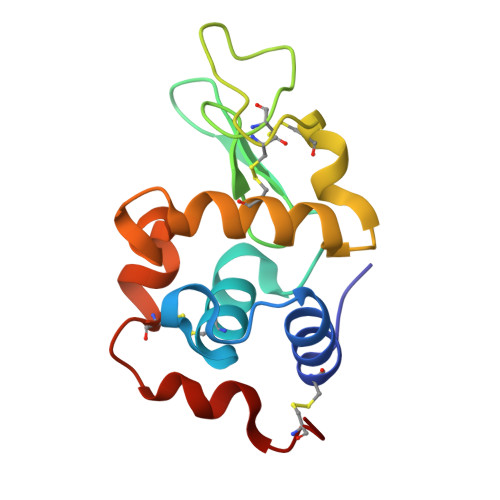
- Primary Citation Related Structures:
9P6R - PubMed Abstract:
In the hands of experts, microcrystal electron diffraction (microED, a 3D ED method) is a powerful tool for structural chemistry and chemical discovery. To expand the accessibility and utility of microED, we introduce Reciprocal Eyes (REyes), an autonomous and intelligent platform (available for academic use) that combines diffraction-based particle selection with real-time data processing to deliver crystal structures without human intervention. REyes spatially maps diffraction signal and autonomously selects crystallites of interest, relying on lattice-quality metrics to acquire and index high-resolution data sets from diverse compounds. Tested on four different transmission electron microscopes (TEMs), it consistently yields preliminary ab initio structural solutions from single crystallites of materials, peptides, metal complexes, natural products (NPs), and proteins.
- Division of Chemistry and Chemical Engineering, California Institute of Technology, Pasadena, California 91125, United States.
Organizational Affiliation: