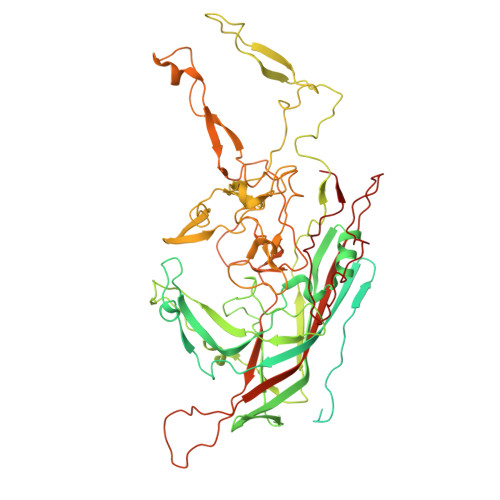
9P4P | pdb_00009p4p

Cryo-EM structure of AAV9-X1

  • Classification: VIRUS
  • Organism(s): Adeno-associated virus
  • Expression System: Homo sapiens
  • Mutation(s): No 

  • Deposited: 2025-06-17 Released: 2026-04-15 
  • Deposition Author(s): Brittain, T.J., Jang, S.
  • Funding Organization(s): National Institutes of Health/National Institute of Neurological Disorders and Stroke (NIH/NINDS), National Institutes of Health/National Institute of Mental Health (NIH/NIMH)

Experimental Data Snapshot

  • Method: ELECTRON MICROSCOPY
  • Resolution: 3.09 Å
  • Aggregation State: PARTICLE 
  • Reconstruction Method: SINGLE PARTICLE 

wwPDB Validation 3D Report Full Report

Validation slider image for 9P4P

This is version 1.1 of the entry. See complete history

Literature

Structural basis of liver de-targeting and neuronal tropism of CNS-targeted AAV capsids.

Brittain, T.J.Jang, S.Coughlin, G.M.Hoang, J.D.Barcelona, B.H.Giriat, I.Ristic, F.Appling, N.Chossis, C.P.M.A.Shay, T.F.Gradinaru, V.

(2026) Mol Ther 

  • DOI: https://doi.org/10.1016/j.ymthe.2026.03.030
  • Primary Citation Related Structures: 
    9P4L, 9P4M, 9P4N, 9P4O, 9P4P, 9P4Q, 9P4R

  • PubMed Abstract: 

    Developing effective vectors for gene therapy requires accurate on-target coverage while minimizing off-target transduction that can lead to adverse events. In mice, the engineered capsid PHP.eB shows enhanced brain transduction, while the further engineered CAP-B10 is also de-targeted from astrocytes and liver. Here, we solved cryoelectron microscopy (cryo-EM) structures of CAP-B10 and its complex with the adeno-associated virus receptor (AAVR) domain PKD2, at 2.22- and 2.20-Å resolutions, respectively. These structures reveal a motif that hinders AAVR binding, which we confirmed by measuring affinities. We showed that this motif is transferable to other capsids by solving cryo-EM structures of AAV9-X1, at 3.09 Å, and AAV9-X1.1 without and with PKD2, at 2.51 and 2.18 Å, respectively. Using this structural information, we designed and validated novel AAV variants with reduced liver and altered brain cell tropism in vivo. Overall, we provide a framework for using structural information to guide rational engineering of gene delivery vectors to achieve safe and effective delivery.


  • Organizational Affiliation
    • Division of Biology and Biological Engineering, California Institute of Technology, Pasadena, CA 91125, USA.

Macromolecule Content 

  • Total Structure Weight: 82.19 kDa 
  • Atom Count: 4,182 
  • Modeled Residue Count: 525 
  • Deposited Residue Count: 743 
  • Unique protein chains: 1

Macromolecules

Find similar proteins by:|  3D Structure
Entity ID: 1
MoleculeChains  Sequence LengthOrganismDetailsImage
Capsid protein VP1743Adeno-associated virusMutation(s): 0 
Gene Names: cap
UniProt
Find proteins for Q6JC22 (Adeno-associated virus)
Explore Q6JC22 
Go to UniProtKB:  Q6JC22
Entity Groups
Sequence Clusters30% Identity50% Identity70% Identity90% Identity95% Identity100% Identity
UniProt GroupQ6JC22
Sequence Annotations
Expand
Reference Sequence

Experimental Data & Validation

Experimental Data

  • Method: ELECTRON MICROSCOPY
  • Resolution: 3.09 Å
  • Aggregation State: PARTICLE 
  • Reconstruction Method: SINGLE PARTICLE 
EM Software:
TaskSoftware PackageVersion
MODEL REFINEMENTPHENIX1.20.1_4487

Structure Validation

View Full Validation Report


Entry History 

& Funding Information

Deposition Data


Funding OrganizationLocationGrant Number
National Institutes of Health/National Institute of Neurological Disorders and Stroke (NIH/NINDS)United StatesDP1NS111369
National Institutes of Health/National Institute of Mental Health (NIH/NIMH)United StatesUF1MH128336

Revision History  (Full details and data files)

  • Version 1.0: 2026-04-15
    Type: Initial release
  • Version 1.1: 2026-05-20
    Changes: Data collection, Database references