Download Mendeley
Zinc-Induced Folding and Solution Structure of the Eponymous Novel Zinc Finger from the ZC4H2 Protein.
Harris, R.E., Rua, A.J., Alexandrescu, A.T.(2025) Biomolecules 15
- PubMed: 40867536 Search on PubMedSearch on PubMed Central
- DOI: https://doi.org/10.3390/biom15081091
- Primary Citation Related Structures:
9P3Z - PubMed Abstract:
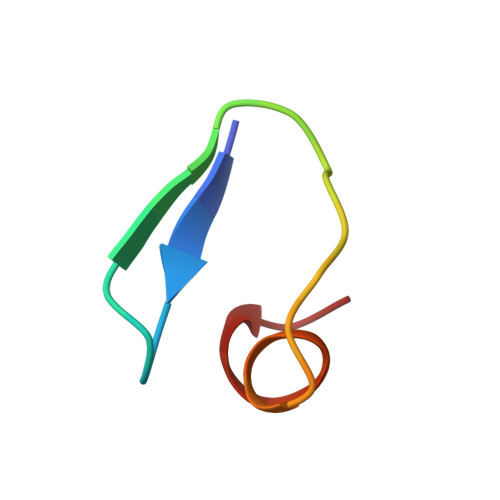
The ZC4H2 gene is the site of congenital mutations linked to neurodevelopmental and musculoskeletal pathologies collectively termed ZARD (ZC4H2-Associated Rare Disorders). ZC4H2 consists of a coiled coil and a single novel zinc finger with four cysteines and two histidines, from which the protein obtains its name. Alpha Fold 3 confidently predicts a structure for the zinc finger but also for similarly sized random sequences, providing equivocal information on its folding status. We show using synthetic peptide fragments that the zinc finger of ZC4H2 is genuine and folds upon binding a zinc ion with picomolar affinity. NMR pH titration of histidines and UV-Vis of a cobalt complex of the peptide indicate its four cysteines coordinate zinc, while two histidines do not participate in binding. The experimental NMR structure of the zinc finger has a novel structural motif similar to RANBP2 zinc fingers, in which two orthogonal hairpins each contribute two cysteines to coordinate zinc. Most of the nine ZARD mutations that occur in the ZC4H2 zinc finger are likely to perturb this structure. While the ZC4H2 zinc finger shares the folding motif and cysteine-ligand spacing of the RANBP2 family, it is missing key substrate-binding residues. Unlike the NZF branch of the RANBP2 family, the ZC4H2 zinc finger does not bind ubiquitin. Since the ZC4H2 zinc finger occurs in a single copy, it is also unlikely to bind DNA. Based on sequence homology to the VAB-23 protein, the ZC4H2 zinc finger may bind RNA of a currently undetermined sequence or have alternative functions.
- Department of Molecular and Cell Biology, University of Connecticut, Storrs, CT 06269, USA.
Organizational Affiliation: