Download Mendeley
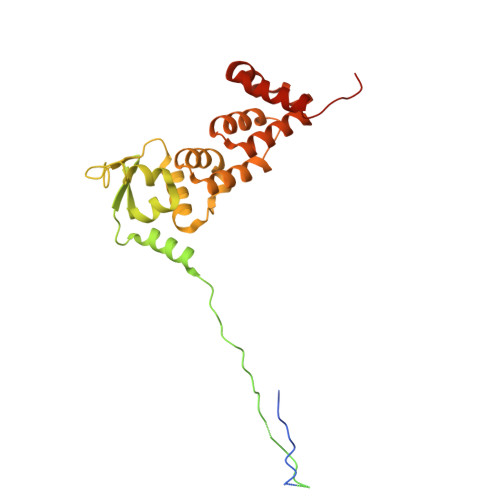
The equilibrium between two quaternary assembly states determines the activity of SPOP and its cancer mutants.
Cuneo, M.J., Gullulu, O., Ammar, M.R., Gui, X., Churion, K., Turk, M., O'Flynn, B.G., Sabri, N., Mittag, T.(2025) bioRxiv
- PubMed: 40666954 Search on PubMedSearch on PubMed Central
- DOI: https://doi.org/10.1101/2025.06.19.659812
- Primary Citation Related Structures:
9OUT, 9OUU, 9OUW - PubMed Abstract:
Proteostasis is critical for preventing oncogenesis. Both activating and inactivating mutations in the ubiquitin ligase subunit SPOP result in oncogenesis in different tissues. SPOP assembles into filaments that are multivalent for substrates, and substrates have multiple weak motifs for SPOP that are not activated via post-translational modifications. It is thus unclear how regulation is achieved. Here, we show that SPOP filaments circularize into rings that dimerize into up to 2.5 MDa-large, auto-inhibited double donuts. The equilibrium between double donuts and linear filaments determines SPOP activity. Activating and deactivating cancer mutations shift the equilibrium towards the filament or the double donut, respectively, and this influences substrate turnover and subcellular localization. This regulatory mechanism requires long filaments that can circularize into rings, likely explaining the presence of multiple weak SPOP-binding motifs in substrates. Activating and deactivating mutations combine to give rise to intermediate activities, suggesting new levers for cancer therapies. SPOP assemblies exist in an equilibrium between circular double donuts and linear filaments.Double donuts occlude access to the substrate binding site and are inactive.Mutations in different cancers shift the equilibrium towards active or inactive states.Regulation through these structural transitions requires large filamentous assemblies.