9OT6 | pdb_00009ot6

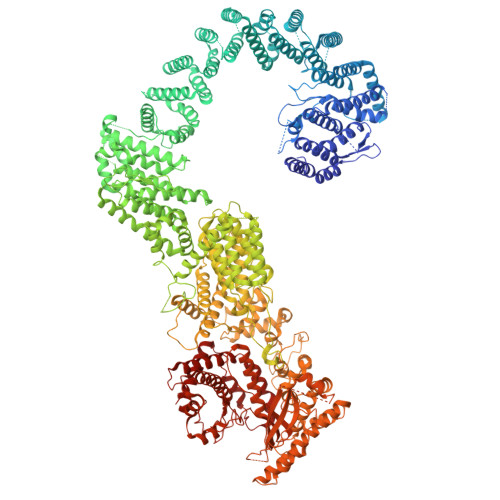
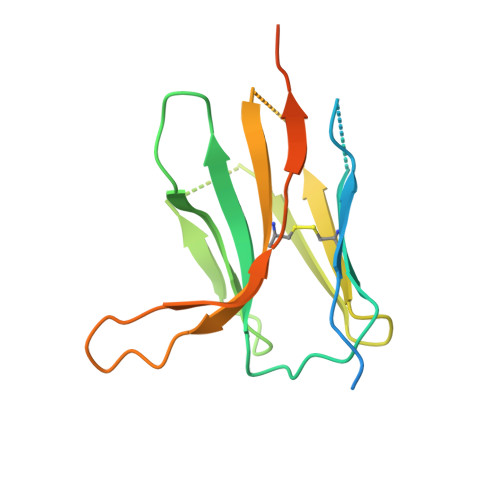
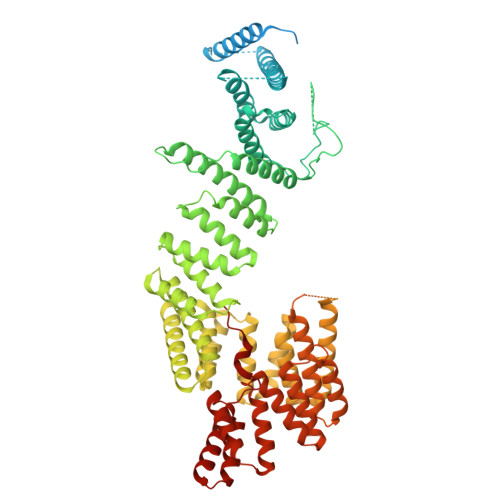
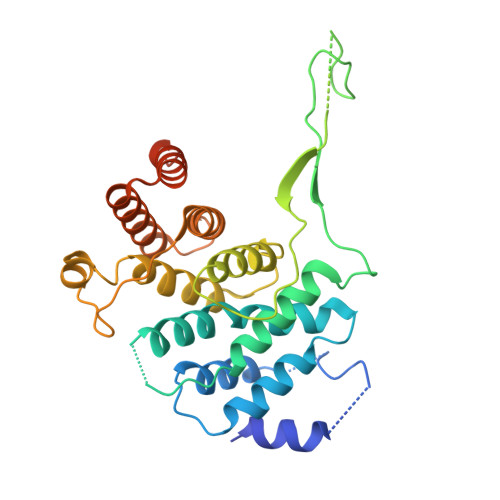
Cryo-EM structure of the PI4KA complex bound to an EFR3 interfering nanobody (F3IN)


Experimental Data Snapshot

  • Method: ELECTRON MICROSCOPY
  • Resolution: 3.54 Å
  • Aggregation State: PARTICLE 
  • Reconstruction Method: SINGLE PARTICLE 

Starting Models: experimental, in silico
View more details

wwPDB Validation   3D Report Full Report


This is version 1.1 of the entry. See complete history


Literature

Development of an inhibitory TTC7B selective nanobody that blocks EFR3 recruitment of PI4KA.

Suresh, S.Shaw, A.L.Akintola, D.K.Lunke, M.Doerr, S.Rohilla, P.Balla, T.Yip, C.K.Hansen, S.D.Cobb, J.A.Burke, J.E.

(2025) J Biological Chem 301: 110886-110886

  • DOI: https://doi.org/10.1016/j.jbc.2025.110886
  • Primary Citation of Related Structures:  
    9OT6

  • PubMed Abstract: 

    Phosphatidylinositol 4 kinase IIIα (PI4KIIIα/PI4KA) is an essential lipid kinase that plays a critical role in regulating plasma membrane identity. PI4KA is primarily recruited to the plasma membrane through the targeted recruitment by the proteins, EFR3A and EFR3B, which bind to the PI4KA accessory proteins TTC7 (TTC7A/B) and FAM126 (FAM126A/B). Here we characterised how both EFR3 isoforms interact with all possible TTC7-FAM126 combinations and developed a nanobody that specifically blocked EFR3-mediated PI4KA recruitment in TTC7B containing complexes. Most EFR3-TTC7-FAM126 combinations show similar binding affinities, with the exception of EFR3A-TTC7B-FAM126A, which binds with a ∼10-fold higher affinity. Moreover, we showed that EFR3B phosphorylation markedly decreased binding to TTC7-FAM126. Using a yeast display approach, we isolated a TTC7B selective nanobody that blocked EFR3 binding. Cryo-electron microscopy and hydrogen deuterium exchange mass spectrometry showed an extended interface with both PI4KA and TTC7B that sterically blocks EFR3 binding. The nanobody caused decreased membrane recruitment both on lipid bilayers and in cells, with decreased PM production of PI4P. Collectively, these findings provide new insights into PI4KA regulation and provide a tool for manipulating PI4KA complexes, that may be valuable for therapeutic targeting.


  • Organizational Affiliation
    • Department of Biochemistry and Microbiology, University of Victoria, Victoria, BC, V8W 2Y2, Canada.

Macromolecules
Find similar proteins by:  (by identity cutoff)  |  3D Structure
Entity ID: 1
MoleculeChains Sequence LengthOrganismDetailsImage
Phosphatidylinositol 4-kinase alpha
A, B
2,104Homo sapiensMutation(s): 0 
Gene Names: PI4KAPIK4PIK4CA
EC: 2.7.1.67
UniProt & NIH Common Fund Data Resources
Find proteins for P42356 (Homo sapiens)
Explore P42356 
Go to UniProtKB:  P42356
PHAROS:  P42356
GTEx:  ENSG00000241973 
Entity Groups  
Sequence Clusters30% Identity50% Identity70% Identity90% Identity95% Identity100% Identity
UniProt GroupP42356
Sequence Annotations
Expand
  • Reference Sequence
Find similar proteins by:  (by identity cutoff)  |  3D Structure
Entity ID: 2
MoleculeChains Sequence LengthOrganismDetailsImage
EFR3 interfering Nanobody (F3IN)
C, H
165Lama glamaMutation(s): 0 
Entity Groups  
Sequence Clusters30% Identity50% Identity70% Identity90% Identity95% Identity100% Identity
Sequence Annotations
Expand
  • Reference Sequence
Find similar proteins by:  (by identity cutoff)  |  3D Structure
Entity ID: 3
MoleculeChains Sequence LengthOrganismDetailsImage
Tetratricopeptide repeat protein 7B
D, F
843Homo sapiensMutation(s): 0 
Gene Names: TTC7BTTC7L1
UniProt & NIH Common Fund Data Resources
Find proteins for Q86TV6 (Homo sapiens)
Explore Q86TV6 
Go to UniProtKB:  Q86TV6
PHAROS:  Q86TV6
GTEx:  ENSG00000165914 
Entity Groups  
Sequence Clusters30% Identity50% Identity70% Identity90% Identity95% Identity100% Identity
UniProt GroupQ86TV6
Sequence Annotations
Expand
  • Reference Sequence
Find similar proteins by:  (by identity cutoff)  |  3D Structure
Entity ID: 4
MoleculeChains Sequence LengthOrganismDetailsImage
Hyccin
E, G
308Homo sapiensMutation(s): 0 
Gene Names: HYCC1DRCTNNB1AFAM126A
UniProt & NIH Common Fund Data Resources
Find proteins for Q9BYI3 (Homo sapiens)
Explore Q9BYI3 
Go to UniProtKB:  Q9BYI3
PHAROS:  Q9BYI3
GTEx:  ENSG00000122591 
Entity Groups  
Sequence Clusters30% Identity50% Identity70% Identity90% Identity95% Identity100% Identity
UniProt GroupQ9BYI3
Sequence Annotations
Expand
  • Reference Sequence
Experimental Data & Validation

Experimental Data

  • Method: ELECTRON MICROSCOPY
  • Resolution: 3.54 Å
  • Aggregation State: PARTICLE 
  • Reconstruction Method: SINGLE PARTICLE 
EM Software:
TaskSoftware PackageVersion
RECONSTRUCTIONcryoSPARC4.5.2
MODEL REFINEMENTPHENIX1.21_5207

Structure Validation

View Full Validation Report


Entry History & Funding Information

Deposition Data


Funding OrganizationLocationGrant Number
Canadian Institutes of Health Research (CIHR)CanadaPJT-195808
Canadian Institutes of Health Research (CIHR)CanadaPJT-168907
Natural Sciences and Engineering Research Council (NSERC, Canada)CanadaRGPIN-2018-03951
Natural Sciences and Engineering Research Council (NSERC, Canada)CanadaAWD-007855

Revision History  (Full details and data files)

  • Version 1.0: 2025-12-03
    Type: Initial release
  • Version 1.1: 2025-12-24
    Changes: Data collection, Database references