9ORE | pdb_00009ore

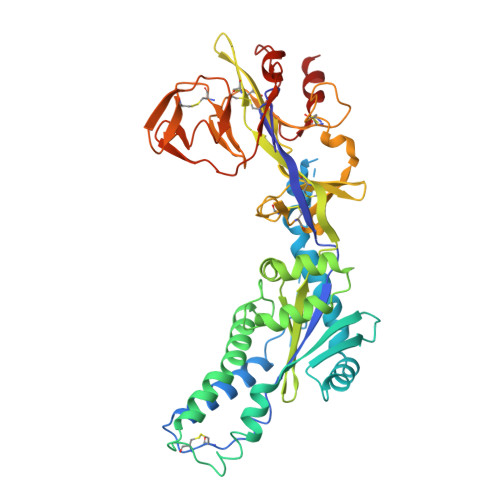
CryoEM structure of 4F11 Fab bound to stabilized MPV-2c HMPV preF


Experimental Data Snapshot

  • Method: ELECTRON MICROSCOPY
  • Resolution: 4.13 Å
  • Aggregation State: PARTICLE 
  • Reconstruction Method: SINGLE PARTICLE 

wwPDB Validation 3D Report Full Report

Validation slider image for 9ORE

This is version 2.0 of the entry. See complete history. 

Literature

DEVELOPMENT OF A POTENT MONOCLONAL ANTIBODY FOR TREATMENT OF HUMAN METAPNEUMOVIRUS INFECTIONS.

Harris, E.D., McGovern, M., Pernikoff, S., Ikeda, R., Kipnis, L., Hannon, W., Sobolik, E.B., Gray, M., Greninger, A.L., He, S., Chin, C.N., Fu, T.M., Pancera, M., Boonyaratanakornkit, J.

(2025) bioRxiv 

  • DOI: https://doi.org/10.1101/2025.06.09.657676
  • Primary Citation Related Structures: 
    9ORE

  • PubMed Abstract: 

    Human metapneumovirus (HMPV) is a major cause of respiratory infections, particularly among vulnerable populations, yet effective therapeutics remain unavailable. Monoclonal antibodies (mAbs) offer a promising approach for both treatment and prevention. Here, we describe the discovery and characterization of 4F11, a highly potent and broadly neutralizing mAb with demonstrated in vitro and in vivo efficacy against HMPV. Using cryo-electron microscopy, we defined a unique mechanism of binding HMPV employed by 4F11, which distinguishes it from previously characterized RSV and HMPV mAbs. 4F11 targets an epitope located at the apex of the prefusion F protein (site Ø) with a 1:1 stoichiometry, distinct from the 3:1 stoichiometry observed with other HMPV site Ø antibodies. Unlike other site Ø antibodies, which penetrate the glycan shield between Asn57 and Asn172, 4F11 binds vertically and directly interacts with the Asn172 glycan, representing a unique glycan-dependent mode of recognition. In vitro, 4F11 displayed high potency and broad neutralization across diverse HMPV strains. It also showed a low propensity for resistance development, with only a single escape mutation (K179E) identified, a mutation not found in any published HMPV sequence to date. Viruses rescued with the K179E escape mutation had significantly decreased fitness in vitro compared to wild-type virus. In a hamster challenge model, 4F11 significantly reduced viral loads in both the lungs and nasal turbinates. These findings highlight 4F11 as a promising candidate for therapeutic development, particularly for immunocompromised individuals and other high-risk groups.


  • Organizational Affiliation: 
    • Vaccine and Infectious Disease Division, Fred Hutch Cancer Center, Seattle, WA USA.

Macromolecule Content 

  • Total Structure Weight: 175.62 kDa 
  • Atom Count: 11,934 
  • Modeled Residue Count: 1,547 
  • Deposited Residue Count: 1,586 
  • Unique protein chains: 3

Macromolecules

Find similar proteins by:|  3D Structure
Entity ID: 1
MoleculeChains  Sequence LengthOrganismDetailsImage
Fusion glycoprotein F0
A, B, C
450human metapneumovirusMutation(s): 0 
UniProt
Find proteins for Q6WB98 (Human metapneumovirus (strain CAN97-83))
Explore Q6WB98 
Go to UniProtKB:  Q6WB98
Entity Groups
Sequence Clusters30% Identity50% Identity70% Identity90% Identity95% Identity100% Identity
UniProt GroupQ6WB98
Glycosylation
Glycosylation Sites: 1
Sequence Annotations
Expand
Reference Sequence
Find similar proteins by:|  3D Structure
Entity ID: 2
MoleculeChains  Sequence LengthOrganismDetailsImage
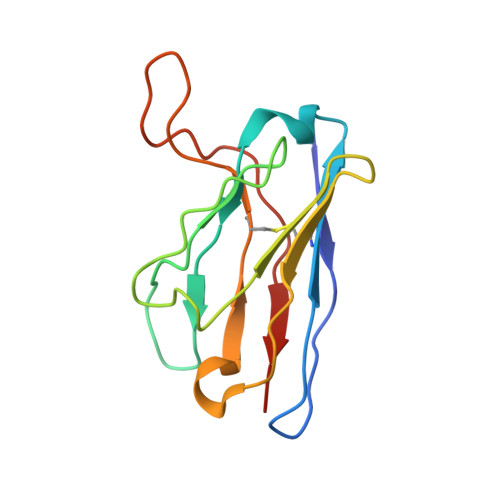
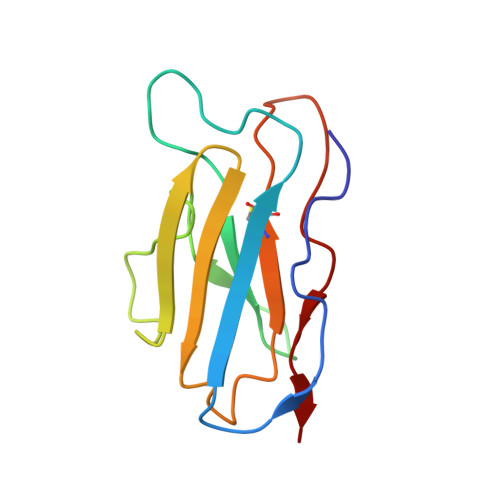
4F11 Heavy ChainD [auth H]123Homo sapiensMutation(s): 0 
Entity Groups
Sequence Clusters30% Identity50% Identity70% Identity90% Identity95% Identity100% Identity
Sequence Annotations
Expand
Reference Sequence
Find similar proteins by:|  3D Structure
Entity ID: 3
MoleculeChains  Sequence LengthOrganismDetailsImage
4F11 Light ChainE [auth L]113Homo sapiensMutation(s): 0 
Entity Groups
Sequence Clusters30% Identity50% Identity70% Identity90% Identity95% Identity100% Identity
Sequence Annotations
Expand
Reference Sequence

Oligosaccharides

Help  
Entity ID: 4
MoleculeChains Length2D Diagram GlycosylationD Interactions
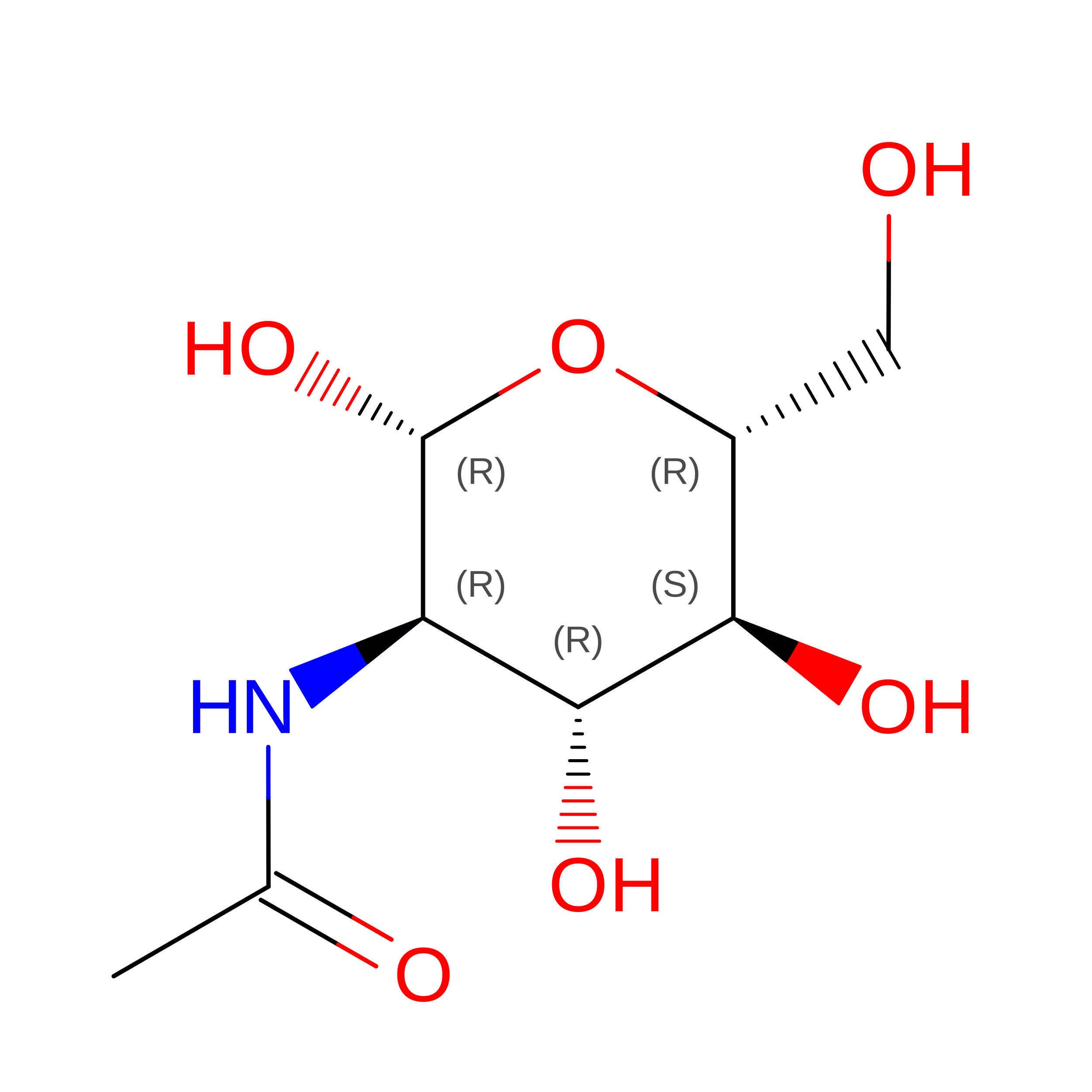
beta-D-mannopyranose-(1-4)-2-acetamido-2-deoxy-beta-D-glucopyranose-(1-4)-2-acetamido-2-deoxy-beta-D-glucopyranoseF [auth D]3N-Glycosylation
Glycosylation Resources
GlyTouCan: G15407YE
GlyCosmos: G15407YE
GlyGen: G15407YE
Entity ID: 5
MoleculeChains Length2D Diagram GlycosylationD Interactions
2-acetamido-2-deoxy-beta-D-glucopyranose-(1-4)-2-acetamido-2-deoxy-beta-D-glucopyranoseG [auth E]2N-Glycosylation
Glycosylation Resources
GlyTouCan: G42666HT
GlyCosmos: G42666HT
GlyGen: G42666HT

Experimental Data & Validation

Experimental Data

  • Method: ELECTRON MICROSCOPY
  • Resolution: 4.13 Å
  • Aggregation State: PARTICLE 
  • Reconstruction Method: SINGLE PARTICLE 
EM Software:
TaskSoftware PackageVersion
MODEL REFINEMENTPHENIX1.20.1_4487
RECONSTRUCTIONcryoSPARC

Structure Validation

View Full Validation Report


Entry History 

& Funding Information

Deposition Data


Funding OrganizationLocationGrant Number
National Institutes of Health/National Institute Of Allergy and Infectious Diseases (NIH/NIAID)United StatesR01 AI171186

Revision History  (Full details and data files)

  • Version 1.0: 2025-07-30
    Type: Initial release
  • Version 2.0: 2026-02-11
    Type: Coordinate replacement
    Reason: Atomic clashes
    Changes: Advisory, Atomic model, Data collection, Database references, Derived calculations, Other, Polymer sequence, Source and taxonomy, Structure summary