Download Mendeley
SINE compounds activate exportin 1 degradation through an allosteric mechanism.
Wing, C.E., Fung, H.Y.J., Kwanten, B., Cagatay, T., Niesman, A.B., Jacquemyn, M., Gharghabi, M., Permentier, B., Shakya, B., Nandi, R., Ready, J.M., Kashyap, T., Shacham, S., Landesman, Y., Lapalombella, R., Daelemans, D., Chook, Y.M.(2025) Nat Chem Biol 21: 2002-2013
- PubMed: 41286136 Search on PubMedSearch on PubMed Central
- DOI: https://doi.org/10.1038/s41589-025-02058-0
- Primary Citation Related Structures:
9OG9, 9OGA, 9OGB, 9OGC, 9OGD, 9OGE, 9OGF, 9OGN, 9OGO - PubMed Abstract:
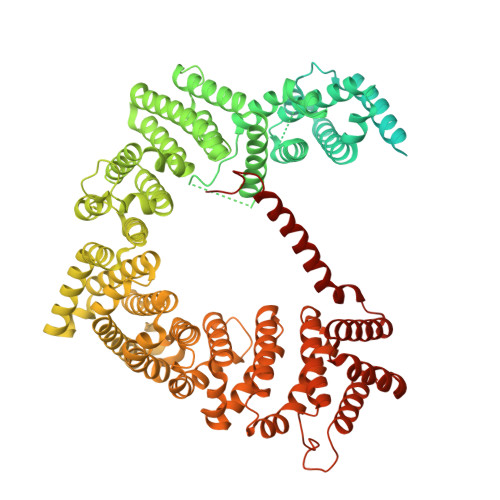
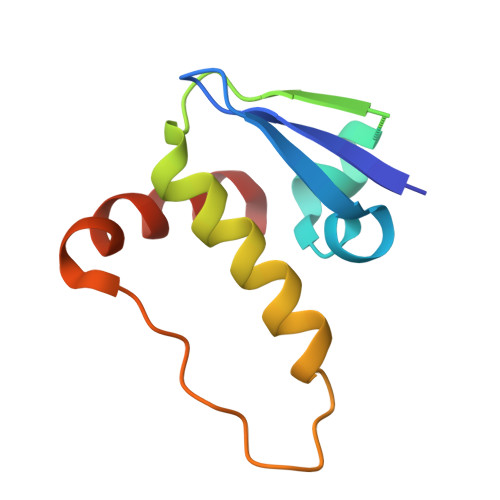
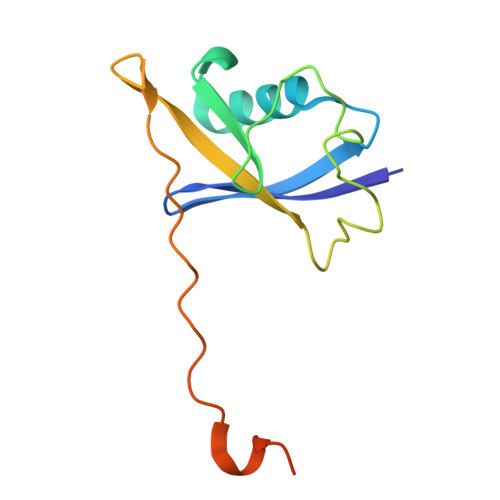
Overexpression of exportin 1 (XPO1/CRM1) in cancer cells mislocalizes numerous cancer-related nuclear export cargoes. Covalent selective inhibitors of nuclear export (SINEs), including the cancer drug selinexor, restore proper nuclear localization by blocking XPO1-cargo interaction. These inhibitors also induce XPO1 degradation through the Cullin-RING E3 ligase (CRL) substrate receptor ASB8. Here we present cryo-electron microscopy structures revealing ASB8 binding to a cryptic XPO1 site that is exposed upon SINE conjugation. Unlike typical molecular glue degraders that directly bridge CRLs and substrates, SINEs bind XPO1 independently of ASB8, triggering an allosteric mechanism that enables high-affinity ASB8 recruitment, leading to XPO1 ubiquitination and degradation. ASB8-mediated degradation is also triggered by the endogenous itaconate derivative 4-octyl itaconate, suggesting that synthetic XPO1 inhibitors exploit a native cellular mechanism. This allosteric XPO1 degradation mechanism expands known modes of targeted protein degradation beyond molecular glue degraders and proteolysis-targeting chimeras of CRL4.
- Department of Pharmacology, University of Texas Southwestern Medical Center, Dallas, TX, USA.
Organizational Affiliation: