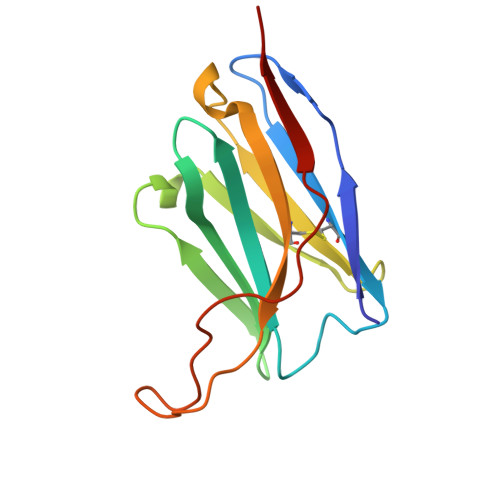
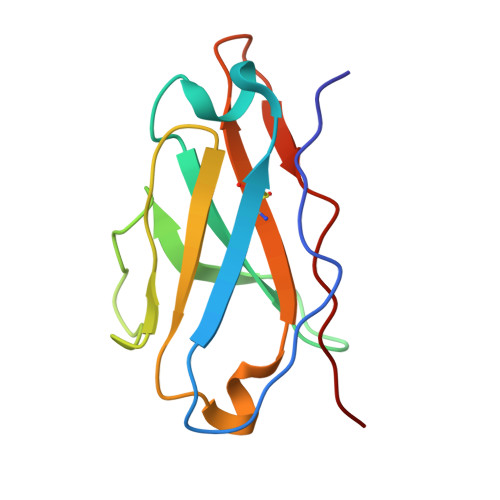
9OCL | pdb_00009ocl

PV2-10D2 Complex

  • Classification: VIRUS
  • Organism(s): Poliovirus 2, Homo sapiens
  • Mutation(s): No 

  • Deposited: 2025-04-24 Released: 2025-12-17 
  • Deposition Author(s): Waddey, B.T., Hafenstein, S.L.
  • Funding Organization(s): National Institutes of Health/National Institute Of Allergy and Infectious Diseases (NIH/NIAID)

Experimental Data Snapshot

  • Method: ELECTRON MICROSCOPY
  • Resolution: 3.65 Å
  • Aggregation State: PARTICLE 
  • Reconstruction Method: SINGLE PARTICLE 

wwPDB Validation   3D Report Full Report


This is version 1.1 of the entry. See complete history


Literature

Neutralizing human monoclonal antibodies to poliovirus map to the receptor binding site.

Waddey, B.T.Charnesky, A.J.Faust, J.E.DiNunno, N.M.Puligedda, R.D.Cho, S.H.Bator, C.M.Dong, S.D.Mahmood, K.Chumakov, K.M.Dessain, S.K.Hafenstein, S.L.

(2026) Nat Commun 

  • DOI: https://doi.org/10.1038/s41467-025-68226-x
  • Primary Citation of Related Structures:  
    9OCL, 9OCO, 9OD3, 9OEA

  • PubMed Abstract: 

    Poliovirus remains a serious threat to human health. Complete eradication of wild-type poliovirus has not yet succeeded, making the development of successful antivirals critical. Microneutralization assays against all three poliovirus serotypes identified a panel of human monoclonal IgGs, which are either serotype-specific or cross-neutralizing. Here, through cryoEM single particle analysis, we solved high resolution structures of four distinct poliovirus-FAb complexes. These antibodies bind to capsids at the circular depression (canyon) surrounding the icosahedral five-fold symmetry axis, which is also the binding site of the poliovirus receptor (PVR). Analysis of these structures confirms overlap of FAb contacts on the viral capsid with those of PVR. For three of the FAbs, the capsid residues are identified that dictate serotype-specific recognition. Contacts for the cross-neutralizing mAb 10D2 are located deep in the capsid canyon. These structural analyses indicate that antibody competition with the receptor likely leads to neutralization of virus particles and inhibition of poliovirus entry into host cells. Thus, the human IgGs studied here may facilitate development of therapeutics for the ongoing efforts in global eradication of poliovirus.


  • Organizational Affiliation
    • College of Biological Sciences, University of Minnesota, Twin Cities, St. Paul, MN, USA.

Macromolecules
Find similar proteins by:  (by identity cutoff)  |  3D Structure
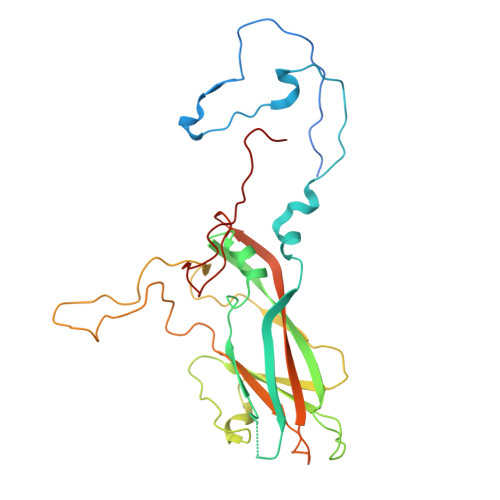
Entity ID: 1
MoleculeChains Sequence LengthOrganismDetailsImage
Capsid protein VP1A [auth 1]301Poliovirus 2Mutation(s): 0 
UniProt
Find proteins for P06210 (Poliovirus type 2 (strain Lansing))
Explore P06210 
Go to UniProtKB:  P06210
Entity Groups  
Sequence Clusters30% Identity50% Identity70% Identity90% Identity95% Identity100% Identity
UniProt GroupP06210
Sequence Annotations
Expand
  • Reference Sequence
Find similar proteins by:  (by identity cutoff)  |  3D Structure
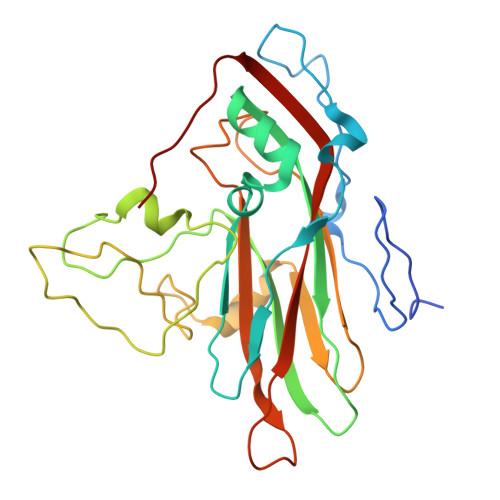
Entity ID: 2
MoleculeChains Sequence LengthOrganismDetailsImage
Capsid protein VP2B [auth 2]271Poliovirus 2Mutation(s): 0 
UniProt
Find proteins for P06210 (Poliovirus type 2 (strain Lansing))
Explore P06210 
Go to UniProtKB:  P06210
Entity Groups  
Sequence Clusters30% Identity50% Identity70% Identity90% Identity95% Identity100% Identity
UniProt GroupP06210
Sequence Annotations
Expand
  • Reference Sequence
Find similar proteins by:  (by identity cutoff)  |  3D Structure
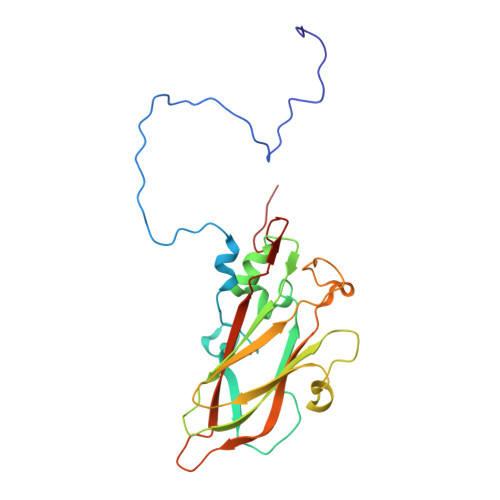
Entity ID: 3
MoleculeChains Sequence LengthOrganismDetailsImage
Capsid protein VP3C [auth 3]235Poliovirus 2Mutation(s): 0 
UniProt
Find proteins for A0A0K1U2R1 (Poliovirus 2)
Explore A0A0K1U2R1 
Go to UniProtKB:  A0A0K1U2R1
Entity Groups  
Sequence Clusters30% Identity50% Identity70% Identity90% Identity95% Identity100% Identity
UniProt GroupA0A0K1U2R1
Sequence Annotations
Expand
  • Reference Sequence
Find similar proteins by:  (by identity cutoff)  |  3D Structure
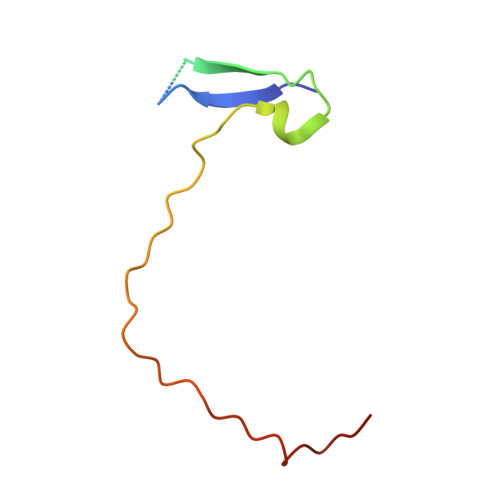
Entity ID: 4
MoleculeChains Sequence LengthOrganismDetailsImage
Capsid protein VP4D [auth 4]68Poliovirus 2Mutation(s): 0 
UniProt
Find proteins for D0QXH8 (Poliovirus 2)
Explore D0QXH8 
Go to UniProtKB:  D0QXH8
Entity Groups  
Sequence Clusters30% Identity50% Identity70% Identity90% Identity95% Identity100% Identity
UniProt GroupD0QXH8
Sequence Annotations
Expand
  • Reference Sequence
Find similar proteins by:  (by identity cutoff)  |  3D Structure
Entity ID: 5
MoleculeChains Sequence LengthOrganismDetailsImage
10D2 Heavy ChainE [auth H]132Homo sapiensMutation(s): 0 
Entity Groups  
Sequence Clusters30% Identity50% Identity70% Identity90% Identity95% Identity100% Identity
Sequence Annotations
Expand
  • Reference Sequence
Find similar proteins by:  (by identity cutoff)  |  3D Structure
Entity ID: 6
MoleculeChains Sequence LengthOrganismDetailsImage
10D2 Light ChainF [auth L]110Homo sapiensMutation(s): 0 
Entity Groups  
Sequence Clusters30% Identity50% Identity70% Identity90% Identity95% Identity100% Identity
Sequence Annotations
Expand
  • Reference Sequence
Small Molecules
Experimental Data & Validation

Experimental Data

  • Method: ELECTRON MICROSCOPY
  • Resolution: 3.65 Å
  • Aggregation State: PARTICLE 
  • Reconstruction Method: SINGLE PARTICLE 
EM Software:
TaskSoftware PackageVersion
MODEL REFINEMENTPHENIX1.21_5207
RECONSTRUCTIONcryoSPARC4.6.2

Structure Validation

View Full Validation Report


Entry History & Funding Information

Deposition Data


Funding OrganizationLocationGrant Number
National Institutes of Health/National Institute Of Allergy and Infectious Diseases (NIH/NIAID)United StatesAI10721-01

Revision History  (Full details and data files)

  • Version 1.0: 2025-12-17
    Type: Initial release
  • Version 1.1: 2026-01-14
    Changes: Data collection, Database references